

Archive

Motivational Interviewing

mail full mailbox


Unsolicited advice is the junk mail of life (Bern Williams, in Miller & Rollnick)

Compassionate listening – stepping back and allowing learners to individually explore their ambivalence, concerns and ideas about an issue or concept – is at the crux of individual discovery and adult learning.

Here’s the rub: as educators we want to support student success, so when we see someone heading in the wrong direction or struggling, we’re often galvanized into action with all good intentions! This “Righting Reflex” is essentially the imperative to do something…to “fix it”, and often kicks in without any conscious awareness (see Miller and Rollnick’s 2013 text on Motivational Interviewing).

To add clarity: A a quick illustration of the Righting Reflex from a conversation I had on my way in to work this morning (for real):

Me: “I’m thinking that I’d like to buy a Smart Car.” 

Significant other: “Well what about a Honda CR-V? I know someone who has one for sale.” 

Me:   ?   !   ?

O-kayyy…How useful was that unsolicited (albeit well-meaning) advice in helping me think things through? And, to be fair, my own Righting Reflex isn’t hard to activate in both personal and professional spheres. Learner autonomy as being at the heart of constructivist approaches is widely discussed and accepted, yet in practice it’s “simple but not easy”.

In an ideal world, educators validate, explore, question. They evoke and encourage students to critically examine different sides of an issue. This doesn’t negate our roles of teacher, guide or concerned other, but it does place the onus – quite rightly – on the learner’s capacity for decision-making and problem-solving.

A big part of education in health care (and other fields) is less about teaching the correct answer, than in facilitating the process of ethical and nuanced judgment and decision-making. If we can resist the Righting Reflex we’re creating a positive space in which to explore, experiment and make mistakes.

So…as for my own automotive decision-making process…a design endorsement by the MOMA may just tip the balance!
Slide1


How can we bridge the teaching/learning gap?


The evidence-based clinical practice model that I use and teach, Motivational Interviewing, is a respectful and collaborative way to talk about change with people who are ambivalent or unwilling.

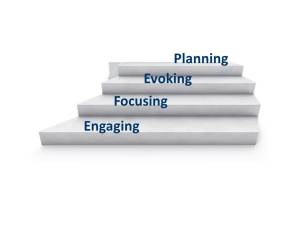
In fact, conversations about change are clearly relevant beyond counselling, therapy or health care. The new edition of Motivational Interviewing by William Miller and Stephen Rollnick outlines four essential processes that map well onto processes of adult education, particularly in contexts where learners may be less than enthusiastic. These processes are somewhat linear but also recursive –  one naturally leads to (and provides a foundation for) the next, but we may also circle backwards and forwards as needed.

1. Engaging:

This is about establishing a relationship with the group and creating a positive learning community. Is it safe to speak up, disagree, critique and explore? Meaningful discourse hinges on successful engagement.

2. Focusing:

Engagement comes first, but it is also important to understand and highlight the relevance of the topic/learning objectives to real world problems and issues. What will I learn, and why should I care? How will mastering new knowledge and skills make my work easier and better? Individuals may raise topics or issues that instructors hadn’t anticipated. These are the burning questions that need to be resolved through successful focusing. Optimally, adult learners are engaged in co-creating curricula.

3. Evoking:

Learning is 100% volitional. Constructivism and paragogy mark a shift from installing knowledge and solutions towards evoking these. Although faculty bring expertise to the table – and we shouldn’t shy away from sharing this – a motivational approach presupposes doing so in partnership with learners, and with a spirit of nonjudgmental acceptance and compassionate empathy.

4. Planning:

We’ve engaged learners in an active partnership, linked curricula to real-world issues, and evoked new connections, insights, ideas and approaches. Now what? Identifying implications for practice and committing to an action plan are key. The planning process helps bridge the gap between learning and life. If new learning has no real-world implications, then we’ve missed the boat somewhere along the way.