Archive

Post-secondary Education

IMG-20130329-00018


Why teaching and learning have a lot in common with street art

I am a big fan of street art. I like how it subverts traditional conceptions of art, artist and viewer. By creating artistic encounters in unexpected places there is a sense of serendipitous discovery and personal connectedness. Street art wakes us up to the creative possibilities in environments that are taken-for-granted and thus invisible.

But is it really art? What is art?


IMG-20130306-00006


Is art beauty? Truth? A thought, idea or emotion captured in images or words?

Or is it an experience, an evocation of some reaction (positive or negative), stimulus for thought/reflection?

All of the above and more?

And who gets to decide what constitutes art? The artist? The viewer? The museum curator? The market?

Maybe I’m especially drawn to street art as a form of conceptual/contemporary art because it has so much in common with my philosophy of teaching and learning. Just like great street art:

Real learning happens outside the classroom.

Advances in knowledge question the status quo.

Learning derives from our engagement with our environment.

Deep learning stimulates an emotional response: surprise, delight, outrage, insight.


IMG-20130329-00023


Teaching and learning are essentially creative enterprises as much (or more?) than cognitive/intellectual processes. Educators are both curators (What will I teach? What sources and strategies will I use?) and artists (What response am I trying to elicit? What experience (curriculum) do I (co-)create to get us to that place?).

The creative imperative is all around – and within – us. We are all artists in our construction of knowledge, experience and expression.


IMG-20130326-00016 IMG-20130326-00017

zen stones water


Blogging can facilitate the convergence of reflection-in AND reflection-on

Reflective practice is a cornerstone for continuous advancement as academic educators and scholars, and we all engage in reflective practice: with our students, with our colleagues, and with ourselves. Donald Schon, in his groundbreaking and influential theory of knowledge generation and learning, posited two reflective processes:

Reflection-in-practice

Reflection-on-practice.

In the moment (reflection-in-practice) we respond and make decisions based on a complex inter-weaving of practice wisdom, experience in classroom teaching, our integrated observation and enactment of what has worked for others, and evidence-based knowledge and skills. In the aftermath (reflection-on-practice) we mull over what worked and what was less effective. We talk things over with colleagues, seek supervision, and/or we journal or otherwise record our reflections.

Traditionally these two processes (reflecting-in and reflecting-on) have been seen to occur as separate but related. Further, the “products” of reflective practice – journaling, goal-setting, dialogue – have been constrained by physical geography and the limits of our professional networks.

Enter social media: thanks to “reflective practice 2.0” reflecting in / on are no longer necessarily distinct. Blogging may well represent a kind of “reflective practice power tool” in its ability to facilitate the convergence of reflection-in and reflection-on.

Digital communication has qualities of speaking and publishing together, and students are part of the conversation. Commenting enables an extended, many-to-many dialogue and blurs the boundaries between in-the-moment (i.e. in-the-classroom) reflection and post hoc reflective discourse. In other words, the act of blogging is itself teaching (in) even as it represents a reflective process (on). The classroom has become porous. Reflective practice is “unboundaried”.

We are all students, and we’re all teachers.

(See an excellent summary of Schon’s work, thinking and contributions at this link).

(Check out the presentation version of this post on Slideshare).

Toronto-20140510-00694


Here’s what the ultimate teaching challenge might look like…and in the future it may be the rule rather than the exception

A new book, Motivational Interviewing in Groups (Wagner and Ingersoll) outlines motivational approaches and strategies in group facilitation. While the book’s emphasis is on clinical practice, the principles and applications are also relevant to education settings.

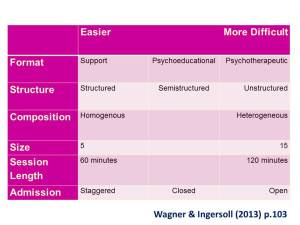
The book’s authors present a table illustrating different types of group format, structure, composition, size, length and admission arranged along a continuum of difficulty (for facilitators) from easier to harder:
Slide1


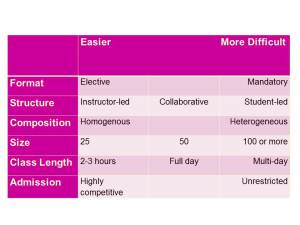
This looks different for educational groups, but the essentials still apply. Here is my modification of Wagner and Ingersoll’s framework calibrated for teaching and learning:
Slide1


In other words:

Elective courses are easier to teach than mandatory courses. Students generally take electives out of interest, as opposed to being forced to take mandatory courses. Teaching students content that someone else thinks they ought to know is tougher than content in which they’re already interested.

Instructor-led courses presuppose a “script” (i.e. lesson plan), versus collaborative or student-led curricula. Paragogical approaches posit peer-to-peer learning and individual autonomy, and demand a proportionately higher level of finesse and facilitation.

Classes where students share more similarities than differences can be easier to work with than heterogeneous class compositions. For example, students who differ widely in age, ability or pre-existing knowledge and skills present more of a challenge in ensuring that all learning needs are met, and establishing an inclusive, cohesive and positive community of learning. Of course diversity, including culture, sex, gender and lived experience, enriches everyone’s learning exponentially – but demands artful facilitation on our part.

Student engagement and interactivity are more straightforward in classes of 25 or less. As class size increases so does the challenge of promoting opportunities for practice and integration of knowledge and skills.

It’s easier to keep peoples’ interest and attention for a single class of 2 or 3 hours than it is for a whole day or for multiple days. The latter demands both a varied menu of instructional strategies as well as formidable stamina (on the part of the instructor and the students).

Strict and highly competitive admission criteria can yield the “cream of the crop” of high-achieving and highly motivated learners. On the other hand, classes where admission is unrestricted means addressing the needs of the best and the brightest alongside those with academic struggles and other challenges.

Like any framework, this conceptualization tends to oversimplify and blur the many complexities and nuances of artful classroom teaching. Real life is always messier than the manual (if there even is a manual). But in general, teaching a mandatory class using a student-led curriculum, among a highly diverse cohort of 100 students or more, over a multi-day course that is freely open to all could well represent the ultimate teaching challenge.

We haven’t added the layer of classroom-based versus online teaching and learning, but does this scenario represent what may well be future of higher education…MOOC 2.0?


 

Tulips2


Six surefire ways to lose an hour in the classroom

Each spring 60 minutes evaporate when we set the clocks forward. Daylight Savings Time (DST) signals the start of long days, fresh colour, smell of earth and birdsong. But still, it hurts to lose that precious hour, especially when there are few enough in the weekend to begin with.

Of course we get an hour of DST back again in the fall, so it’s only a temporary loss. But for educators and students, how many precious hours of learning opportunity are lost in the classroom? Hours that add up to days, weeks, months and years over the course of a high school and post-secondary career. We could argue that this is a student issue based on motivation, attention or capacity: after all, learning is volitional and each of us is personally responsible. Still, I see this stance as at least somewhat disingenuous.

Even the most motivated, attentive and able students can find themselves wishing there was such a thing as what I call Classroom Savings Time (CST) during boring, irrelevant or unproductive “learning” activities. Here are a few tried and true instructional strategies to make them want to fast-forward the clock:

1. Give too much information (because “To teach well, we need not say all that we know, only what is useful for the pupil to hear.”)

2. Teach people what they already know

3. Lecture for more than 10 minutes at a time (TED talks might run twice as long, but after all these are some of the world’s most compelling speakers)

4. Permit student presentations in excess of 10 minutes each (see previous point)

5. Play a video for longer than eight minutes (and that’s still probably three minutes too long)

6. At all times stick to your script (textbook and/or lesson plan).

There is truth to the old saying: “You can lead a horse to water, but you can’t make him drink.” However, you CAN make him thirsty! There may be no getting away from DST, but we can all avoid CST. Students everywhere will be grateful.


Toronto-20140102-00509


The hardest thing about writing is writing (Nora Ephron)


Student plagiarism is a big issue (and apparently an equally big industry) in high school and post-secondary education. It’s never been easier to craft a bricolage of web-based material for a written assignment, and it’s never been easier to detect evidence of academic dishonesty. Tools like Turnitin, iThenticate and online search engines allow for immediate identification of copied source material. Given the high risk and high stakes involved, why do students do it?

The way I see it, a number of interacting factors have created a “perfect storm” kind of context in which student plagiarism can flourish:

1. Stewart Brand, digital social network pioneer, famously said that “information wants to be free”. We’ve seen how intellectual ownership of music and film has been defended vigorously in the courts, yet for every torrent site that gets shut down, a new one pops up. Digital content on the network behaves like water: block one pipeline and it effortlessly reroutes through others. The digital generation has grown up accustomed to immediate access to a gushing flood of “free” content.

2. This leads to the next contributing factor: social media platforms are as much about the flow of content as original content creation. Pinterest, Tumblr, Twitter, and others are about free flow of media and ideas. There is a culture of “content curation”, and the best curators are rewarded by likes, notes, reblogs, retweets, repins etc.

3. Academic databases have traditionally been way less user-friendly than search engines. This is starting to change, but the reality is that if you’re pressed for time, don’t understand Boolean logic, and want easily-digested and accessible information, a quick web search might win out. There have been periodic (and growing) exhortations for researchers to make the products of research more accessible, however we have far to go in realizing this knowledge transfer ideal.

4. I am not sure that students really appreciate the consequences of academic misconduct. It’s a bit like impaired driving: seems worth the risk at the time, but when you find yourself in court, without a license, and facing massive fines, insurance costs and social stigma, the cost of booking a stretch limo is a bargain. Same goes for plagiarism. Universities take it pretty seriously, and that meeting with the Dean is a lot like going before a judge.

5. Finally, writing is hard. Encoding our ideas in abstract alphabetical symbols just doesn’t come naturally for most of us. In fact, sometimes coming up with original ideas to encode doesn’t come too naturally either.

Academic Integrity is the foundation of knowledge generation and production. But somehow there’s a disconnect with digital norms and popular culture/practice. The solution? Still murky, but I think that an ongoing dialogue with students acknowledging and exploring the terrain between these separate realities is a good place to start.


cat paw


Why it’s less about managing the class than joining with the group

Recently overheard in a high school classroom: “F#*%  you…sir!”    Wow: Did I just witness respect + disrespect expressed simultaneously? How does that work exactly?

Teaching is a tough job whatever the age group. Adults may be less “out there” than teenagers, but the group dynamics are the same. Groups tend to behave like unitary entities: they can be your best friend or your worst enemy. But if they fall into the latter category they are a many-headed hydra who cannot be vanquished.

Here’s how I see it: If you have to actually “manage” the class that is not a good sign. Now I am not talking about classroom management in terms of providing guidance or direction with respect to learning content or processes. Every group needs a guide to stay on track. What I mean is that if students act out, tune out or walk out, things have already gone bad. At that point it’s likely not so much a student issue as a group issue.

Here are a few tips to help get things off to a good start, and to keep it that way:

1. Mutual respect is an essential precondition for ANY relationship. If it’s lacking there’s no relating. Regularly affirm your respect for each student and for the class as a whole (the “two clients”: the individual and the group).

2. Make it interesting. Easy to say, but how? Three words: make it relevant. OK, but how? The group will tell you if you ask. What do they care about? Why are they there in the first place? What do they want from you and from each-other?

3. But… what if I am teaching a mandatory course that no one cares about? Here’s the thing: There is no such thing as a topic that’s inherently interesting (have you ever gone to a talk that intrigued you only to be bored out of your mind?). And, conversely, there is no such thing as a topic that’s inherently boring (have you ever gone to a talk you were dreading only to be pleasantly surprised?). Why is the course mandatory? What’s the larger narrative? Why is this essential knowledge and learning? These are the primary questions to address as part of an ongoing group dialogue.

4. Show that you care. Not just about what you’re teaching, and not just about your students as people, but about their experience in the here-and-now. Who’s tired? Who’s bored? How comfortable is the room? What else is happening in the world and how does that impact the tasks at hand? This in-the-moment reflection continuously reestablishes the connection between facilitator and class. In clinical practice it’s called therapeutic use of self – tune in to your own experience to help you tune in to the group.

5. Be generous. Generous with your humour, your time, your interest, yourself. I think of generosity as comprised of curiosity, authenticity, empathy and joy. It’s less a focus on how the group sees you than on who is in the group and what you see in them. And be generous with people when they’re having a bad day. It happens to all of us.

Over the last two days I facilitated a mandatory training for a diverse group of health and social service professionals in Halifax, Nova Scotia. What a pleasure – even if some learners started off the day with ambivalence, we all ended on a high note. And just to add…if you ever find yourself in that beautiful city, be sure to check out Cabin Coffee on Hollis Street for a latte and a killer cinnamon bun!

mail full mailbox


Unsolicited advice is the junk mail of life (Bern Williams, in Miller & Rollnick)

Compassionate listening – stepping back and allowing learners to individually explore their ambivalence, concerns and ideas about an issue or concept – is at the crux of individual discovery and adult learning.

Here’s the rub: as educators we want to support student success, so when we see someone heading in the wrong direction or struggling, we’re often galvanized into action with all good intentions! This “Righting Reflex” is essentially the imperative to do something…to “fix it”, and often kicks in without any conscious awareness (see Miller and Rollnick’s 2013 text on Motivational Interviewing).

To add clarity: A a quick illustration of the Righting Reflex from a conversation I had on my way in to work this morning (for real):

Me: “I’m thinking that I’d like to buy a Smart Car.” 

Significant other: “Well what about a Honda CR-V? I know someone who has one for sale.” 

Me:   ?   !   ?

O-kayyy…How useful was that unsolicited (albeit well-meaning) advice in helping me think things through? And, to be fair, my own Righting Reflex isn’t hard to activate in both personal and professional spheres. Learner autonomy as being at the heart of constructivist approaches is widely discussed and accepted, yet in practice it’s “simple but not easy”.

In an ideal world, educators validate, explore, question. They evoke and encourage students to critically examine different sides of an issue. This doesn’t negate our roles of teacher, guide or concerned other, but it does place the onus – quite rightly – on the learner’s capacity for decision-making and problem-solving.

A big part of education in health care (and other fields) is less about teaching the correct answer, than in facilitating the process of ethical and nuanced judgment and decision-making. If we can resist the Righting Reflex we’re creating a positive space in which to explore, experiment and make mistakes.

So…as for my own automotive decision-making process…a design endorsement by the MOMA may just tip the balance!

stk19901boj


The brave (not-so-)new world of online learning

I have an online graduate course starting next week – this is my 11th year teaching in the “virtual classroom”, and the new term has put me in mind of some of the most valuable learning I have gained through experience, course evaluations and student feedback. Here are my Top 3:

1. Put out the welcome mat

Universities and organizations generally have a standardized, branded Learning Management System (LMS). The LMS is the platform in which the online course is delivered, so your customization options tend to be fairly limited. In other words, it is your words – versus the overall site design – that are key to a positive first impression.

For example, is the first announcement or discussion posting focused on technical instructions and course requirements? Or on how you will support students’ success in the course, and how enjoyable and inspiring the collective learning journey will be? Time spent crafting a warm and positive welcome helps set the stage for group safety and engagement.

2. Generate controversy

If fostering meaningful critical discourse is challenging in traditional classrooms, it can be even more so online. Students often feel more inhibited when posting messages as opposed to speaking up in face-to-face groups. And online conversation can quickly take on the flavour of a series of rather stilted “mini-essays” unless you model and shape conversational threads.

One effective way I’ve found to stimulate authentic and lively conversation is to post about a controversial topic related to the course content – preferably something that links to a website, video or social media site, or all three. In my addictions course, this might be the way that addiction is portrayed in popular media, and how that connects to broader theories of addiction. Now the class is critiquing theory in a context that highlights real-life applications and relevance.

3. Over-communicate but under-state

Over-communicate because people don’t read. That is to say, they read, but tend to skim or miss points that are buried in the “fine print”. It’s better to make the same points in different ways across the learning platform or course tools in order to ensure that no one gets lost or left behind. This refers to issues that are process-related (like assignment deadlines, accessing technical support or how students will be graded), as well as content-specific (for example key definitions, essential points or important references). In my courses I try to reinforce communication using discussion forums, weekly overviews, course announcements and email to make sure that everyone is on board and on track.

Under-state because there is a phenomenon associated with text-based communication known as “emotional magnification”. Without visual cues, the same content delivered in person with no ill effects can be experienced with greater emotional intensity and negative valence when delivered online. We’ve all experienced this in email and other digital communication modes, and the consequences can adversely impact the positive learning community you’ve worked so hard to foster. Special care in providing corrective feedback is warranted, and this is especially critical in group discussion forums.

There is lots more to online teaching than captured here, but these are my “Top 3” and will be front of mind for me next week as the new term starts.

calendar plan 


What (and who) inspired me in 2012?

As the calendar clicks over to 2013, it’s an opportune time to reflect on some of the inspiring tools and ideas that have engaged me over the past year – and will continue to have traction in the coming year.

Here is a reverse-ordered list with lots of links to explore. Happy New Year!

10. Playlists: Every course (or presentation) needs a good soundtrack. Songza is an auto-playlist-maker recommended by Mary Nisi on NPR’s technology blog

9. Infographics: We can all do a better job at presenting complex ideas visually and elegantly. Here is a List.ly List of infographics tools

8. Presentation Zen: (Re)imagining visual communication – Garr Reynolds has been a big influencer on my own presentation style and content

7. Personal Learning Networks (PLNs): The whole really is greater than the sum of its parts

6. Gaming: Networked learning and simulation can benefit from the principles of successful, immersive and authentic hi-fidelity game environments – and this is progressing in medical simulation in Canada and worldwide.

5. Virality: What is the “replicability factor” intrinsic to certain memes? How can we infuse knowledge products with that same DNA? Check out some emerging research by Berger and Milkman (2012) What Makes Online Content Viral? and Stanford now offers an online course on viral marketing

4. Another MOOC MOOC by Hybrid Pedagogy: Because information wants to be free

3. Motivational Interviewing: A clinical approach that maps equally well to teaching and learning

2. Y Combinator: A model with applications for curricular innovation, education research and student engagement?

1. Social Inclusion: Anyone can learn if they have the tools – like the instrumental support pioneered by the World Braille Foundation: Braille = Equality… Why? Because literacy is the key to opportunity, economic security and freedom. Yet in many countries 95 per cent of blind children don’t even attend school due to lack of skilled teachers and limited access to Braille materials.

This international foundation is dedicated to promoting literacy, independence and empowerment to blind persons, with past and current projects in Kenya, Swaziland, Niger, Burkina Faso, Mali, Liberia and Lesotho. I make a donation every year. Plus, full disclosure, the WBF was started 10 years ago by my dad, Euclid Herie, and my #1 inspiration!

Slide1


How can we bridge the teaching/learning gap?


The evidence-based clinical practice model that I use and teach, Motivational Interviewing, is a respectful and collaborative way to talk about change with people who are ambivalent or unwilling.

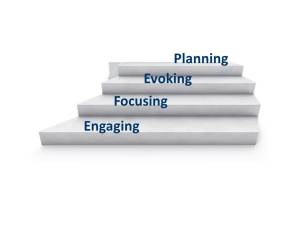
In fact, conversations about change are clearly relevant beyond counselling, therapy or health care. The new edition of Motivational Interviewing by William Miller and Stephen Rollnick outlines four essential processes that map well onto processes of adult education, particularly in contexts where learners may be less than enthusiastic. These processes are somewhat linear but also recursive –  one naturally leads to (and provides a foundation for) the next, but we may also circle backwards and forwards as needed.

1. Engaging:

This is about establishing a relationship with the group and creating a positive learning community. Is it safe to speak up, disagree, critique and explore? Meaningful discourse hinges on successful engagement.

2. Focusing:

Engagement comes first, but it is also important to understand and highlight the relevance of the topic/learning objectives to real world problems and issues. What will I learn, and why should I care? How will mastering new knowledge and skills make my work easier and better? Individuals may raise topics or issues that instructors hadn’t anticipated. These are the burning questions that need to be resolved through successful focusing. Optimally, adult learners are engaged in co-creating curricula.

3. Evoking:

Learning is 100% volitional. Constructivism and paragogy mark a shift from installing knowledge and solutions towards evoking these. Although faculty bring expertise to the table – and we shouldn’t shy away from sharing this – a motivational approach presupposes doing so in partnership with learners, and with a spirit of nonjudgmental acceptance and compassionate empathy.

4. Planning:

We’ve engaged learners in an active partnership, linked curricula to real-world issues, and evoked new connections, insights, ideas and approaches. Now what? Identifying implications for practice and committing to an action plan are key. The planning process helps bridge the gap between learning and life. If new learning has no real-world implications, then we’ve missed the boat somewhere along the way.

animals toy plastic


Just how important are your academic references for grad school admission?

I’ve written my share of academic references – never more so than the last couple of months, where one candidate requested a record of twelve (yes, that’s 12) separate letters – but I’ve never served on a university admissions committee. I’ve always been curious about their importance relative to other factors like grades, personal/research statement, publications and relevant experience. My curiosity was finally satisfied when I found myself sitting next to just such a person on a train (currently reviewing candidates for a competitive university program) and we got to talking.

The short answer is VERY IMPORTANT – and although I always knew that excellent references are key, I didn’t appreciate the full extent of their influence.

So, in the interests of supporting would-be grad students everywhere, here are some tips from the perspective of a referee:

1. Be strategic. Is it better to ask a more junior instructor from a small class you loved where you got an A-, versus a tenured, senior faculty member where you got the same grade in a large class you weren’t so enthusiastic about (and not sure the prof remembered anyone’s names)? Rest assured that the sessional might not remember individual students very well either, and the answer should depend on…

2. How will this person rank me relative to what comparison group? In my 10 years of writing reference letters, I have never been asked this question directly – yet this is the most crucial question you need to ask your referee. You are looking for someone who is going to rank you in the top tier, across all categories if possible. Let’s look at the previous example: Is it the junior prof’s first year of university teaching? If so, even a ranking in the top 1% of 20 students probably carries less weight than the seasoned, tenured prof’s ranking in the top 5% of 5000 students. Ask the question – if you don’t like the answer maybe it isn’t the right person.

3. Send your referee a summary of the personal accomplishments and key points you want to emphasize in your application. And can I add that writing clearly and concisely, without errors in spelling, punctuation, grammar and syntax should be a given. Trust me, if I disagree with you I will edit. If I agree I will amplify. I will also add my own content. Sending me only your CV and personal or research statement makes it harder to write the best letter I can for you.

4. Follow up and say thank you – whatever the outcome. This obvious courtesy is not always observed, and you might need me again when you decide to apply for your next degree.

5. Don’t give up! This isn’t really a tip about reference letters but I am adding it because grad school applications are a lot of work, and so discouraging when there is no offer. Keep applying and consider spreading your net a little wider next time.

Just please don’t ask me for all twelve letters at once?


Will it be on the exam?

In-class exams may well be one of the most stressful – and for some, traumatic – experiences in a student’s life. This truism came front and centre last week at a certificate program I was teaching, geared to seasoned interprofessional practitioners. The varying responses to our in-class, summative, multiple-choice exam tended to cluster around the less enthusiastic end of the spectrum.

Why are exams so aversive?

One obvious reason is that they can be high stakes, as in this (admittedly oversimplified) equation:

high grades = approval + scholarship $$$ + grad school admission

Another reason may have to do with lack of autonomy: we didn’t write the exam questions, and we generally can’t know – or in many cases – anticipate – them in advance. And people inherently strive towards personal autonomy.

But I think that radical pedagogical analyses get closest to the crux of the matter, in their critical interrogation of power dynamics in the classroom, the stance of the professor as “expert”, and framing of “curricular content” (for example, Laura Béres 2008 article).

Constructivism frames learning as socially constructed by learners, where learning is meaningful and relevant to real life. In-class exams are, by nature, removed from real life and focus on content domains that the instructor sees as key.

This can be an uneasy alliance in progressive classrooms, and one that I am still struggling to reconcile… Especially in a knowledge landscape where locating information should take precedence over memorizing information (see Julio Frenk’s influential report in the Lancet, “Health professionals for a new century: transforming education to strengthen health systems in an interdependent world”).

Closing thought:

Exams do stimulate affective arousal, which is associated with enhanced memory retention. I’m just not sure that those memories correlate well with the exam content!


Network of networks = your very own PLN


Today, there’s no problem finding information – the challenge is sifting through and locating the right information at the right time. And not just the right information at the right time – it’s also about access to tools and ideas that you never even knew you needed until you saw them. That’s where PLNs come in.

In the olden days before the advent of online academic journals and research databases, I always made at least one serendipitous discovery while browsing library holdings or leafing through print materials. I would be scanning a row of books looking for a particular call number, and suddenly notice a different book that was a great fit for some other topic I was researching. It’s hard to replicate that kind of happenstance when digital searches yield a specific document or information source with laser-like precision.

Plus, learning is not just about acquiring information – paragogy (a.k.a. the new andragogy) views learning as inherently non-linear and socially constructed via networks/peers. So PLNs – because they’re naturally hyper-textual and social – fit beautifully within a paragogical frame.

This article about PLNs at edudemic.com gives a great overview and rationale for the functions of various social media tools in building, customizing and contributing to your own composite, ongoing knowledge stream. Your very own PLN.

3 tips for success


Students want to know: “What do I need to do to succeed in this course?”


As in many things, the answer is simple (but not always easy). At the start of each semester I share the following three elements that, in my experience in university teaching, almost always translate into academic success.

  1. Show up: If you don’t actually come to class you miss important stuff.
  2. Be 100% present: If you show up and spend the class on your smartphone, you’re not really present.
  3. Do your homework: The real learning happens outside the classroom.

BUT here’s the caveat: It’s a three-legged stool. You need all three elements or you “fall off” (and if you start shaving away any of the legs, it gets a bit wobbly).

And I’ve found that these are pretty good rules to live by in life generally, whether in work, relationships, travel, and so on. When things get complicated it’s nice to take it back to the basics!

Predicting the Future: Higher Education in 2112 (Part 2)

My workplace overlooks a big downtown university campus, and it’s always fun to see the frosh week excitement and back-to-school energy.

This made me think about: what will higher (university) education look like 100 years from now? Hard to imagine, especially because universities have sustained a pretty enduring business model and delivery system for – what – the last thousand years or so?

But I think we’re seeing the fault lines in higher education, some driven by students themselves and their expectations/learning preferences, some changes being driven by new technologies/social media, and perhaps the most significant changes are a result of globalization and rise of “educational megalopolies”.

So – here are some of my predictions:

This first one is kind of a no-brainer: Face-to-face learning will be the exception. Students will design and access knowledge and skills guided by both human and virtual tutors/faculty

Students will register and be affiliated with multiple academic institutions from the same family of university “brands” (as smaller schools become gobbled up by the big names)

Students will travel virtually or geographically throughout their academic careers and access a plethora of institutionally-branded choices in different metropolitan centres and online, with the entire academic record in a single transcript file location

The electronic transcript will look more like a virtual portfolio of students’ work and assessments, and will link to other accomplishments/activities

There will be no such thing as “full” courses (due to over-enrollment) because all courses will be webcast

The most successful university brands will offer programs in multiple languages: for example, English, Mandarin, Portuguese, Hindi, Russian (via automatic simultaneous translation of faculty/instructional materials)

Unique, personalized programs of study will be developed so as to fit specific jobs via proprietary algorithms (and these will be recalibrated as students’ career goals change)

Teaching performance will be graded on a variety of metrics – including student performance and feedback/reviews – and this will be integrated within mobile academic course calendars (inside-out universities).