Archive

Tag Archives: andragogy

 road grass sky


Five big lessons learned along the way


1. How do you feel when you walk out the door?

I’ve always valued the axiom that people don’t remember what you do or say – they remember how you made them feel. Think about your favorite teacher – what do you remember most from that class? The course content? Or is it the passion, inspiration, affirmation, compassion, kindness and care that he or she offered? For the most part, process is way more important than content in teaching and learning.


2. Transformational learning is about inspiring change, not transmitting information (no matter how “essential”).

Another axiom: “To teach well we need not say all we know, only what is useful for the pupil to hear”. In other words, no course or continuing professional education workshop is ever long enough for all of the didactic content that we regard as essential. Here’s my most important learning objective, no matter what the content:

At the end of this course the learner will…

Be so energized and inspired by the importance and relevance of this topic that he or she will continue to access knowledge and skills development long after the session has ended.


3. It’s not my decision.

Learning is 100% volitional. So is change. No matter how urgently I believe that I know what is best, that’s not really the point. Each individual is the expert on his or her life, including the learning goals and activities that may guide growth and development.


4. Change is a process, not an event – and so is learning.

Teaching and learning are really about change. By definition, seeing things from a new perspective involves a fundamental shift in standpoint or beliefs. Sometimes a (brief) interaction and connection doesn’t yield any appreciable indication that I have successfully “taught” anything. Then ten years later I randomly see a former student at the airport and am privileged to hear an inspiring story of transformation – initiated by something that I said or did. We plant seeds and only rarely witness the harvest.


5. We’re all protagonists (and want to be treated as such).

No matter how ubiquitous the student concerns, complaints, issues, grade appeals, special requests – each of us is at the centre of our own lives. Individual experience is at once singular and universal: all people are “like all others, some others, and no others” (to paraphrase Murray and Kluckhohn, 1953). It’s about listening (on our part) and – more important – feeling heard (on the other person’s part). Which brings us right back to Point #1.


So…although these are my top five, as Joni Mitchell famously said:

“People will tell you where they’ve gone, they’ll tell you where to go, but till you get there yourself you never really know.”



IMG-20131214-00435


Democratizing education may mean creating a strange and hybridized monster


In principle, MOOCs embody the democratization of information and education: open access to leading edge scholarship and learning, facilitated by outstanding leaders in their respective fields. Massive Open Online Courses (MOOCs) are being described as a great equalizer in higher education (awarded an overall “B” grade in a recent New York Times Sunday Review article). Maybe MOOCs are shaping up to be the “killer app” of higher education?


Except…there are a couple of snags.

In her exploration of the Ethics of MOOCs, Nora Dunne questions whether it’s defensible to use institutional resources to create and support MOOCs if this diverts what’s available to tuition-paying students. Unless the money comes from a school’s marketing budget?

Institutions of higher learning care about students. They care about access. They want to make the world a better place by linking students with research, theory, knowledge, skills and applications. They also care about enrollment, to which their funding is inextricably tied. They care about their brand. They are competitive.

Such drivers are not mutually exclusive and are not a bad thing. Visionary thinking drives innovation, and so does competition. But there is a risk if academic institutions start regarding MOOCs as “loss leaders”.


Are MOOCs at risk of becoming brand advertisements to drive enrollment?

From an education research and theory perspective, best practices in online learning emphasize the importance of interactivity, both with peers and with faculty. Conversely, the one-to-many model, whether delivered in a massive open lecture hall or in a massive open online course, focuses more on information delivery than knowledge construction.

The ideal would be a customizable and dynamic MOOC that integrates high-quality learning objects, pre-recorded or streamed video of outstanding instructors, asynchronous and synchronous small group discussion, simulations, and individual tutoring. But taking it back to budgets, how is this sustainable from a cost perspective?

Unfortunately it’s just not. And the problem with the one-to-many approach is its fundamental incompatibility with 2.0 anything. But…what if all of the above learning tools/strategies were crowdsourced? Not just across institutions of higher learning but from students themselves (past, present and future)? (Representing an authentically paragogical/heutagogical approach, a.k.a. “Andragogy 2.0“).


The Digital Frontier

If we venture into the frontier of digital open-access territory, we need to understand that MOOCs, by their nature, are free, open and out there. Positive institutional branding becomes a by-product of bleeding-edge, innovative curricula co-created by outstanding faculty and students.

And might this mean the creation of a strange and hybridized monster – a WikiMOOC?

IMG-20130505-00095


Teaching as effortless action


Course evaluations can provide helpful feedback about what we’ve done well and where we can improve. The confusing part is when we see polarities in evaluation data (too much group discussion, not enough group discussion; too much time, not enough time; etc.). But the solution isn’t necessarily working harder at the front of the classroom.

The Eastern notion of “effortless action” implies action aligned with our authentic selves. The harder we try to exert influence and control, the further we get from the fundamental essence of what it is to teach and to learn.


IMG-20130505-00090


The Tao of teaching is the unity between: 

Thinking and doing 

Speaking and listening

Working and playing 

Teaching and learning.


Consider: Each of these contains elements of the other. Thought is itself a form of action, and action embodies elements of thought. As we speak we are responding (to), and we listen to ourselves. As we listen our mind is speaking. Work and play are not distinct from one another. As we teach we learn, and we learn as we teach. 

Effortless action in a Western frame might be conceptualized as the psychology of flow.


Whatever name we give to something essentially un-nameable, for me the Tao of Teaching means finding that place inside and then reaching out and connecting with what is true and authentic in others. That’s when magic happens. 

robot


Disruptive innovations aren’t easy for established institutions

Online learning has been around for over two decades now. Yet institutions – secondary and post-secondary – continue to struggle with its integration and applications. I am still hearing lots of questioning and debate about the suitability and effectiveness of online delivery. What does the research say?

Learning outcomes have been shown to be modestly better for online versus classroom-based courses (Means et al. 2010)

Learning activities can be equally effective across online and face-to-face conditions (Neuhauser, 2002)

Online courses across a variety of theoretical and practical topic areas have been offered successfully (Tallent-Runnels et al. 2006).

Course development (whether face-to-face, mixed mode or online) is resource-intensive. Here is a radical rethink of higher education from a systems perspective, from a provocative 2003 article by Carol Twigg (decribed as a Rock Star in higher education technology and innovation) for Educause:

American higher education remains what Bill Massy and Bob Zemsky have called a “handicraft” industry in which the vast majority of courses are developed and delivered as “one-offs” by individual professors… Currently in higher education, both on campus and online, we individualize faculty practice (that is, we allow individual faculty members great latitude in course development and delivery) and standardize the student learning experience (that is, we treat all students in a course as if their learning needs, interests, and abilities were the same). Instead, we need to do just the opposite.

Full disclosure: I have taught a graduate clinical course focused on addiction treatment for over 10 years. Don’t get me wrong, I love classroom teaching. But feedback I get from students has consistently reinforced three things:

1. There are as many ways of teaching online as there are face-to-face. Just like there can be good and bad classroom courses (and instructors), same goes for online.

2. Online courses can be experienced as equally or more rigorous than their in-class counterparts, in that online students report having to critique, reflect and formulate their ideas more deeply in order to contribute to class discussion and dialogue.

3. Online learning is accessible to students in a way that classroom teaching can’t accomplish.

In any case, the debate may well be moot: Instructional videos on YouTube – for everything from how to change a tire or rig a sailboat, to advanced chemistry – constitute what might well be the world’s biggest and most vibrant online apprenticeship training. Khan Academy (“our mission: to provide a world-class education for anyone, anywhere”) materials are used by teachers worldwide in their classrooms. (Because the online version teaches it better?) Students today have grown up in a world where the Internet has always existed. Digital communication, networking and collaboration are like talking (or breathing).

So why, twenty years on, aren’t there more online offerings in colleges and universities (especially among those in the top tier)? I think the hesitation comes from a deep place in our collective psyche as educators. We want to believe that our physical presence at the front of the class is a key contributor to meaning-making and learning for our students. From an instructivist theoretical frame, this makes sense. Thing is, the education field has widely adopted constructivist models of teaching and learning, at odds with a “sage on the stage” approach.

Online learning in higher education represents a paradigm shift and a disruptive innovation. Big time.

zen stones water


Blogging can facilitate the convergence of reflection-in AND reflection-on

Reflective practice is a cornerstone for continuous advancement as academic educators and scholars, and we all engage in reflective practice: with our students, with our colleagues, and with ourselves. Donald Schon, in his groundbreaking and influential theory of knowledge generation and learning, posited two reflective processes:

Reflection-in-practice

Reflection-on-practice.

In the moment (reflection-in-practice) we respond and make decisions based on a complex inter-weaving of practice wisdom, experience in classroom teaching, our integrated observation and enactment of what has worked for others, and evidence-based knowledge and skills. In the aftermath (reflection-on-practice) we mull over what worked and what was less effective. We talk things over with colleagues, seek supervision, and/or we journal or otherwise record our reflections.

Traditionally these two processes (reflecting-in and reflecting-on) have been seen to occur as separate but related. Further, the “products” of reflective practice – journaling, goal-setting, dialogue – have been constrained by physical geography and the limits of our professional networks.

Enter social media: thanks to “reflective practice 2.0” reflecting in / on are no longer necessarily distinct. Blogging may well represent a kind of “reflective practice power tool” in its ability to facilitate the convergence of reflection-in and reflection-on.

Digital communication has qualities of speaking and publishing together, and students are part of the conversation. Commenting enables an extended, many-to-many dialogue and blurs the boundaries between in-the-moment (i.e. in-the-classroom) reflection and post hoc reflective discourse. In other words, the act of blogging is itself teaching (in) even as it represents a reflective process (on). The classroom has become porous. Reflective practice is “unboundaried”.

We are all students, and we’re all teachers.

(See an excellent summary of Schon’s work, thinking and contributions at this link).

(Check out the presentation version of this post on Slideshare).

Toronto-20140510-00694


Here’s what the ultimate teaching challenge might look like…and in the future it may be the rule rather than the exception

A new book, Motivational Interviewing in Groups (Wagner and Ingersoll) outlines motivational approaches and strategies in group facilitation. While the book’s emphasis is on clinical practice, the principles and applications are also relevant to education settings.

The book’s authors present a table illustrating different types of group format, structure, composition, size, length and admission arranged along a continuum of difficulty (for facilitators) from easier to harder:

Slide1


This looks different for educational groups, but the essentials still apply. Here is my modification of Wagner and Ingersoll’s framework calibrated for teaching and learning:

Slide1


In other words:

Elective courses are easier to teach than mandatory courses. Students generally take electives out of interest, as opposed to being forced to take mandatory courses. Teaching students content that someone else thinks they ought to know is tougher than content in which they’re already interested.

Instructor-led courses presuppose a “script” (i.e. lesson plan), versus collaborative or student-led curricula. Paragogical approaches posit peer-to-peer learning and individual autonomy, and demand a proportionately higher level of finesse and facilitation.

Classes where students share more similarities than differences can be easier to work with than heterogeneous class compositions. For example, students who differ widely in age, ability or pre-existing knowledge and skills present more of a challenge in ensuring that all learning needs are met, and establishing an inclusive, cohesive and positive community of learning. Of course diversity, including culture, sex, gender and lived experience, enriches everyone’s learning exponentially – but demands artful facilitation on our part.

Student engagement and interactivity are more straightforward in classes of 25 or less. As class size increases so does the challenge of promoting opportunities for practice and integration of knowledge and skills.

It’s easier to keep peoples’ interest and attention for a single class of 2 or 3 hours than it is for a whole day or for multiple days. The latter demands both a varied menu of instructional strategies as well as formidable stamina (on the part of the instructor and the students).

Strict and highly competitive admission criteria can yield the “cream of the crop” of high-achieving and highly motivated learners. On the other hand, classes where admission is unrestricted means addressing the needs of the best and the brightest alongside those with academic struggles and other challenges.

Like any framework, this conceptualization tends to oversimplify and blur the many complexities and nuances of artful classroom teaching. Real life is always messier than the manual (if there even is a manual). But in general, teaching a mandatory class using a student-led curriculum, among a highly diverse cohort of 100 students or more, over a multi-day course that is freely open to all could well represent the ultimate teaching challenge.

We haven’t added the layer of classroom-based versus online teaching and learning, but does this scenario represent what may well be future of higher education…MOOC 2.0?


Tulips2


Six surefire ways to lose an hour in the classroom

Each spring 60 minutes evaporate when we set the clocks forward. Daylight Savings Time (DST) signals the start of long days, fresh colour, smell of earth and birdsong. But still, it hurts to lose that precious hour, especially when there are few enough in the weekend to begin with.

Of course we get an hour of DST back again in the fall, so it’s only a temporary loss. But for educators and students, how many precious hours of learning opportunity are lost in the classroom? Hours that add up to days, weeks, months and years over the course of a high school and post-secondary career. We could argue that this is a student issue based on motivation, attention or capacity: after all, learning is volitional and each of us is personally responsible. Still, I see this stance as at least somewhat disingenuous.

Even the most motivated, attentive and able students can find themselves wishing there was such a thing as what I call Classroom Savings Time (CST) during boring, irrelevant or unproductive “learning” activities. Here are a few tried and true instructional strategies to make them want to fast-forward the clock:

1. Give too much information (because “To teach well, we need not say all that we know, only what is useful for the pupil to hear.”)

2. Teach people what they already know

3. Lecture for more than 10 minutes at a time (TED talks might run twice as long, but after all these are some of the world’s most compelling speakers)

4. Permit student presentations in excess of 10 minutes each (see previous point)

5. Play a video for longer than eight minutes (and that’s still probably three minutes too long)

6. At all times stick to your script (textbook and/or lesson plan).

There is truth to the old saying: “You can lead a horse to water, but you can’t make him drink.” However, you CAN make him thirsty! There may be no getting away from DST, but we can all avoid CST. Students everywhere will be grateful.

cat paw


Why it’s less about managing the class than joining with the group

Recently overheard in a high school classroom: “F#*%  you…sir!”    Wow: Did I just witness respect + disrespect expressed simultaneously? How does that work exactly?

Teaching is a tough job whatever the age group. Adults may be less “out there” than teenagers, but the group dynamics are the same. Groups tend to behave like unitary entities: they can be your best friend or your worst enemy. But if they fall into the latter category they are a many-headed hydra who cannot be vanquished.

Here’s how I see it: If you have to actually “manage” the class that is not a good sign. Now I am not talking about classroom management in terms of providing guidance or direction with respect to learning content or processes. Every group needs a guide to stay on track. What I mean is that if students act out, tune out or walk out, things have already gone bad. At that point it’s likely not so much a student issue as a group issue.

Here are a few tips to help get things off to a good start, and to keep it that way:

1. Mutual respect is an essential precondition for ANY relationship. If it’s lacking there’s no relating. Regularly affirm your respect for each student and for the class as a whole (the “two clients”: the individual and the group).

2. Make it interesting. Easy to say, but how? Three words: make it relevant. OK, but how? The group will tell you if you ask. What do they care about? Why are they there in the first place? What do they want from you and from each-other?

3. But… what if I am teaching a mandatory course that no one cares about? Here’s the thing: There is no such thing as a topic that’s inherently interesting (have you ever gone to a talk that intrigued you only to be bored out of your mind?). And, conversely, there is no such thing as a topic that’s inherently boring (have you ever gone to a talk you were dreading only to be pleasantly surprised?). Why is the course mandatory? What’s the larger narrative? Why is this essential knowledge and learning? These are the primary questions to address as part of an ongoing group dialogue.

4. Show that you care. Not just about what you’re teaching, and not just about your students as people, but about their experience in the here-and-now. Who’s tired? Who’s bored? How comfortable is the room? What else is happening in the world and how does that impact the tasks at hand? This in-the-moment reflection continuously reestablishes the connection between facilitator and class. In clinical practice it’s called therapeutic use of self – tune in to your own experience to help you tune in to the group.

5. Be generous. Generous with your humour, your time, your interest, yourself. I think of generosity as comprised of curiosity, authenticity, empathy and joy. It’s less a focus on how the group sees you than on who is in the group and what you see in them. And be generous with people when they’re having a bad day. It happens to all of us.

Over the last two days I facilitated a mandatory training for a diverse group of health and social service professionals in Halifax, Nova Scotia. What a pleasure – even if some learners started off the day with ambivalence, we all ended on a high note. And just to add…if you ever find yourself in that beautiful city, be sure to check out Cabin Coffee on Hollis Street for a latte and a killer cinnamon bun!

thumbs up & down


Complex skills are best learned in authentic environments

Buying a new car has meant finding a good home for my beloved 95 Chevy. A colleague is now the proud owner, only there is one small but crucial detail…he has never learned how to drive a car with manual transmission (stick shift). Thus, last Sunday afternoon his friend was the one who drove off into the sunset after we did the deal, but that’s no long-term solution. Oh Chevy, I see grinding gears and burning clutch in your future!

Driving a stick shift isn’t easy. In fact, in the beginning it feels pretty complicated and there’s not always much room for error. I’ve been thinking about some of the ways that learning to drive shares common ground with learning the complex skills of clinical practice.

1. The stakes are high: If you don’t master key practical skills, your own and others’ safety are at risk. Have you ever stalled out on a steep grade with other cars right behind? Not a good situation in which to freeze up or panic!

2. It can be a challenge to practice new skills in an environment that feels safe yet also authentic: See Point 1 – you need the experience of stalling the car on a steep hill to learn how to get going again, but you don’t want the reality of rolling backwards into the guy behind. My drivers’ ed training car had a clutch and brake for both me and the instructor/passenger, so I knew that a mistake wouldn’t be catastrophic. Simulation in healthcare education accomplishes the same objectives of safety + authenticity.

3. An experienced mentor can make all the difference: My driving instructor was about 70 years young and had over 40 years experience in teaching new drivers. Everything that a student could possibly do or say he had seen or heard, and literally nothing rattled him. He had this very calm and patient demeanor, which I guess is how he survived that long teaching people like me how to drive. Just knowing that any mistakes I made were par for the course and all part of the learning process freed me up to get into the zone of deep learning.

4. Corrective feedback in the moment shapes behaviour: Direct observation and feedback about the skills I was practicing effectively and where I needed more work helped me learn faster and better. Abstract instructions and memorization aren’t nearly as effective for integrating and mastering practical application of complex skills.

Perhaps a couple of “continuing education” sessions on how to drive a stick shift would not go amiss for Chevy’s new owner. Who knows, might save the cost of a replacement clutch and maybe more. SWP, are you listening?

mail full mailbox


Unsolicited advice is the junk mail of life (Bern Williams, in Miller & Rollnick)

Compassionate listening – stepping back and allowing learners to individually explore their ambivalence, concerns and ideas about an issue or concept – is at the crux of individual discovery and adult learning.

Here’s the rub: as educators we want to support student success, so when we see someone heading in the wrong direction or struggling, we’re often galvanized into action with all good intentions! This “Righting Reflex” is essentially the imperative to do something…to “fix it”, and often kicks in without any conscious awareness (see Miller and Rollnick’s 2013 text on Motivational Interviewing).

To add clarity: A a quick illustration of the Righting Reflex from a conversation I had on my way in to work this morning (for real):

Me: “I’m thinking that I’d like to buy a Smart Car.” 

Significant other: “Well what about a Honda CR-V? I know someone who has one for sale.” 

Me:   ?   !   ?

O-kayyy…How useful was that unsolicited (albeit well-meaning) advice in helping me think things through? And, to be fair, my own Righting Reflex isn’t hard to activate in both personal and professional spheres. Learner autonomy as being at the heart of constructivist approaches is widely discussed and accepted, yet in practice it’s “simple but not easy”.

In an ideal world, educators validate, explore, question. They evoke and encourage students to critically examine different sides of an issue. This doesn’t negate our roles of teacher, guide or concerned other, but it does place the onus – quite rightly – on the learner’s capacity for decision-making and problem-solving.

A big part of education in health care (and other fields) is less about teaching the correct answer, than in facilitating the process of ethical and nuanced judgment and decision-making. If we can resist the Righting Reflex we’re creating a positive space in which to explore, experiment and make mistakes.

So…as for my own automotive decision-making process…a design endorsement by the MOMA may just tip the balance!

stk19901boj


The brave (not-so-)new world of online learning

I have an online graduate course starting next week – this is my 11th year teaching in the “virtual classroom”, and the new term has put me in mind of some of the most valuable learning I have gained through experience, course evaluations and student feedback. Here are my Top 3:

1. Put out the welcome mat

Universities and organizations generally have a standardized, branded Learning Management System (LMS). The LMS is the platform in which the online course is delivered, so your customization options tend to be fairly limited. In other words, it is your words – versus the overall site design – that are key to a positive first impression.

For example, is the first announcement or discussion posting focused on technical instructions and course requirements? Or on how you will support students’ success in the course, and how enjoyable and inspiring the collective learning journey will be? Time spent crafting a warm and positive welcome helps set the stage for group safety and engagement.

2. Generate controversy

If fostering meaningful critical discourse is challenging in traditional classrooms, it can be even more so online. Students often feel more inhibited when posting messages as opposed to speaking up in face-to-face groups. And online conversation can quickly take on the flavour of a series of rather stilted “mini-essays” unless you model and shape conversational threads.

One effective way I’ve found to stimulate authentic and lively conversation is to post about a controversial topic related to the course content – preferably something that links to a website, video or social media site, or all three. In my addictions course, this might be the way that addiction is portrayed in popular media, and how that connects to broader theories of addiction. Now the class is critiquing theory in a context that highlights real-life applications and relevance.

3. Over-communicate but under-state

Over-communicate because people don’t read. That is to say, they read, but tend to skim or miss points that are buried in the “fine print”. It’s better to make the same points in different ways across the learning platform or course tools in order to ensure that no one gets lost or left behind. This refers to issues that are process-related (like assignment deadlines, accessing technical support or how students will be graded), as well as content-specific (for example key definitions, essential points or important references). In my courses I try to reinforce communication using discussion forums, weekly overviews, course announcements and email to make sure that everyone is on board and on track.

Under-state because there is a phenomenon associated with text-based communication known as “emotional magnification”. Without visual cues, the same content delivered in person with no ill effects can be experienced with greater emotional intensity and negative valence when delivered online. We’ve all experienced this in email and other digital communication modes, and the consequences can adversely impact the positive learning community you’ve worked so hard to foster. Special care in providing corrective feedback is warranted, and this is especially critical in group discussion forums.

There is lots more to online teaching than captured here, but these are my “Top 3” and will be front of mind for me next week as the new term starts.

calendar plan 


What (and who) inspired me in 2012?

As the calendar clicks over to 2013, it’s an opportune time to reflect on some of the inspiring tools and ideas that have engaged me over the past year – and will continue to have traction in the coming year.

Here is a reverse-ordered list with lots of links to explore. Happy New Year!

10. Playlists: Every course (or presentation) needs a good soundtrack. Songza is an auto-playlist-maker recommended by Mary Nisi on NPR’s technology blog

9. Infographics: We can all do a better job at presenting complex ideas visually and elegantly. Here is a List.ly List of infographics tools

8. Presentation Zen: (Re)imagining visual communication – Garr Reynolds has been a big influencer on my own presentation style and content

7. Personal Learning Networks (PLNs): The whole really is greater than the sum of its parts

6. Gaming: Networked learning and simulation can benefit from the principles of successful, immersive and authentic hi-fidelity game environments – and this is progressing in medical simulation in Canada and worldwide.

5. Virality: What is the “replicability factor” intrinsic to certain memes? How can we infuse knowledge products with that same DNA? Check out some emerging research by Berger and Milkman (2012) What Makes Online Content Viral? and Stanford now offers an online course on viral marketing

4. Another MOOC MOOC by Hybrid Pedagogy: Because information wants to be free

3. Motivational Interviewing: A clinical approach that maps equally well to teaching and learning

2. Y Combinator: A model with applications for curricular innovation, education research and student engagement?

1. Social Inclusion: Anyone can learn if they have the tools – like the instrumental support pioneered by the World Braille Foundation: Braille = Equality… Why? Because literacy is the key to opportunity, economic security and freedom. Yet in many countries 95 per cent of blind children don’t even attend school due to lack of skilled teachers and limited access to Braille materials.

This international foundation is dedicated to promoting literacy, independence and empowerment to blind persons, with past and current projects in Kenya, Swaziland, Niger, Burkina Faso, Mali, Liberia and Lesotho. I make a donation every year. Plus, full disclosure, the WBF was started 10 years ago by my dad, Euclid Herie, and my #1 inspiration!

Slide1


How can we bridge the teaching/learning gap?


The evidence-based clinical practice model that I use and teach, Motivational Interviewing, is a respectful and collaborative way to talk about change with people who are ambivalent or unwilling.

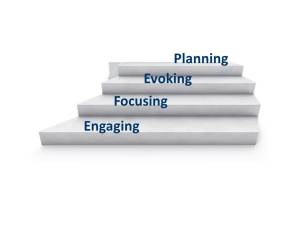
In fact, conversations about change are clearly relevant beyond counselling, therapy or health care. The new edition of Motivational Interviewing by William Miller and Stephen Rollnick outlines four essential processes that map well onto processes of adult education, particularly in contexts where learners may be less than enthusiastic. These processes are somewhat linear but also recursive –  one naturally leads to (and provides a foundation for) the next, but we may also circle backwards and forwards as needed.

1. Engaging:

This is about establishing a relationship with the group and creating a positive learning community. Is it safe to speak up, disagree, critique and explore? Meaningful discourse hinges on successful engagement.

2. Focusing:

Engagement comes first, but it is also important to understand and highlight the relevance of the topic/learning objectives to real world problems and issues. What will I learn, and why should I care? How will mastering new knowledge and skills make my work easier and better? Individuals may raise topics or issues that instructors hadn’t anticipated. These are the burning questions that need to be resolved through successful focusing. Optimally, adult learners are engaged in co-creating curricula.

3. Evoking:

Learning is 100% volitional. Constructivism and paragogy mark a shift from installing knowledge and solutions towards evoking these. Although faculty bring expertise to the table – and we shouldn’t shy away from sharing this – a motivational approach presupposes doing so in partnership with learners, and with a spirit of nonjudgmental acceptance and compassionate empathy.

4. Planning:

We’ve engaged learners in an active partnership, linked curricula to real-world issues, and evoked new connections, insights, ideas and approaches. Now what? Identifying implications for practice and committing to an action plan are key. The planning process helps bridge the gap between learning and life. If new learning has no real-world implications, then we’ve missed the boat somewhere along the way.


Will it be on the exam?

In-class exams may well be one of the most stressful – and for some, traumatic – experiences in a student’s life. This truism came front and centre last week at a certificate program I was teaching, geared to seasoned interprofessional practitioners. The varying responses to our in-class, summative, multiple-choice exam tended to cluster around the less enthusiastic end of the spectrum.

Why are exams so aversive?

One obvious reason is that they can be high stakes, as in this (admittedly oversimplified) equation:

high grades = approval + scholarship $$$ + grad school admission

Another reason may have to do with lack of autonomy: we didn’t write the exam questions, and we generally can’t know – or in many cases – anticipate – them in advance. And people inherently strive towards personal autonomy.

But I think that radical pedagogical analyses get closest to the crux of the matter, in their critical interrogation of power dynamics in the classroom, the stance of the professor as “expert”, and framing of “curricular content” (for example, Laura Béres 2008 article).

Constructivism frames learning as socially constructed by learners, where learning is meaningful and relevant to real life. In-class exams are, by nature, removed from real life and focus on content domains that the instructor sees as key.

This can be an uneasy alliance in progressive classrooms, and one that I am still struggling to reconcile… Especially in a knowledge landscape where locating information should take precedence over memorizing information (see Julio Frenk’s influential report in the Lancet, “Health professionals for a new century: transforming education to strengthen health systems in an interdependent world”).

Closing thought:

Exams do stimulate affective arousal, which is associated with enhanced memory retention. I’m just not sure that those memories correlate well with the exam content!


Are the most important health care competencies the ones that can’t be taught?

 What, in your opinion, are the core competencies for practitioners working with women and girls who have concurrent mental health and substance use problems?

This was the question that I posed to a group of about 100 interprofessional clinicians at a recent conference session titled “Women and Concurrent Disorders (Addiction and Mental Health)”.

I posed the question before referencing the core competency domains identified by the Substance Abuse and Mental Health Service Administration’s 2011 document Addressing the needs of women and girls: Developing core competencies for mental health and substance abuse service professionals:

 SAMHSA Core Competency Domains

Sex and gender differences

Relational approaches in working with women and girls

Family-centred needs

Special considerations during pregnancy

Women’s health and health care

Interprofessional collaboration

I was curious to hear what this group of experienced and seasoned health care providers had to say about the core competencies that were top of mind. Without hesitation, hands went up and people called out examples: 

Practitioner-Identified Core Competency Domains

Empathy

Respect

Trust

Compassion

Listening

Care

It’s striking that no one mentioned any of the SAMHSA competencies, which focus on domain-specific knowledge and skills. Rather, the areas addressed by the audience emphasized process over content. Now, this is not to minimize the centrality of scientific and clinical knowledge and skills. Healthcare consumers expect this of us, and we as professionals expect it of ourselves.

But in those moments when the group named these key areas as most important, we collectively moved to the tacit underpinnings of excellence in healthcare: the human interactions that form the basis of helping. The things that are much harder to teach – if we can teach them at all.

View the full presentation on slideshare