Archive

Tag Archives: clinical education

Plastic Toy Blocks for Child and Adults

Planning for Positive Change

In each of three previous posts, we looked at Motivational Interviewing (MI) as having four key processes and reviewed practice exercises targeting the first three processes:  engagingfocusing and evoking. In this article we examine the fourth MI process: planning.

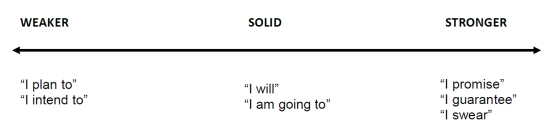
Commitment language is predictive of behaviour change, and is distinct from preparatory change talk in that it embodies implementation intentions. Consider the following example:
commitment language continuum

Reference: Miller and Rollnick, 2012: 290


What’s the hurry?

Practitioners often rush toward action planning prematurely, resulting in clients’ reactance and disengagement. Learning to recognize – and strengthen – commitment language signals to us when it is appropriate to move toward the planning process in MI. Also, remember that the four processes are recursive. In other words, even when we hear strong commitment language, clients may still experience ambivalence (evoking process)  and decide to re-examine their goals (focusing process).  And, as always, we need to continuously engage and re-engage with the other person (engaging process).


Strategies to Strengthen Commitment

Here are some strategies to strengthen clients’ commitment for change:

  • Engaging in a supportive and collaborative working relationship
  • Focusing on clear goal(s) for change
  • Linking the person’s values with their goals
  • Evoking the person’s own motivations for change
  • Developing a specific change plan
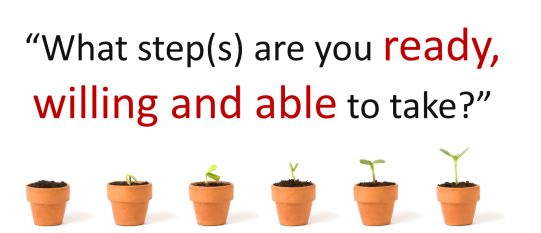
  • Determining what step(s) the person is ready, willing and able to take.
 

MI commitment language


We can’t force a plant to grow, but plants are likely to thrive under the right conditions. What about human growth and realizing our potential? Motivational Interviewing provides the “right conditions” in which people can become ready, willing and able to make positive change.


Reflective Practice Questions

Consider a challenging client – one who does not seem to be making progress. Based on your understanding of the four processes of MI (engaging, focusing, evoking, planning), where do you think you need to be with this client? Are there avenues for small, incremental change that you could focus on to evoke commitment language? What might these be?

Come up with a reflection or a question that would evoke commitment language.

 

DSC_0004


It’s not our problem – it’s the group’s problem!


Last week I had the pleasure of working with a number of seasoned group therapists around advancing their practice in group facilitation. It is a rare opportunity (and luxury) to all get together and explore what is frequently a solitary job. Busy clinics can leave little time for practitioners to reflect on and process what they do. But it is more a necessity than a luxury to reflect in and on practice (in the words of Donald Schön).

We kicked things off talking about two questions relating to group facilitation:


2 Adv Groups 2015 FINAL 2 Adv Groups 2015 FINAL 1


In other words, what are areas where things are going well, and where are you (individually and collectively) struggling or feeling challenged?

That second question in particular evoked lots of conversation, and I started to make a list. Here are some of the things that people came up with: participants who talk too much or not at all; disruptive behaviour; group engagement (lack thereof); lateness, attendance and drop-out; peoples’ diverse needs, expectations and abilities.

Then something interesting happened. The conversation started to shift to challenges like: balancing group content with process; agenda-setting; fostering trust and cohesion; appropriate disclosure; boundary-setting. The dialogue moved from focusing on participant behaviour to facilitator behaviour.

This is common in clinical supervision teams – it is so much easier to look at others’ behaviour – yet the most productive troubleshooting stems from identifying what we, ourselves, can do differently. The energy in the room changes too. Focusing on difficult client behaviour feels frustrating, hopeless and stressful. Focusing on new strategies that we can experiment with and implement feels productive and inspiring.

One of the biggest “aha” moments was how we group facilitators tend to take on all of the participants’ behavioural issues or concerns as our problem to solve. It’s kind of like the song “The Weight” by legendary roots rock group The Band: “Take a load off Fanny, take a load for free. Take a load off Fanny, and you put the load right on me!”

Addressing and dealing with stuff that comes up is really the whole group’s responsibility (and problem!). Of course, we are part of the group, but so are the participants. Asking open-ended questions and offering complex reflections about group process (not content) tends to be more productive than asserting our authority and directing traffic. In short, it’s not our job to single-handedly solve every problem that arises. It is our job to facilitate collective problem-solving and dialogue in a supportive and respectful space.


I’m thinking how closely this all maps onto classroom teaching. We’re not doing therapy in the classroom (although sometimes it can feel that way). The best teachers – like the best group therapists – demonstrate agility in creating shared accountability for positive norms and behaviours, and do so with authenticity, compassion, partnership, humour and deep acceptance.


Related

Reflective listening 101