Archive

Tag Archives: Education challenges

bowling trophy figures


It’s all about creativity, reflexivity and connectivity

Teaching as informing is a short-term solution to a long-term problem. Today, providing information is secondary to engaging peoples’ interest and motivation so much that they will want to seek out more and more, beyond the boundaries of the boardroom, lecture hall or online discussion forum. It’s about meta-teaching…teaching others to become their own teachers.

Daniel Pink, in A Whole New Mind, describes how the information age has undergone a seismic shift to the conceptual age. Meaning that the left brain skills of information management/analysis have been surpassed by the right brain skills of creativity, reflexivity and connectivity.

We’ve progressed from a society of farmers [the agricultural revolution] to a society of factory workers [the industrial age] to a society of knowledge workers [the information age]. And now we’re progressing yet again – to a society of creators and empathizers, pattern recognizers, and meaning makers [the conceptual age].

In the conceptual age, educators and presenters need to go way beyond informing because:

a. The information that the presenter deems essential may not align with the relevance and priorities of the audience; so that means little incentive for long-term retention.

b. People generally don’t remember much of what they hear. Or if they do, the half-life of information is pretty short, so there isn’t much impact to be realized if our focus is on the content of a presentation.

c. Even if the information is relevant and memorable, our knowledge landscape is a moving target – information changes so rapidly that what is current today quickly becomes out of date.

And that is where transformative learning comes in…

Introduced by Jack Mezirow in 1997, transformative learning is about engaging peoples’ underlying assumptions and facilitating change in frames of reference. Think of it as that “aha!” moment, when a whole new concept seems to snap into place and suddenly we see things from a new and broader perspective. Signal moments in learning are accompanied by affect – delight, surprise, disappointment, satisfaction, excitement – extending beyond solely cognitive-based insight or understanding.

A defining condition of being human is that we have to understand the meaning of our experience. For some, any uncritically assimilated explanation by an authority figure will suffice. But in contemporary societies we must learn to make our own interpretations rather than act on the purposes, beliefs, judgments, and feelings of others. Facilitating such understanding is the cardinal goal of adult education. Transformative learning develops autonomous thinking.

How can we as educators make this magic happen in our day-to-day work? Well, transformative learning presupposes transformative teaching (if teaching is the right word in this context) (a.k.a. transformative faculty development?). And in turn, transformative teaching implies…teaching about teaching. Meta teaching.

Both the words and the music. Play that funky music.


do not go near to the pond sign


“A recent survey stated that the average person’s greatest fear is having to give a speech in public. This ranked even higher than death, which was third on the list. So, you’re telling me that at a funeral, most people would rather be the guy in the coffin than the guy giving the eulogy?”Jerry Seinfeld


We all get stage fright. Even the most seasoned presenters experience performance anxiety to some degree, although this lessens over time and with experience. From a behaviour modification perspective, the most effective long-term antidote to an acute and severe case of nerves is repeated exposure to the triggering stimuli. In other words, the more you force yourself on that stage, the more confident you will become.

“Of course”, you might be thinking, “That’s all well and good, but what can I do to deal with stage fright in the meantime?” Read on….

Here are my favorite five tried-and-true strategies for combating presentation jitters:

1. Sip juice instead of water

People often don’t eat much (if at all) before a talk because anxiety diminishes appetite. You probably don’t want a five-course meal before going onstage, but you need something! That shaky, sick feeling just might be low blood sugar, so pack a small bottle of orange juice in your brief case.

2. Talk to people in the audience ahead of time

It’s good to get a feel for who is attending and what brought them there. This shifts the focus away from yourself (and how you’re feeling) to the group (and how they’re feeling). This is right and good. You are there for them. Bonus points for learning and remembering peoples’ names and incorporating an important insight or contribution that an individual has shared into your onstage remarks.

3. Challenge cognitive distortions

What are your beliefs about the talk you are going to deliver? “I must succeed, and it will be catastrophic if I fail” is a message designed to evoke fear in anyone. Challenging these beliefs and replacing them with a more reasonable and realistic appraisal will lessen negative emotions (because emotions follow from how we interpret things). “It would be nice if I did well, and I really want to do well, but my life won’t end if I mess this up.”

4. Breathe…and smile

When anxious, our breathing tends to be shallow. Take a couple of deep, calming breaths as you’re being introduced. And smile too. Even fake smiling makes you feel better. Plus, people are looking over at you during your introduction, so best to look happy to be there even if – in that moment – you are anything but.

5. Slow down

Nerves make us talk fast, and fast talking doesn’t create the most compelling/positive first impression. When you get to the podium…pause. Collect your thoughts. Look right at the audience and make eye contact.

And one “don’t”: Please oh please don’t start things off with “I’m nervous”. We already know that most people are nervous about public speaking. Plus, once you get started you’ll be fine, so why handicap yourself? It’s so much better to start graciously and gracefully with a “thank you and pleased to be here”.

Follow these links for more presentation tips:

Tips for Engaging Large Audiences: What to do when it’s just you and several hundred people

That’s just how we roll: Presenting in less-than-optimal surroundings

How to TAME difficult, skeptical, hostile or challenging participants: Take a deep breath, pretend you’re not defensive, and say thank you


Auto repair


The foremost decision is the decision to provide treatment


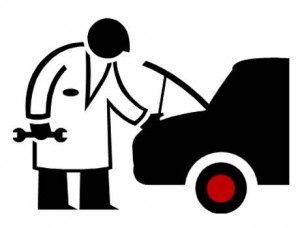
Last week I met a colleague who leads a community college program on auto maintenance and repair. This arena of study and practice has always seemed fairly straightforward to me: learn the mechanics of engines and other things that make cars work, and learn how to fix them. I confess it was surprising to me when he shared that the most important skills his students need to learn are critical judgment, reflection and decision-making. That’s partly because car design has changed so dramatically over the last two decades that cars have become complex electronic as well as mechanical systems. Just like in health care, for a good mechanic the foremost decision is whether to provide treatment.


Who knew that our most important teaching goals and teaching challenges – his in auto repair and mine in counselling and health behaviour change – were so aligned?


This reminded me of another conversation I had with a surgeon a couple of years ago. We were talking about laparoscopic surgery, and I wondered whether today’s medical students had a learning advantage due to their years of experience playing videogames. The doctor stated that it doesn’t take long to teach anyone to how to perform laparoscopies (although video game players might learn a little faster). He said that what takes years to teach and learn is when not to do the surgery.


When and how to intervene may be the most challenging things for anyone to learn because the skills are so complex. Education for diverse fields of practice – from car repair to medicine and lots in between – demands that students master three essential foundation skills:


1. Critical reflection: Meaning-making and interrogating the limits of one’s knowledge and skills; considering costs, benefits and outcomes of different possibilities


2. Attention: Including listening, observation and data-gathering, from a stance of care and concern


3. Decision-making: This includes decisions regarding a specific course of action, as well as decisions about what additional information might be needed; acting with integrity and ethics.


A nice article on how diagnosis is more art than science features wisdom from “master diagnosticians”, and underlines the importance of the above three skills, along with humility and a commitment to continuous learning:


“If you want to be a master diagnostician,”  says Dr. Lewin,  ”you’d better be prepared to be a master student.” It’s a lesson Dr. Goodgold, now in his fifth decade of practice, still takes to heart.  ”Being a good diagnostician means being good at solving problems. It starts with being intellectually honest.  You must admit to yourself that you don’t know everything. Not a week goes by that I don’t see something new. I must continue to be a student of medicine and science.”

[…]

Consider the wisdom of Sherlock Holmes, who was modeled by his creator, Sir Arthur Conan Doyle (a physician turned fiction writer), after one of the most renowned diagnosticians of his day: Dr. Joseph Bell, professor of medicine at the University of Edinburgh.  ”I see no more than you,”  the super sleuth explained to his sidekick, Dr. Watson,  ”but I have trained myself to notice what I see.”


 road grass sky


Five big lessons learned along the way


1. How do you feel when you walk out the door?

I’ve always valued the axiom that people don’t remember what you do or say – they remember how you made them feel. Think about your favorite teacher – what do you remember most from that class? The course content? Or is it the passion, inspiration, affirmation, compassion, kindness and care that he or she offered? For the most part, process is way more important than content in teaching and learning.


2. Transformational learning is about inspiring change, not transmitting information (no matter how “essential”).

Another axiom: “To teach well we need not say all we know, only what is useful for the pupil to hear”. In other words, no course or continuing professional education workshop is ever long enough for all of the didactic content that we regard as essential. Here’s my most important learning objective, no matter what the content:

At the end of this course the learner will…

Be so energized and inspired by the importance and relevance of this topic that he or she will continue to access knowledge and skills development long after the session has ended.


3. It’s not my decision.

Learning is 100% volitional. So is change. No matter how urgently I believe that I know what is best, that’s not really the point. Each individual is the expert on his or her life, including the learning goals and activities that may guide growth and development.


4. Change is a process, not an event – and so is learning.

Teaching and learning are really about change. By definition, seeing things from a new perspective involves a fundamental shift in standpoint or beliefs. Sometimes a (brief) interaction and connection doesn’t yield any appreciable indication that I have successfully “taught” anything. Then ten years later I randomly see a former student at the airport and am privileged to hear an inspiring story of transformation – initiated by something that I said or did. We plant seeds and only rarely witness the harvest.


5. We’re all protagonists (and want to be treated as such).

No matter how ubiquitous the student concerns, complaints, issues, grade appeals, special requests – each of us is at the centre of our own lives. Individual experience is at once singular and universal: all people are “like all others, some others, and no others” (to paraphrase Murray and Kluckhohn, 1953). It’s about listening (on our part) and – more important – feeling heard (on the other person’s part). Which brings us right back to Point #1.


So…although these are my top five, as Joni Mitchell famously said:

“People will tell you where they’ve gone, they’ll tell you where to go, but till you get there yourself you never really know.”


IMG-20131214-00435


Democratizing education may mean creating a strange and hybridized monster


In principle, MOOCs embody the democratization of information and education: open access to leading edge scholarship and learning, facilitated by outstanding leaders in their respective fields. Massive Open Online Courses (MOOCs) are being described as a great equalizer in higher education (awarded an overall “B” grade in a recent New York Times Sunday Review article). Maybe MOOCs are shaping up to be the “killer app” of higher education?


Except…there are a couple of snags.

In her exploration of the Ethics of MOOCs, Nora Dunne questions whether it’s defensible to use institutional resources to create and support MOOCs if this diverts what’s available to tuition-paying students. Unless the money comes from a school’s marketing budget?

Institutions of higher learning care about students. They care about access. They want to make the world a better place by linking students with research, theory, knowledge, skills and applications. They also care about enrollment, to which their funding is inextricably tied. They care about their brand. They are competitive.

Such drivers are not mutually exclusive and are not a bad thing. Visionary thinking drives innovation, and so does competition. But there is a risk if academic institutions start regarding MOOCs as “loss leaders”.


Are MOOCs at risk of becoming brand advertisements to drive enrollment?

From an education research and theory perspective, best practices in online learning emphasize the importance of interactivity, both with peers and with faculty. Conversely, the one-to-many model, whether delivered in a massive open lecture hall or in a massive open online course, focuses more on information delivery than knowledge construction.

The ideal would be a customizable and dynamic MOOC that integrates high-quality learning objects, pre-recorded or streamed video of outstanding instructors, asynchronous and synchronous small group discussion, simulations, and individual tutoring. But taking it back to budgets, how is this sustainable from a cost perspective?

Unfortunately it’s just not. And the problem with the one-to-many approach is its fundamental incompatibility with 2.0 anything. But…what if all of the above learning tools/strategies were crowdsourced? Not just across institutions of higher learning but from students themselves (past, present and future)? (Representing an authentically paragogical/heutagogical approach, a.k.a. “Andragogy 2.0“).


The Digital Frontier

If we venture into the frontier of digital open-access territory, we need to understand that MOOCs, by their nature, are free, open and out there. Positive institutional branding becomes a by-product of bleeding-edge, innovative curricula co-created by outstanding faculty and students.

And might this mean the creation of a strange and hybridized monster – a WikiMOOC?

IMG-20130505-00095


Teaching as effortless action


Course evaluations can provide helpful feedback about what we’ve done well and where we can improve. The confusing part is when we see polarities in evaluation data (too much group discussion, not enough group discussion; too much time, not enough time; etc.). But the solution isn’t necessarily working harder at the front of the classroom.

The Eastern notion of “effortless action” implies action aligned with our authentic selves. The harder we try to exert influence and control, the further we get from the fundamental essence of what it is to teach and to learn.


IMG-20130505-00090


The Tao of teaching is the unity between: 

Thinking and doing 

Speaking and listening

Working and playing 

Teaching and learning.


Consider: Each of these contains elements of the other. Thought is itself a form of action, and action embodies elements of thought. As we speak we are responding (to), and we listen to ourselves. As we listen our mind is speaking. Work and play are not distinct from one another. As we teach we learn, and we learn as we teach. 

Effortless action in a Western frame might be conceptualized as the psychology of flow.


Whatever name we give to something essentially un-nameable, for me the Tao of Teaching means finding that place inside and then reaching out and connecting with what is true and authentic in others. That’s when magic happens. 

Manufactured Landscape


Is blogging the digital equivalent of tree-planting?

In his famous series of large-scale photographs capturing the impacts of industry Edward Burtynsky highlights massive reconstructions of our natural world. I watched the award-winning 2006 documentary Manufactured Landscapes on a long-haul flight a few years ago, juxtaposing mountains of discarded computer monitors (on the screen in front of me), with pristine polar ice (out the airplane window).

Burtynsky shows us debris fields in real environments. What are some of the by-products and reconfigured terrains of the knowledge construction industry?  Here are three manifestations:

1. Degree inflation: Just like 50 is the new 40, Masters are the new Bachelors. Is this because today’s world is infinitely more complex and new hires need additional time and preparation for job readiness? Or are we seeing the equivalent of monetary inflation? I once served on a selection committee for a prestigious lectureship, where the candidate we chose had the credentials PhD, PhD. Let’s leave it at that.

2. Manufactured authenticity: Knowledge workers tend to spend a lot of time indoors. We all crave the experience of real-world adventure but fear of the attendant risks can be a deterrent. That’s what simulations are for: in teaching, learning and recreation. Google Glass represents the first wave of integrated mobile computing. Will this be the next television?

3. Digital nostalgia: The internet is a social construction and was once (in the words of Howard Rheingold) an electronic frontier. Consider the contrast between the WELL and Facebook with respect to discourse and advertising presence. Burtynsky catalogued the manufactured landscapes of the industrial world – what will 2020’s documentary on the manufactured landscapes of the information economy look like?

The post-industrial wastelands of the digisphere weren’t always there. Maybe blogging is the digital equivalent of tree-planting?


misty shore


The world is opening up, and that’s a good thing. (Don Tapscott) 


In their 2010 book Wikibrands, Sean Moffett and Mike Dover argue that with the advent of the social web, it’s no longer the purview of a company to articulate and define its brand – it’s what people say about the company that defines the brand. The implications for all organizations and sectors, including education, are huge.

Institutions of higher learning expend considerable resources on branding, but for the most part this follows traditional marketing channels. And where social media is integrated into organizational branding, it tends to be used as more a corporate communication tool than a meaningful way to engage with students or prospective students. Reputation management is a big consideration. How do you control your brand if you open up a “comments” or “review” page on your website?

A recent investigative reporting piece focusing on healthcare invited Canadians to rate hospitals, and while popular among the public (see story), was sharply criticized – by hospital administrators (though not by patients, see story).

Whether we like it or not, there are multiple outlets for review and commentary, and these are more likely to be adopted when the “official” website is perceived as promoting versus informing. When I choose a hotel do I trust a corporate website or visit TripAdvisor for candid ratings and reviews? Why should it be any different in selecting a college or university? The stakes are a lot higher, and information = power, or at least the illusion of such.

The drive towards inside-out organizations is premised on the notion that we – organizations – get more from sharing than we do from secrecy. This is a big culture change for education. It’s radical. Although high-level data about high school and post-secondary outcomes are publicly available, specifics (e.g. course evaluations, students’ comments and reviews) are not.

Here’s the thing: In a very short time frame complete institutional transparency is going to be expected. As a matter of course. If we don’t provide it someone else will be happy to step in and do it for us. And they get to keep the ad revenue from the high click-through rate: RateMyProfessors is only the beginning.

As Don Tapscott puts it: “Institutions are becoming naked, and if you’re going to be naked … fitness is no longer optional. If you’re going to be naked, you better get buff.”

IMG-20130329-00018


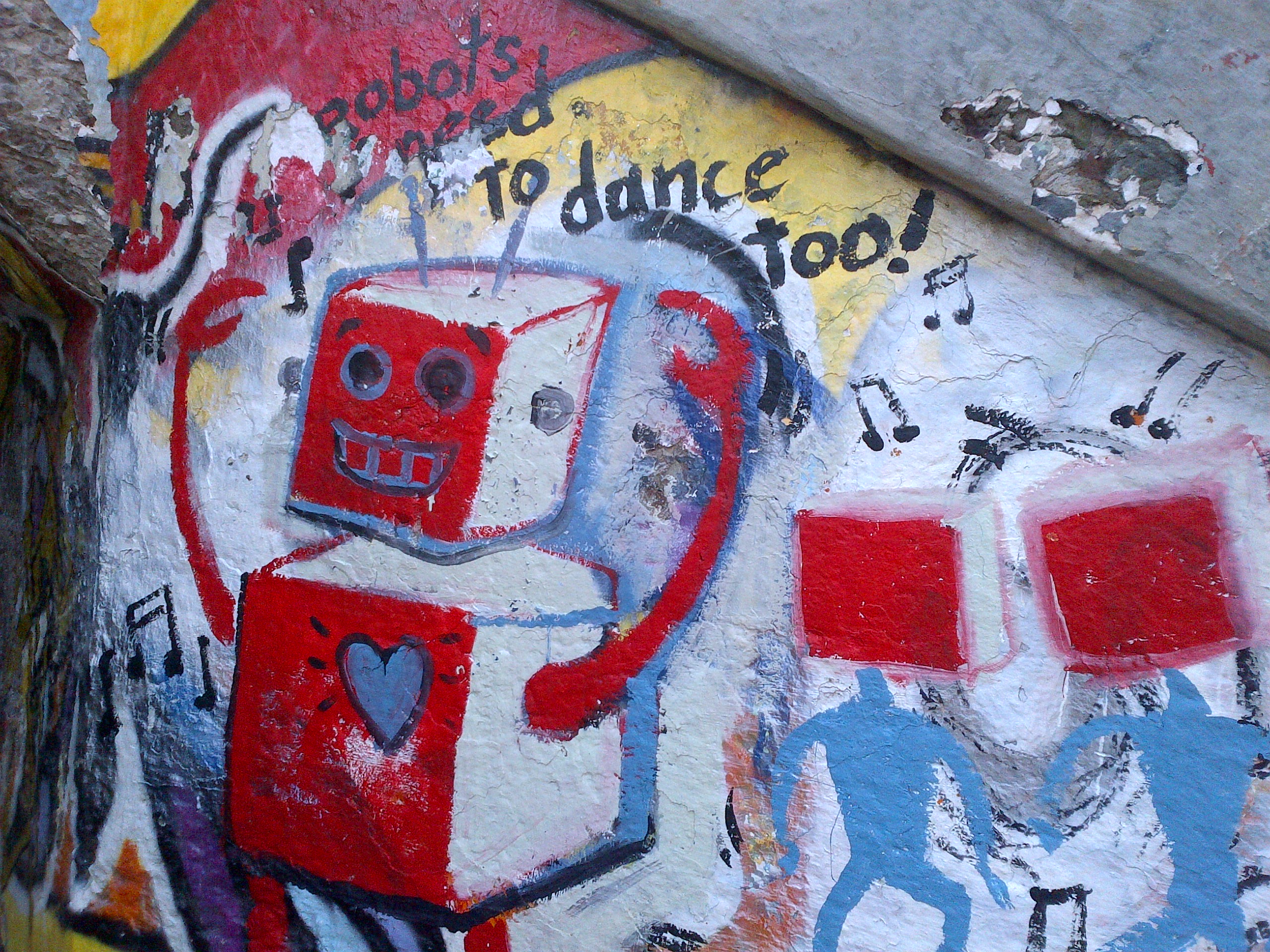
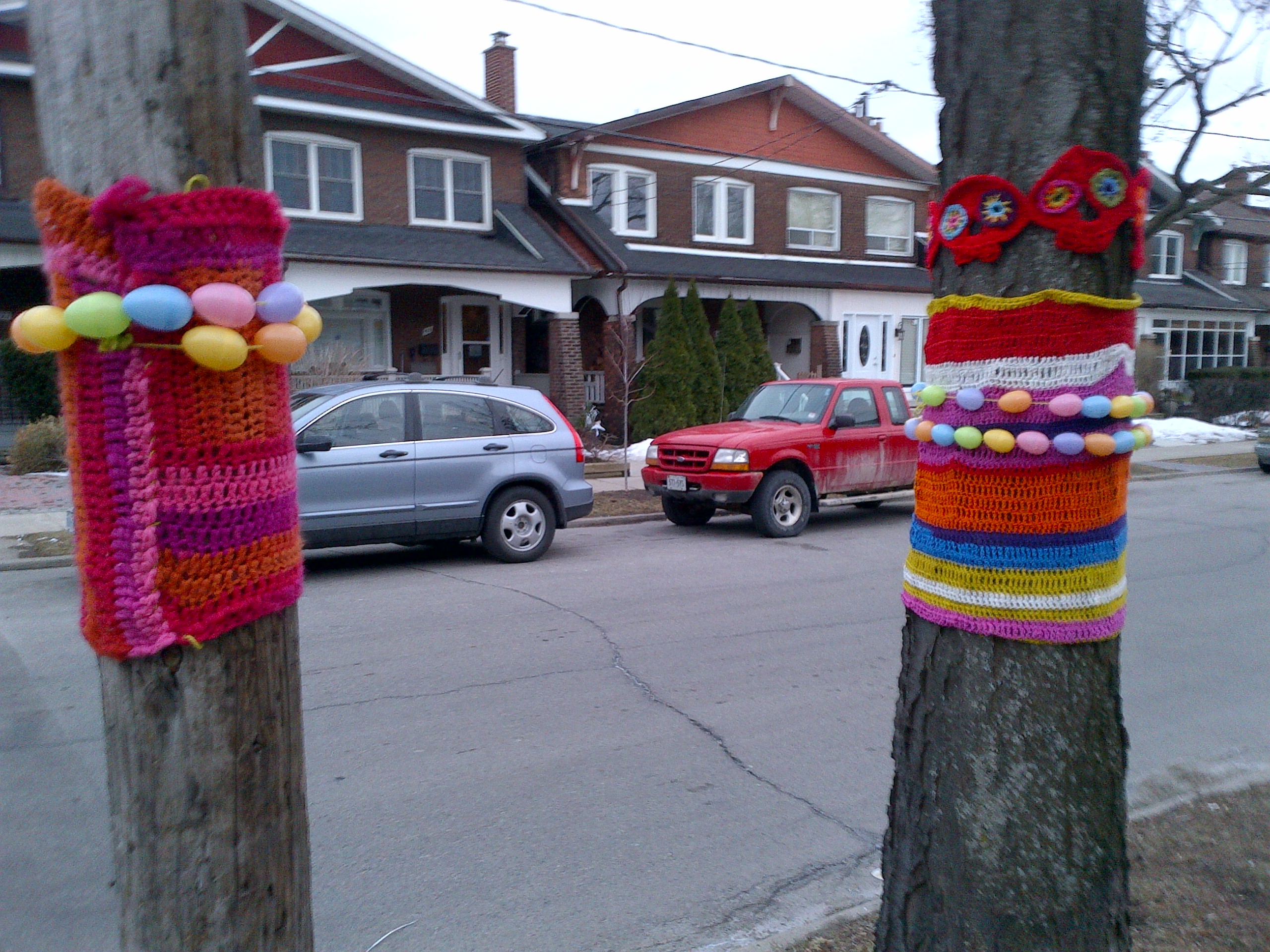
Why teaching and learning have a lot in common with street art

I am a big fan of street art. I like how it subverts traditional conceptions of art, artist and viewer. By creating artistic encounters in unexpected places there is a sense of serendipitous discovery and personal connectedness. Street art wakes us up to the creative possibilities in environments that are taken-for-granted and thus invisible.

But is it really art? What is art?


IMG-20130306-00006


Is art beauty? Truth? A thought, idea or emotion captured in images or words?

Or is it an experience, an evocation of some reaction (positive or negative), stimulus for thought/reflection?

All of the above and more?

And who gets to decide what constitutes art? The artist? The viewer? The museum curator? The market?

Maybe I’m especially drawn to street art as a form of conceptual/contemporary art because it has so much in common with my philosophy of teaching and learning. Just like great street art:

Real learning happens outside the classroom.

Advances in knowledge question the status quo.

Learning derives from our engagement with our environment.

Deep learning stimulates an emotional response: surprise, delight, outrage, insight.


IMG-20130329-00023


Teaching and learning are essentially creative enterprises as much (or more?) than cognitive/intellectual processes. Educators are both curators (What will I teach? What sources and strategies will I use?) and artists (What response am I trying to elicit? What experience (curriculum) do I (co-)create to get us to that place?).

The creative imperative is all around – and within – us. We are all artists in our construction of knowledge, experience and expression.


IMG-20130326-00016 IMG-20130326-00017

Tulips2


Six surefire ways to lose an hour in the classroom

Each spring 60 minutes evaporate when we set the clocks forward. Daylight Savings Time (DST) signals the start of long days, fresh colour, smell of earth and birdsong. But still, it hurts to lose that precious hour, especially when there are few enough in the weekend to begin with.

Of course we get an hour of DST back again in the fall, so it’s only a temporary loss. But for educators and students, how many precious hours of learning opportunity are lost in the classroom? Hours that add up to days, weeks, months and years over the course of a high school and post-secondary career. We could argue that this is a student issue based on motivation, attention or capacity: after all, learning is volitional and each of us is personally responsible. Still, I see this stance as at least somewhat disingenuous.

Even the most motivated, attentive and able students can find themselves wishing there was such a thing as what I call Classroom Savings Time (CST) during boring, irrelevant or unproductive “learning” activities. Here are a few tried and true instructional strategies to make them want to fast-forward the clock:

1. Give too much information (because “To teach well, we need not say all that we know, only what is useful for the pupil to hear.”)

2. Teach people what they already know

3. Lecture for more than 10 minutes at a time (TED talks might run twice as long, but after all these are some of the world’s most compelling speakers)

4. Permit student presentations in excess of 10 minutes each (see previous point)

5. Play a video for longer than eight minutes (and that’s still probably three minutes too long)

6. At all times stick to your script (textbook and/or lesson plan).

There is truth to the old saying: “You can lead a horse to water, but you can’t make him drink.” However, you CAN make him thirsty! There may be no getting away from DST, but we can all avoid CST. Students everywhere will be grateful.


Toronto-20140102-00509


The hardest thing about writing is writing (Nora Ephron)


Student plagiarism is a big issue (and apparently an equally big industry) in high school and post-secondary education. It’s never been easier to craft a bricolage of web-based material for a written assignment, and it’s never been easier to detect evidence of academic dishonesty. Tools like Turnitin, iThenticate and online search engines allow for immediate identification of copied source material. Given the high risk and high stakes involved, why do students do it?

The way I see it, a number of interacting factors have created a “perfect storm” kind of context in which student plagiarism can flourish:

1. Stewart Brand, digital social network pioneer, famously said that “information wants to be free”. We’ve seen how intellectual ownership of music and film has been defended vigorously in the courts, yet for every torrent site that gets shut down, a new one pops up. Digital content on the network behaves like water: block one pipeline and it effortlessly reroutes through others. The digital generation has grown up accustomed to immediate access to a gushing flood of “free” content.

2. This leads to the next contributing factor: social media platforms are as much about the flow of content as original content creation. Pinterest, Tumblr, Twitter, and others are about free flow of media and ideas. There is a culture of “content curation”, and the best curators are rewarded by likes, notes, reblogs, retweets, repins etc.

3. Academic databases have traditionally been way less user-friendly than search engines. This is starting to change, but the reality is that if you’re pressed for time, don’t understand Boolean logic, and want easily-digested and accessible information, a quick web search might win out. There have been periodic (and growing) exhortations for researchers to make the products of research more accessible, however we have far to go in realizing this knowledge transfer ideal.

4. I am not sure that students really appreciate the consequences of academic misconduct. It’s a bit like impaired driving: seems worth the risk at the time, but when you find yourself in court, without a license, and facing massive fines, insurance costs and social stigma, the cost of booking a stretch limo is a bargain. Same goes for plagiarism. Universities take it pretty seriously, and that meeting with the Dean is a lot like going before a judge.

5. Finally, writing is hard. Encoding our ideas in abstract alphabetical symbols just doesn’t come naturally for most of us. In fact, sometimes coming up with original ideas to encode doesn’t come too naturally either.

Academic Integrity is the foundation of knowledge generation and production. But somehow there’s a disconnect with digital norms and popular culture/practice. The solution? Still murky, but I think that an ongoing dialogue with students acknowledging and exploring the terrain between these separate realities is a good place to start.


cat paw


Why it’s less about managing the class than joining with the group

Recently overheard in a high school classroom: “F#*%  you…sir!”    Wow: Did I just witness respect + disrespect expressed simultaneously? How does that work exactly?

Teaching is a tough job whatever the age group. Adults may be less “out there” than teenagers, but the group dynamics are the same. Groups tend to behave like unitary entities: they can be your best friend or your worst enemy. But if they fall into the latter category they are a many-headed hydra who cannot be vanquished.

Here’s how I see it: If you have to actually “manage” the class that is not a good sign. Now I am not talking about classroom management in terms of providing guidance or direction with respect to learning content or processes. Every group needs a guide to stay on track. What I mean is that if students act out, tune out or walk out, things have already gone bad. At that point it’s likely not so much a student issue as a group issue.

Here are a few tips to help get things off to a good start, and to keep it that way:

1. Mutual respect is an essential precondition for ANY relationship. If it’s lacking there’s no relating. Regularly affirm your respect for each student and for the class as a whole (the “two clients”: the individual and the group).

2. Make it interesting. Easy to say, but how? Three words: make it relevant. OK, but how? The group will tell you if you ask. What do they care about? Why are they there in the first place? What do they want from you and from each-other?

3. But… what if I am teaching a mandatory course that no one cares about? Here’s the thing: There is no such thing as a topic that’s inherently interesting (have you ever gone to a talk that intrigued you only to be bored out of your mind?). And, conversely, there is no such thing as a topic that’s inherently boring (have you ever gone to a talk you were dreading only to be pleasantly surprised?). Why is the course mandatory? What’s the larger narrative? Why is this essential knowledge and learning? These are the primary questions to address as part of an ongoing group dialogue.

4. Show that you care. Not just about what you’re teaching, and not just about your students as people, but about their experience in the here-and-now. Who’s tired? Who’s bored? How comfortable is the room? What else is happening in the world and how does that impact the tasks at hand? This in-the-moment reflection continuously reestablishes the connection between facilitator and class. In clinical practice it’s called therapeutic use of self – tune in to your own experience to help you tune in to the group.

5. Be generous. Generous with your humour, your time, your interest, yourself. I think of generosity as comprised of curiosity, authenticity, empathy and joy. It’s less a focus on how the group sees you than on who is in the group and what you see in them. And be generous with people when they’re having a bad day. It happens to all of us.

Over the last two days I facilitated a mandatory training for a diverse group of health and social service professionals in Halifax, Nova Scotia. What a pleasure – even if some learners started off the day with ambivalence, we all ended on a high note. And just to add…if you ever find yourself in that beautiful city, be sure to check out Cabin Coffee on Hollis Street for a latte and a killer cinnamon bun!

thumbs up & down


Complex skills are best learned in authentic environments

Buying a new car has meant finding a good home for my beloved 95 Chevy. A colleague is now the proud owner, only there is one small but crucial detail…he has never learned how to drive a car with manual transmission (stick shift). Thus, last Sunday afternoon his friend was the one who drove off into the sunset after we did the deal, but that’s no long-term solution. Oh Chevy, I see grinding gears and burning clutch in your future!

Driving a stick shift isn’t easy. In fact, in the beginning it feels pretty complicated and there’s not always much room for error. I’ve been thinking about some of the ways that learning to drive shares common ground with learning the complex skills of clinical practice.

1. The stakes are high: If you don’t master key practical skills, your own and others’ safety are at risk. Have you ever stalled out on a steep grade with other cars right behind? Not a good situation in which to freeze up or panic!

2. It can be a challenge to practice new skills in an environment that feels safe yet also authentic: See Point 1 – you need the experience of stalling the car on a steep hill to learn how to get going again, but you don’t want the reality of rolling backwards into the guy behind. My drivers’ ed training car had a clutch and brake for both me and the instructor/passenger, so I knew that a mistake wouldn’t be catastrophic. Simulation in healthcare education accomplishes the same objectives of safety + authenticity.

3. An experienced mentor can make all the difference: My driving instructor was about 70 years young and had over 40 years experience in teaching new drivers. Everything that a student could possibly do or say he had seen or heard, and literally nothing rattled him. He had this very calm and patient demeanor, which I guess is how he survived that long teaching people like me how to drive. Just knowing that any mistakes I made were par for the course and all part of the learning process freed me up to get into the zone of deep learning.

4. Corrective feedback in the moment shapes behaviour: Direct observation and feedback about the skills I was practicing effectively and where I needed more work helped me learn faster and better. Abstract instructions and memorization aren’t nearly as effective for integrating and mastering practical application of complex skills.

Perhaps a couple of “continuing education” sessions on how to drive a stick shift would not go amiss for Chevy’s new owner. Who knows, might save the cost of a replacement clutch and maybe more. SWP, are you listening?

 TO LISTEN

Ears + Eyes + Undivided Attention + Heart

Zen rocks lake

Group facilitation is more about listening than speaking

Facilitating groups is a delicate art: groups progress through certain well-defined stages of development, and our style as facilitators needs to be pitched to where the group is at. Furthermore, facilitators need to respond to the “two clients” – the individual, and the group – and attend to both content and process. This multilayered complexity, whether in education or clinical contexts, is a big part of what makes groups so energizing and exciting.

What is reflective listening?

In its simplest form, it’s a response that paraphrases or mirrors the spoken content of a person’s statement. Reflective listening is a way to check back and make sure that we’ve understood what someone else tells us. This type of response is also a good alternative to the “Righting Reflex”!

Done artfully, the skill of reflective listening looks easy but is far from it (at least in my own experience). Really impactful reflective listening goes further than paraphrasing, and mirrors back the implied meaning beneath a person’s words; exploring the emotions, assumptions, ideas, hopes, concerns or wishes. These types of complex reflections demand our full listening attention and focus on the other. We all want to feel understood, and reflective listening helps bridge the communication gap in a respectful and validating way.

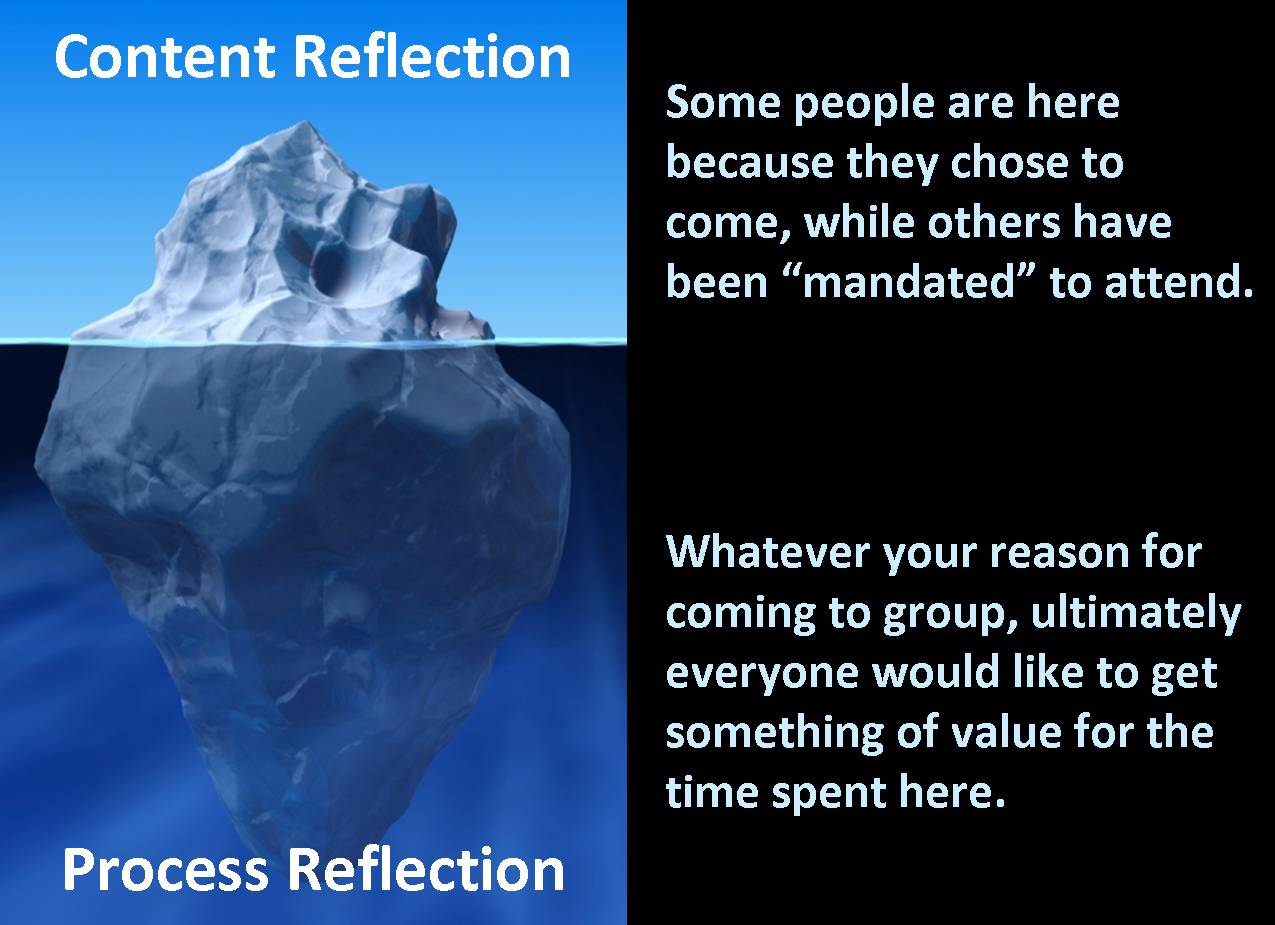
Here’s an analogy: simple reflections are like the tip of an iceberg – the content “above the waterline” – while complex reflections go deeper.

This video example of an angry client demonstrates how the practitioner uses lots of reflective listening to establish understanding and build rapport.

Reflective Listening in Groups

Reflective listening in groups ups the ante because of their interpersonal complexity. But, looked at another way, groups give us even more options and opportunities to use this important skill. I’ve come up with three general categories for practicing reflective listening in groups (and I’m sure that there are more):

1. Simple versus complex reflections

2. Reflecting an individual’s comments versus content taken from the group’s overall contributions

3. Reflecting group content versus group process.

Note that a facilitator might decide to use any one of these approaches (and within each category are a myriad of alternate ways of responding)…that’s the artful strategy part!

Here’s an illustrative example of a hypothetical client who is coming to the first session of a support group for people living with heart disease. The facilitator has asked group members to share their goals for attending, and the last client to speak says:

“I’m only coming to group today because my doctor and my wife are both pressuring me.”

Reflect 1

Reflect 2

Reflect 3

Notice how each reflective strategy builds on the next – but they aren’t sequential (or prescriptive for that matter). Just some pretty powerful tools that are appropriate across a spectrum of clinical, educational, professional and other kinds of groups. Because in the end, the best facilitation is more about listening than talking.

mail full mailbox


Unsolicited advice is the junk mail of life (Bern Williams, in Miller & Rollnick)

Compassionate listening – stepping back and allowing learners to individually explore their ambivalence, concerns and ideas about an issue or concept – is at the crux of individual discovery and adult learning.

Here’s the rub: as educators we want to support student success, so when we see someone heading in the wrong direction or struggling, we’re often galvanized into action with all good intentions! This “Righting Reflex” is essentially the imperative to do something…to “fix it”, and often kicks in without any conscious awareness (see Miller and Rollnick’s 2013 text on Motivational Interviewing).

To add clarity: A a quick illustration of the Righting Reflex from a conversation I had on my way in to work this morning (for real):

Me: “I’m thinking that I’d like to buy a Smart Car.” 

Significant other: “Well what about a Honda CR-V? I know someone who has one for sale.” 

Me:   ?   !   ?

O-kayyy…How useful was that unsolicited (albeit well-meaning) advice in helping me think things through? And, to be fair, my own Righting Reflex isn’t hard to activate in both personal and professional spheres. Learner autonomy as being at the heart of constructivist approaches is widely discussed and accepted, yet in practice it’s “simple but not easy”.

In an ideal world, educators validate, explore, question. They evoke and encourage students to critically examine different sides of an issue. This doesn’t negate our roles of teacher, guide or concerned other, but it does place the onus – quite rightly – on the learner’s capacity for decision-making and problem-solving.

A big part of education in health care (and other fields) is less about teaching the correct answer, than in facilitating the process of ethical and nuanced judgment and decision-making. If we can resist the Righting Reflex we’re creating a positive space in which to explore, experiment and make mistakes.

So…as for my own automotive decision-making process…a design endorsement by the MOMA may just tip the balance!