Archive

Clinical Education

sticky buns


One of the axioms about great presentation skills is to “make it sticky”


Sounds good, but how? Here are four of tried-and-true strategies (the “application” part is how I say it – you can adapt to your style!).


1. Get people talking

People remember most of what they say, versus what the presenter says

Application: “Take 3 minutes, turn to the person next to you and share one thing that stands out so far”


2. Evoke disagreement

Critical analysis often means criticism – ideas don’t stick if a person hasn’t had a chance to integrate within existing knowledge, assumptions, worldview

Application: “Write down one concern, question or skeptical comment or idea about what I’ve been saying”


3. Initiate a “Teach Back”

No matter how much knowledge/skills/expertise I might have started with, anything I’ve ever had to teach forced me to learn more deeply.

Application: “Find someone you haven’t spoken to yet and teach them ___ (concept, skill, approach, etc.)


4. Bridge the Gap

Don’t be afraid to assign homework.

Application: “Before you go to sleep tonight, write down three things that you are going to practice or do differently based on the work we’ve done here today…and put them on your computer screen/refrigerator/other.”


Last week I was asked to facilitate a workshop for a diverse group of community health and counselling providers. The organizers asked for an outline of the proposed session as well as an overview of a subsequent follow-up session to help ensure uptake and implementation. In other words, why invest in staff training if there’s no traction over the longer term?


The research/education/practice gap is undeniably tough to bridge, and follow-up coaching and training certainly helps increase adoption and skill development. But in my mind, every presentation is an important opportunity to foster motivation for change – with or without follow-up.

welcome woodburned


Learning is up to the learner, but teaching is up to the teacher


It’s one thing to teach, and quite another to learn. Learning is up to the learner, not the teacher. Just like the old saying: “You can lead a horse to water, but you can’t make him drink.”

But…here’s the thing: You can make him thirsty!

So the question is, how do we create environments that make learners “thirsty”? In other words, how can we foster learner engagement? Herewith, my personal Top 10. Some are prosaic and some can be incredibly challenging. And that’s a good thing, because we are all learners and we’re all teachers.

1. Start as you mean to go on: Begin every workshop, class, course, etc. with a question. Establishing right at the outset that our learning journey will be collective and collaborative is key, and especially early on I make a point of explicitly praising and otherwise rewarding any and all signs of positive engagement on the part of individuals/groups.

2. Incentivize participation: We want learners to take risks and make mistakes. When a person volunteers for something high risk, reinforce the desired behaviour. I don’t advertise it ahead of time, but whoever comes to the front of the room to do a role play with me is going to go back to his or her seat with some small token. It doesn’t even really matter what it is (think $ store).

3. Provide normative feedback: Using in-class mobile polling or an audience response system (like iClickers) lets learners compare their own knowledge/opinions/beliefs/assumptions with others in the room.

4. Establish relevance: Learners what to know “what’s in it for me?” Creating learning activities that help people bridge curricula to their own lives = good. Co-constructing learning activities that address/solve real-world problems = better.

5. Show your sense of humour: It’s hard to be serious all the time. Make it fun and mix it up! Shared laughter builds group cohesion.

6. Affirm autonomy: Let’s face it. Some days we are more fired up than others about our life’s work, and it’s no different for our students. When individuals or groups just don’t seem to be getting on board, I find that stating out loud (with 100% sincerity and with 0% judgement) that how/when/if folks engage is entirely their choice seems to free up some good energy for engagement.

7. Deploy multiple “engagement channels”: Individuals come to learning environments with a range of different learning preferences and a range of preferred ways of participating and engaging. Some people like the limelight, others need time to process and formulate a thoughtful response, and many are more comfortable sharing in a smaller group. The more choices we can offer about how to participate the better, including: verbal/written, large group/small group, synchronous/asynchronous, classroom-based/online, and more.

8. Evoke affect:  Research about emotion (affect), memory, and implications for learning suggest that teaching needs to go beyond engaging at a purely intellectual (cognitive) level, and touch peoples’ feelings (for example, Sylwester, 1994; and more recent perspectives that encompass academic technology and affective/cognitive learning, Calvo & D’Mello, 2011). Create learning activities that pair new knowledge and skills acquisition with positive affect, like surprise, delight, excitement, curiosity for deeper and more durable learning.

9. Show them you care: Authentic care and concern can go far in building good will and fostering mutual respect and support for one another’s learning and achievement.

10. And last but not least – know when to break the rules (and go ahead and break them). Like the time I called it a day and took the group shopping. 


Related articles

Five Reasons why Reality TV is not a Waste of Time: How reality TV can inform teaching best practices

Seven Essentials for 21st Century Education and Teaching: Stuff it took me 20 years to learn and I’m still trying to figure out

Rules of Engagement: The “Top 4” preconditions for learner engagement


large pink flower


What’s the difference between education and learning?


“Education is what others do to you. Learning is what you do to yourself.”


Amy J.C. Cuddy


cogs and wheels

It’s often good to follow your own advice

Last Friday I presented to a group of health practitioners (registered dietitians) at their annual conference. The topic was “presentation skills” – an important element of their professional practice, as dietitians frequently work with various client goups experiencing complex and challenging health conditions. They are not just presenting information. It’s more about inspiring and motivating health behaviour change when the stakes are high.

I have always found that ‘presenting about presenting’ poses a particular set of mental challenges. Audience expectations are generally higher than the norm and my expectations of myself are correspondingly escalated. I have to keep reminding myself of the axiom that any presentation needs to feel more like a conversation than a performance. That means focusing on the audience’s learning needs, goals, and practice challenges, as opposed to my own ‘performance’.

And mirroring the dietitians’ clinical practice with groups, the information that I shared was nowhere near the most important part. (There’s a whole library of books written on presenting and facilitating, covering more content and in greater depth than any 45 minute talk could ever do justice to.) Sparking some lively critical reflection and dialogue (internal and external) about the pitfalls and best practices for us all to pay attention to when presenting to groups was the most meaningful part of the session.

It’s often effective to follow one’s own advice, and happily I was able to come reasonably close to putting into practice the four themes of my session:

1. Stop performing

2. Engage everyone

3. Transform your slides

4. Make it sticky.

OK, maybe I didn’t engage absolutely everyone – but on my way out of the room the A/V guy did give a big thumbs-up, and let’s just say that hasn’t been a uniform experience. I say, gather your nuggets where you find them!

acorn in forest


what if collage


Learning how to learn and deciding how to decide


We are all lifelong learners, and this has got me thinking about the learning that occurs outside of formal, post-secondary classrooms via the series of decisions, big and small, that comprise each person’s life path. In clinical/professional practice, critical judgment and decision-making are key, and we get to hone these skills every day in the multiplicity of choices that we are continuously called to make.

Sometimes the implications and outcomes of making one choice over another are clear; but a lot of the time there’s mighty thick cloud cover. On those occasions I have found myself wishing for a crystal ball to foresee the results of a specific decision before I decide. And maybe some future convergence of digital technology and computing (“the singularity”) will offer an uber-intelligent clarity and vision to better inform which direction to take. But at this time we pretty much weigh our options and just do the best we can.

psychic advisor sign


So, I’ve been wondering…is life’s learning trajectory essentially based on how we navigate through our own individual series of crossroads? For example…


We have to make many decisions without benefit of much experience or perspective to guide us:

Which high school? What’s after that? What’s my career path? How do I approach parenting? Do I choose to be a parent?


Some decisions are made either by default (inertia, status quo), or because we are willing to take a chance and leap into the unknown:

Start a relationship or end the relationship? Take the job or leave the job? Stick close to home or move to a whole new place?


Some decisions can be heartbreaking, and represent a lack of positive choices at all:

Do I pay the rent or feed the kids? Support the family or get an education?


And many crossroads test our own moral compass and integrity:

Should I speak out or follow the pack? Stand up and take action or do nothing?


crossroads house


The chaotic complexity of an individual’s inward/outward subjective experience and learning is never still. Each person’s journey accretes a unique composition and form. And every decision point at every crossroads iteratively informs the ones still to come.

Through this lens, effectively teaching professional decision-making might rest on our ability to come alongside learners, and link our vast, collective landscape of lifelong learning with discrete and situational reflective practice. In other words, the ultimate “meta crossroads” are learning how to learn and deciding how to decide. Over and over. Each and every day.


tree reflection in puddle

Motivational Interviewing Change or No Change


Motivational interviewing is a form of collaborative conversation for strengthening a person’s own motivation and commitment to change.


In a recent workshop I presented on Motivational Interviewing (originated by Dr. William Miller and Dr. Stephen Rollnick), the audience of interprofessional clinical practitioners came with varying degrees of familiarity with this well-established and evidence-based practice model. Below is a short summary of the essentials, with links for further reading, exploration and video examples. Start with this short interview with Dr. Miller, offering an overview of the background and basics of Motivational Interviewing.


The Righting Reflex


The “righting reflex” happens when we are triggered to want to “fix it” for the person…and tends to evoke a “Yes, but…” response from the person we are trying to motivate. As soon as we hear a person respond “Yes, but…”, that is feedback that we have likely slipped into the righting reflex.


Motivational Interviewing Spirit


Motivational Interviewing Spirit


The spirit of Motivational Interviewing (compassion, acceptance, partnership, evocation) is even more important than the specific skills (Open questions, Affirmations, Reflective listening, Summary statements – OARS). The ‘spirit’ is the essential foundation from which we practice.


Four Motivational Interviewing Processes


Slide1


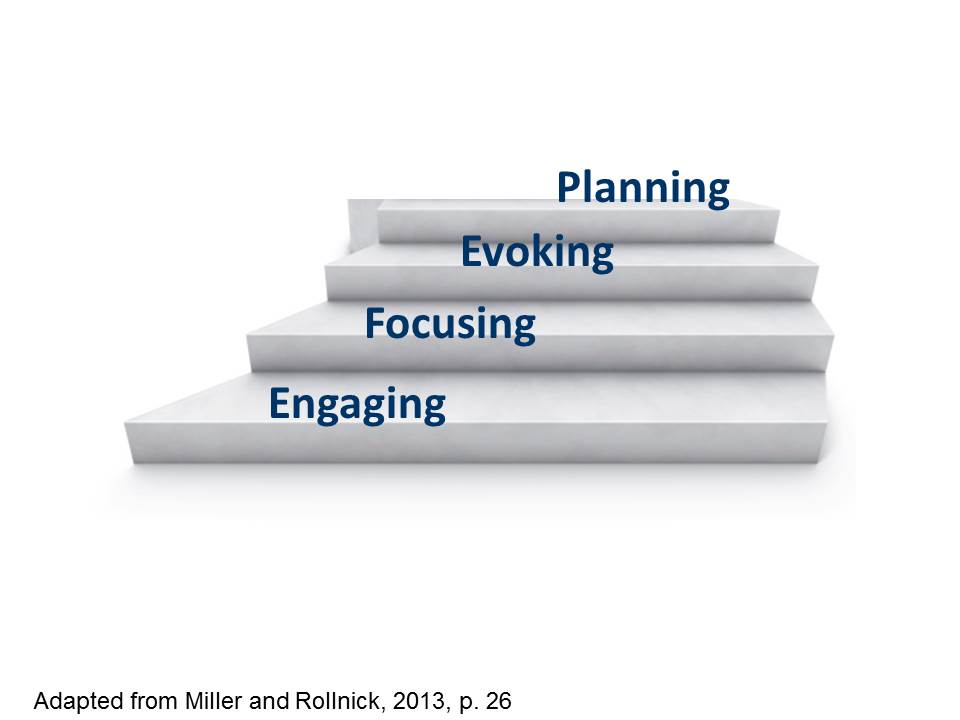
There are Four Processes in Motivational Interviewing. They are not all necessarily sequential or linear, and we may need to jump backwards and forwards depending on where the person is at.


1. The process starts with engaging: without engagement there can be nothing

2. Motivational Interviewing is directional (as opposed to directive), with a trajectory toward a common goal (with engagement comes the process of focusing)

3. Once we identify and agree on a goal with the person, we move to the process of evoking change talk to enhance motivation for change

4. Commitment language signals a person’s readiness for the process of planning key strategies and supports to mobilize change

Note that these processes are not linear – we are continuously moving between processes as we stay alongside the person we are working with.


Foundation Skills of Motivational Interviewing: OARS

There are four foundation skills in Motivational Interviewing. The OARS skills are used in different ways throughout the processes of Motivational Interviewing. Caution: these skills are simple but not easy!

1. Open questions help us to get to know the whole person – closed questions gather focused information

2. Affirmations offer a neutral observation of a person’s strengths, resources, efforts, values – and statements of affirmation are more motivational than praise

3. Reflective listening communicates understanding and attention. Complex reflections aren’t complicated – shorter can be better!

4. Summary statements offer an opportunity to gather together diverse aspects of a problem, issue or conversational journey, and can also link back to previous material or ideas, and/or further exploration and dialogue.


Here are some of my favourite “Motivational Interviewing Axioms”:


“People are most able to change when they feel free not to” (affirm autonomy)


“You have two ears and one mouth. Use them in that ratio” (listen to understand)


“People only change when the pain of change is less than the pain of staying the same” (working with ambivalence)


“I learn what I believe as I hear myself speak” (evoke change talk)


Guilford Press offers the definitive series of Motivational Interviewing ‘textbooks’ across a range of clinical practice populations, disciplines and target areas.


Motivational Interviewing Tip Sheet


Click here for a one-page Motivational Interviewing Tip Sheet


Click here for video examples of Motivational Interviewing


Toy Circus


Stuff it took me 20 years to learn – and I’m still trying to figure out


1. Learning is volitional. It cannot be mandated. We can teach, but each person decides for him- or herself what will be absorbed and integrated.


2. What’s taught in the classroom is only the starting point for knowledge-acquisition and skill mastery. Deep learning happens when class is over – the space for real world application and practice.


3. Motivation to learn influences how much work a person is willing to put into self-directed learning and mastery.


4. People are most motivated to learn things that are of direct interest and relevance.


5. Motivation is a state, not a trait. Motivation is largely a product of how we (instructors) engage students.


6. We can amplify students’ engagement by giving them an authentic and substantive voice in co-creating curricula.


7. Paragogy and heutagogy, emerging theories of teaching and learning, point to decentred learning, self-determination, and peer-to-peer learning as core to 21st Century education.


What might paragogical teaching look like in a post-secondary classroom? In this Acclaim interview with Maegan Stephens (Public Speaking as an “Interactive Democracy”), Professor Stephens describes how:

I give them a ballot of issues to vote on, including the content of the speeches they will give, how they will be graded, and class policies on cell phone use and on attendance. I also ask them if they would prefer to spend class time doing activities, watching speeches, hearing me lecture, or a combination.

I try to ask as more as more of a moderator and facilitator than as a lecturer. This kind of interaction, advances the aspects of debate and speaking oriented pedagogy on day one. It is not so much about flipping the classroom as it is about reversing the authority and changing the professor student dynamic, and encouraging my students to take more responsibility for their classroom.


Love it. Can’t wait to try it.


reflection

Why is Reflective Listening so difficult? And so important to clinical practice?

We all want to be understood – that’s the major impetus for any form of communication. And the trouble is that there are so many ways that communication can go wrong. In Thomas Gordon’s model of Parent Effectiveness Training, it’s evident how easy it is to misunderstand the intent and/or the content of another’s communication as our messages are coded and decoded through a series of filters:

thomas gordon listening

Reflective listening, considered to be THE foundation skill of Motivational Interviewing, is like offering a hypothesis about how we perceive someone else’s meaning. Reflections are offered in the spirit of “I’m listening to understand (not to judge, persuade or correct)”. True, unadulterated listening is rare, refreshing and affirming. It communicates respect and builds relationships. It goes “below the surface” and articulates the underlying meaning – thoughts, feelings, ideas, hopes, values – that a person may be expressing.

Bonus tip:  Reflections can sound contrived when they are prefaced by “stock” phrases such as:

“What I hear you saying is…”

“So you are saying that…”

“I am hearing that…”

I think practitioners use these phrases to (a) buy time while we’re busy figuring out what exactly we’d like to reflect; and (b) because we’re concerned that we might be ‘putting words into the other person’s mouth’. However, when we offer reflective listening statements with a spirit of partnership, acceptance, compassion and collaboration, it’s OK if we’re a little off-target with respect to the other person’s meaning, affect or intent. Our reflections can still evoke further elaboration.

Also: it might seem counter-intuitive, but reflections are more genuine and engaging when we just come right out with a statement (not an question, and no ‘stock phrase’ preface):

“You wish that…”

“It’s frustrating because…”

“It would be nice if…”

“You’re not too happy that…”

Understanding is at the heart of effective communication. It’s also key to building trust, rapport and safety. The saying: “I learn what I believe as I hear myself speak” articulates the power of dialogue in fostering insight and enhancing motivation for change. Reflective listening holds up the mirror.

Related articles:

Reflective Listening: The Most Powerful Tool in the Tool-box?

Reflective Listening Reflections

Neon sign retro party


When words (and worlds) collide


This week I facilitated a webinar on Motivational Interviewing for members of the Ontario Association of Social Workers. I like how webinars offer an opportunity for professional development in a distributed learning format from the comfort of home or office; and clinical social workers tuned in for our evening session from various regions, cities and towns. We had a fun and at times informal conversation in the chat bar, with some interesting discussion focused on my unintentional use of idiomatic expressions and vernacular language.


Idioms are culture-bound and can be confusing to diverse groups who may puzzle at their intended meaning. For example, when I talk about needing to keep my head above water in working with complex clinical scenarios. And one of my personal favorites is a skill or tool that’s as easy as pie. No doubt there was a time when pie-making was super-easy, but not anymore (at least for me anyway).


Expressions aren’t just culture-bound, they can also be generational in their meaning. In this week’s webinar I talked about the Coles Notes version of Motivational Interviewing in reference to a one-page “Motivational Interviewing Tip Sheet”. There was some light-hearted (another idiom!) text-chat in the sidebar about the generational divide among people who understand what Coles Notes actually refers to.


Last night I had a conversation with the teenager in my life about putting pen to paper. Her reply? “I don’t know what that means”.


Maybe I need to spend some time with urbandictionary.com.


Related:

Six Tips for Facilitating Webinars


robot cute


Reflections on motivation and why people change


How to motivate change is a big question for clinical educators and practitioners because someone else’s behaviour change is, in the end, wholly out of our hands. Over my 15 + years of practicing and teaching Motivational Interviewing, I still find myself getting stuck in the “righting reflex” when I see a person making (what I consider to be) unwise decisions.

It all comes down to individual motivation and commitment, and that’s a scary prospect when the stakes are high. We see someone following a risky trajectory and we want to grab the steering wheel. How bad do things have to get before an individual figures it out for him- or herself?

My own experience is that everyone has a particular “pain” threshold: biologically, psychologically and socially. In other words, a state of being that I might find totally unendurable physically, mentally or inter-personally may not be so bad for someone else. We each bring a singular standpoint and value-set to the decisions we make and how we live our lives. 

And here’s the thing:

People only change when the pain of change is less than the pain of staying the same.


In other words, motivation is tied to individual perception and experience of suffering. For example, from a teaching standpoint, it can be heartbreaking to see a promising student at risk of failing a course due to not attending class or completing assignments. But the important thing is…how does the student see it?

A “red flag” from a Motivational Interviewing perspective is when I am more invested in change than the person I’m working with (in this case, the student). I can better enhance motivation by stepping back, exploring possible reasons for change, and offering what I’m hearing about the pain of staying the same. Underlining a person’s perception of some of the costs of negative behaviours can open the door to a productive conversation about possible solutions.


As Andy Warhol put it:

When people are ready to, they change. They never do it before then, and sometimes they die before they get around to it. You can’t make them change if they don’t want to, just like when they do want to, you can’t stop them.


Related articles:

Reflective Listening: The most valuable tool in the tool box?

Reflective Listening Reflections


Awareness


One word to ponder.


Something we are always learning and relearning.


Wallpaper 1

Advances in education theory for a digital world


This article is abbreviated from:

Herie, M. (2013). Andragogy 2.0? Teaching and Learning in the Global Classroom: Heutagogy and Paragogy. Global Citizen Digest, 2(2): 8-14.

Whether implicit or explicit, everyone has a theory of teaching and learning. This gets expressed and enacted by how we engage with others, whether as instructor or student. Traditional theoretical frameworks can be broadly grouped into four domains: instructivism, critical theory, constructivist approaches and andragogy (or adult learning). However Web 2.0, characterized by many-to-many, decentred and non-linear networking and communication, has given rise to corresponding advances in conceptualizing teaching and learning in the global classroom. Emerging frameworks – heutagogy (learning as self-determined and non-linear) and paragogy (peer-to-peer and decentred learning) – have important implications for practice in the 21st Century.

Education theory has seen a trajectory from teacher-centred (instructivism) to learner-centred approaches (constructivism and andragogy), incorporating broader contextual issues and dynamics of power, privilege and community (critical pedagogy). However, these theories were all developed prior to the rise and ubiquity of Web 2.0 and social media. Integrating emerging models can extend constructivist, critical and andragogical frameworks towards a kind of “andragogy 2.0”.

Heutagogy and paragogy represent potentially useful extensions of constructivist, critical and adult learning theories; that is, androgogy 2.0. Both heutagogy and paragogy offer models of learning that are (1) self-determined, (2) peer-led, (3) decentred and (4) non-linear. These characteristics map onto social media applications and the democratization of knowledge and information. Heutagogical and paragogical approaches also extend traditional andragogical and adult learning frameworks through their emphasis on meta learning, or learning how to learn.

Andragogy, as self-directed learning focused on competency development, is reconceptualized in heutagogy as self-determined learning focused on developing capabilities. As our rapidly-changing occupational terrains continuously advance and expand workforce competency needs, today’s workforce requires lifelong learners who are both competent and capable. No post-secondary program of study can ever really prepare students with all of the knowledge and skills needed (competencies); rather, it is one’s capability in determining what knowledge and skills need continuous development, and how to access/master them (capabilities). The skills associated with locating and interrogating information to inform decision-making, what we might call “knowledge curators”, are paramount in a knowledge economy.

This in turn implies access to knowledge and skills in a non-linear fashion by today’s “hyperlearners” (derived from the hypertextuality of the web, where information is hyperlinked with no beginning-, middle- or end-point). The process of knowledge construction is itself non-linear, and non-linear curricula would mirror real-world knowledge retrieval and construction. Similarly, shifting from instructors and learners collaboratively co-creating curricula, towards a learner-directed approach, may better prepare learners with the skills needed for lifelong learning via personal learning networks (mapping onto autonomous digital communities).

Finally, heutagogy and paragogy address process over content – the “how” as opposed to the “what” – or meta-learning (learning how to learn). Through networked community and crowd-sourcing, “the whole may be greater than the sum of its parts”. This is illustrated by the elegant solutions to complex problems yielded via crowd-sourced distributed networks. For example, in 2011 crowd-sourcing was used to successfully solve a protein structure (retroviral protease of the Mason-Pfizer monkey virus, the cause of an AIDS-like disease in monkeys) that had puzzled scientists for over a decade (Akst, 2011). The crowd-sourced solution was published in the peer-reviewed, academic journal Nature Structural and Molecular Biology (Khatib et al. 2011).

An emphasis on developing capabilities in a learner-directed, non-linear and process-oriented way makes it particularly well suited to today’s digital generation, where connectivity, creativity and reflexivity are foundational to global citizenship and collaboration.


These models represent a departure from mainstream structures of higher learning. Just as social media and Web 2.0 turned a “one-to-many”, broadcast model of Web 1.0 on its head, the notion of peer-to-peer, self-determined, decentred learning within the context of a learning community characterized by principles of social justice, equity and inclusion may sound utopian: “It is […] no easy task to adopt a decentralised model, since it will require massive procedural, economic and professional change in higher education” (Weller, 2009, in Corneli and Danoff, 2011). Yet in many ways, heutagogy and paragogy simply extend constructivist and critical frameworks, reimagined for a digital generation and a global community.

A provocative 2003 article by Carol Twigg references higher education as largely a “handicraft industry”, with most courses developed by individual faculty for unique cohorts of students:

Currently in higher education, both on campus and online, we individualize faculty practice (that is, we allow individual faculty members great latitude in course development and delivery) and standardize the student learning experience (that is, we treat all students in a course as if their learning needs, interests, and abilities were the same). Instead, we need to do just the opposite (Twigg, 2003, p.38).

Globalization has led to global classrooms, where difference among learners is the rule rather than the exception, spanning culture, language, gender, sexual orientation, faith, ability, social location, migration history and standpoint. It is unsurprising that educational institutions struggle with students’ accommodation needs and demands: it is hard to reconcile standardized curricula with learner heterogeneity along multiple intersecting dimensions.

An analogous example can be seen in advances in chronic disease management. Like education, medicine has traditionally delivered care via an expert model, where treatment is provided based on clinical diagnoses and evidence-informed interventions. In acute settings this works well, however the highest costs and challenges to health care today relate to chronic disease prevention and management. Unlike acute medical problems, chronic diseases like diabetes and hypertension are, by definition, ongoing and rely on patients’ own decisions and motivation regarding health behaviour change. New models of medicine are now focusing on patient self-management and enhancing motivation for change, whereby the system of care (both formal and informal) surrounds – and is largely directed by – each patient for him or herself (Frenk et al., 2010).

Similarly, while instructor-led curricula may be effective for brief episodic and “acute” educational needs, programs of study to prepare students for “chronic lifelong learning” demand student self-management and motivational enhancement. Just as chronic disease prevention supports patients in becoming their own health care leaders, our increasingly complex and digitally connected world places a demand on higher education to shift focus towards more effectively helping learners to become their own teachers within formal and informal networks of guidance and support. This does not negate our role as subject matter expert, but it does place the onus – quite rightly – on supporting students’ capacity for nuanced critical reflection, judgment and decision-making.

Radically self-determined and networked learning approaches (like heutagogy and paragogy) affirm individuals as experts in their lives and learning trajectories. As Stuart Brand famously said, “information wants to be free”. So does learning.

Wallpaper 2

View the June 3, 2013 presentation for the College and Degree Operating Group (CDOG) conference on the topic of “Andragogy 2.0? Introducing emerging frameworks for teaching and learning: Paragogy and Heutagogy” on Slideshare.

Related articles:

Androgy 2.0: Emerging Theories of Teaching and Learning

Wiki-MOOCS

 

latte drakehotel


The latte factor in Motivational Interviewing


Reflective listening, as it’s used in Motivational Interviewing, can include both simple (content-focused) and complex (beneath-the-surface) reflections. I like to use the analogy of an iceberg to illustrate the difference between simple and complex reflections (link to article); but the iceberg image doesn’t quite to do justice to the richness of what’s “below the waterline”.


At a recent professional development workshop I attended, the facilitator used the image of a café latte to illustrate listening for varying verbal and non-verbal content. This got me thinking: a better (and better-tasting) analogy for reflective listening might well be a macchiato versus an iceberg:

The top layer of foam represents the spoken content that the person offers.

The middle (espresso) layer represents the person’s thoughts and feelings.

The bottom layer – the foundation, as it were – represents the person’s values and beliefs.


Accurate empathy (that is, listening with ears, eyes, undivided attention, and compassion/heart) is needed to hear and reflect a person’s unspoken emotions as well as underlying values.


Here’s a quick example:


Client: “It is way too stressful right now for me to make this change.”


Now you have three choices:

Reflect the spoken content (simple reflection)

Reflect your sense of what the person might be thinking or feeling (complex reflection)

Go for the underlying values/beliiefs as you understand them (complex relfection)


It goes without saying that this is offered in the spirit of Motivational Interviewing: Partnership, acceptance, compassion and evocation. You might be on target or not quite accurate, but in the end your reflective response – especially complex reflections – will forward the conversation (and exploration) in an affirming and supportive way.


Halloween Topiary


What’s not to like about putting on a costume and knocking on strangers’ doors for free candy?


I grew up in a low-candy household, so when I was a kid, October 31st was my chance to stock up for the year. As fellow witches, ghosts and monsters dropped away one by one, I persevered alone carrying a heavy white pillowcase, trudging on until I achieved a self-imposed quota of sugary provisions. Months later, in the heat of an August day, lying on my bedroom floor desultorily reading an Archie comic, I would find a mass of dusty and melted candy forgotten underneath the bed.


The lessons learned?

Candy tastes really good. Scarcity makes things more appealing and desirable. Too much candy, after a while, doesn’t taste so good. A surfeit of that which is most desired siphons the magic away…Until months pass, autumn leaves turn, and the cycle continues anew.


I resolve to apply the following lessons learned from childhood to my teaching:

Don’t give out more than students want: “To teach well we need not say all we know, only what is useful for the pupil to hear”.

Make learning appealing and desirable (and fun).

Awaken others’ minds to the places where their knowledge is scarce (because that will make them want it even more).

In the end, the one who wants it most will trudge on after all others have had enough or given up.

and

There may be such a thing as too much Halloween candy, but there’s no such thing as too much knowledge.


collection


What do you collect when it comes to knowledge, skill and learning?


Our collections of knowledge are built over months, years and decades. We are all collectors of a singular miscellany of knowledge and skills. What is prized by one may not be assigned equal value by another. A quick example: I had a neighbor who did his doctoral thesis on medieval witch trials…in a specific region of Poland. (I think someone needs to do a doctoral thesis on doctoral theses).


Some people are intentional, assiduous collectors – their mind a perfect gallery. Some accumulate by chance and circumstance – a drawer of buttons and bits of string, but also containing rare and necessary objects.


Some learning costs us dearly and we value it accordingly: “This took me years to master.” When it costs nothing, when it’s effortless, do we assign a lesser value? (“It just comes naturally.”)


Some display their wealth of knowledge in opulent pride (which can be off-putting). Others hoard their wealth in private, only offering a rare glimpse or glimmer (which is intriguing). Who overestimates the value of what they’ve learned? Who underestimates it by far? Who suddenly changes their mind and their path and decides to start over?


The most prized collections are not easily achieved. Always alert for the dusty treasure in a forgotten corner. In the end what is amassed? An incalculable value.