
The Limits of the Possible
Leave a comment


Begin with the ending, end with the beginning
The best presentations are structured like a really good story, with a clear beginning, middle and end. Dale Carnegie’s famous axiom offers a skeleton how-to: “Tell the audience what you’re going to say, say it; then tell them what you’ve said.” But starting your talk with “Today I am going to share with you…” is not the most dynamic or compelling way to capture an audience’s attention. On the other hand, people want a road map – it’s important to orient the group to what they are about to learn and experience.
Begin with the ending
So, what does “beginning with the ending” look like in practice? For me, the ending doesn’t reference the conclusion of my presentation. Rather, the real ending – the whole purpose and intent of my presentation – are the implications for attitudinal, behavioural and/or practice change. In other words, I like to start with where I want the audience to end up – not me!
For example, when I offer clinical workshops on Motivational Interviewing, I begin by asking the group to reflect on specific clients that they find challenging: “Imagine it’s Monday morning, and you get to work, look at your calendar, and see that the first three clients you’re scheduled to see are the most difficult individuals that you’re working with. How are you feeling?” Common responses include “stressed”, “anxious”, “hopeless”, “frustrated” , “annoyed with the person who scheduled these clients!”. Then I say: “Now imagine that you’ve finished this workshop, you get to work tomorrow morning, and you see these same three clients booked into your calendar – and you actually look forward to your morning because you get to try out the skills and strategies that we are going to learn today!”
This brief thought experiment gets people involved right away because it establishes not only the relevance of the content, but its application beyond the workshop.
End with the beginning
I agree that it’s useful to offer a summary of what I’ve covered as I wrap up a presentation or workshop (“tell them what you told them”), but that’s not the end. After summarizing, I make a point of explicitly circling back to the beginning by inviting participants to reflect on where they were when we started our collective learning journey, where they are now…and where they want to go. Bridging the knowledge-practice gap is a challenge, yet therein lies the value of the whole experience. Setting concrete implementation objectives and a plan for follow-up is key.
I also point to the ending as a beginning, and to our continuing development as an ongoing series of new beginnings. We are always still beginning, each time from a different place.
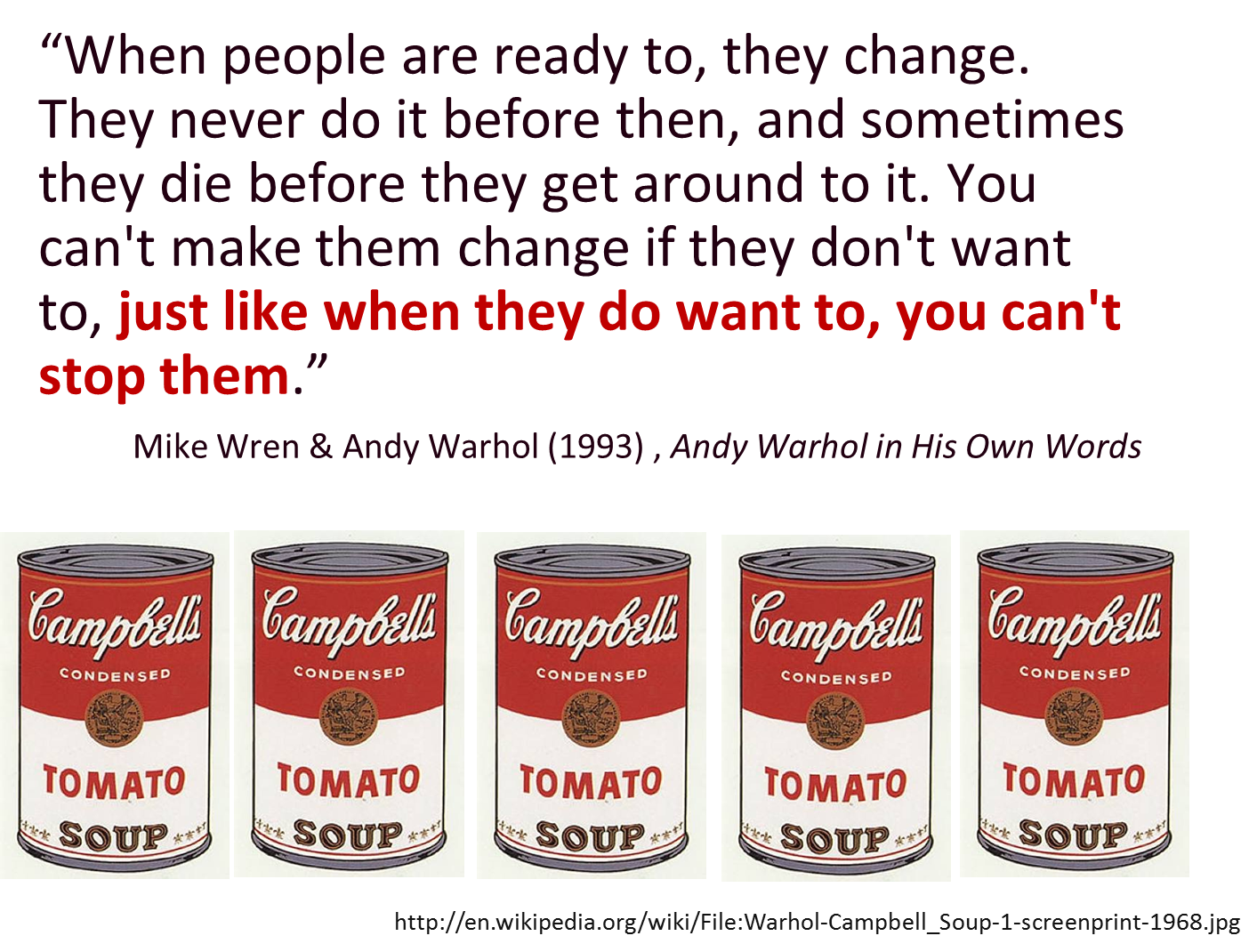
Finally, ending with a great quotation is always a nice touch. Here’s one of my favourite quotes on motivation and change:
So…what will you try out in your next presentation?

It’s not our problem – it’s the group’s problem!
Last week I had the pleasure of working with a number of seasoned group therapists around advancing their practice in group facilitation. It is a rare opportunity (and luxury) to all get together and explore what is frequently a solitary job. Busy clinics can leave little time for practitioners to reflect on and process what they do. But it is more a necessity than a luxury to reflect in and on practice (in the words of Donald Schön).
We kicked things off talking about two questions relating to group facilitation:

In other words, what are areas where things are going well, and where are you (individually and collectively) struggling or feeling challenged?
That second question in particular evoked lots of conversation, and I started to make a list. Here are some of the things that people came up with: participants who talk too much or not at all; disruptive behaviour; group engagement (lack thereof); lateness, attendance and drop-out; peoples’ diverse needs, expectations and abilities.
Then something interesting happened. The conversation started to shift to challenges like: balancing group content with process; agenda-setting; fostering trust and cohesion; appropriate disclosure; boundary-setting. The dialogue moved from focusing on participant behaviour to facilitator behaviour.
This is common in clinical supervision teams – it is so much easier to look at others’ behaviour – yet the most productive troubleshooting stems from identifying what we, ourselves, can do differently. The energy in the room changes too. Focusing on difficult client behaviour feels frustrating, hopeless and stressful. Focusing on new strategies that we can experiment with and implement feels productive and inspiring.
One of the biggest “aha” moments was how we group facilitators tend to take on all of the participants’ behavioural issues or concerns as our problem to solve. It’s kind of like the song “The Weight” by legendary roots rock group The Band: “Take a load off Fanny, take a load for free. Take a load off Fanny, and you put the load right on me!”
Addressing and dealing with stuff that comes up is really the whole group’s responsibility (and problem!). Of course, we are part of the group, but so are the participants. Asking open-ended questions and offering complex reflections about group process (not content) tends to be more productive than asserting our authority and directing traffic. In short, it’s not our job to single-handedly solve every problem that arises. It is our job to facilitate collective problem-solving and dialogue in a supportive and respectful space.
I’m thinking how closely this all maps onto classroom teaching. We’re not doing therapy in the classroom (although sometimes it can feel that way). The best teachers – like the best group therapists – demonstrate agility in creating shared accountability for positive norms and behaviours, and do so with authenticity, compassion, partnership, humour and deep acceptance.
Related

education = meta-learning + change
I’ve been looking at the 2015 NMC Horizon Report: Higher Education Edition, which charts the biggest near- and longer-term trends across the post-secondary landscape. One of the key directions is advancing highly flexible and innovative learning environments..
With change comes challenge. According to the NMC Report, post-secondary institutions will struggle with how to create these flexible, customizable and personalized learning environments (as students increasingly want and demand). Related challenges include: teaching complex thinking in the context of digital information proliferation, and addressing/resolving competing models of what higher education should/does look like.
The mainstreaming of radically student-centred learning represents a massive disruption to the traditional “broadcast” model of education (one instructor + many students). Just as one-to-many “Web 1.0” gave way to many-to-many social sharing, collaboration and self-curated content consumption (“Web 2.0”), will higher ed institutions see a similarly tectonic shift?
And yet…moving toward student-centred and customizable learning may bring us closer to education in its truest sense. Carl Rogers, the influential humanistic psychotherapist, education theorist and founder of client-centred therapy, stated:
“The only person who is educated is the one who has learned how to learn and change.”
Learning how to learn – the capacity to curate and critically reflect on new information and knowledge – is especially crucial at a time when ‘data never sleep’ (check out this infographic showing what happens during one minute on the Internet).
And, at its heart, all learning is really about change.
In other words: education = meta-learning + change.

When the kids are away, the mice will…work
It’s March Break and school’s out for the week. This week I’ll be taking a workation.
Definition
A workation ensues when your kids are away on a trip… without you (the parent). Thus permitting you to:
Example
Jack and Janet went on a trip to their grandparents’ house. They tried to paint a goat-house and made a mess. Mother and father went on a workation.


Order’s up!
Educators agree that it’s good practice to foster scaffolded learning. We want individuals and groups to incrementally build on progressively more complex and sophisticated knowledge and skills. And we typically ‘serve it up’ over a multi-week course, comprised of two or three hour classes. For several years. Higher education is the equivalent of fine gourmet dining.
At the same time, a gushing torrent of digital information makes accessing ‘just in time’ learning seem attainable in short bursts of focused content. Interest, relevance and engagement are measured by clicks and eyeballs. If higher ed is a fancy restaurant, then YouTube is fast food.
The two seem diametrically opposed, but I’m thinking that YouTube has some good lessons for teaching and learning in higher education, such as:
This last is a challenge when higher education is very much a business (see Richard Wellan’s book review: Grappling with Academic Capitalism in Canadian Universities, reflecting “the logic of commercialization and corporate models on the behavior of essentially public institutions”). Similarly, a fabulous and expensive dinner out is a luxury few can afford.
It occurs to me that lots of fancy restaurants are putting artisanal versions of ‘fast food’ basics on their menus. I wonder what my courses would look like if I were to break them apart and YouTube-ify them? (I’m not talking about MOOCs – I’m talking “wiki-MOOCs”).
Food for thought.

Artifice and performance are the enemies of engagement
I gave a talk yesterday on presentation and facilitation skills, and one of the key themes was the importance of shifting our focus away from ourselves (“Am I doing a good job?” “Do I measure up?”), and directing our attention to the needs and interests of the audience. This marks the crucial shift from performance to conversation.
Paradoxically, at the same time we also need to pay attention to being ourselves. I was struck once again by the “simple but not easy” axiom as it relates to authenticity. On one hand, what is simpler than just being who we are? But on the other hand, what is harder than offering our real, true self in front of a large (or smallish) group?
“The snow goose need not bath to make itself white.
Neither need you do anything but be yourself.” (Lao Tzu)
I’ve never seen a snow goose, but I’ve seen quite a lot of snow this winter. And up close every snow flake is unique and beautiful.
The most engaging presenters are fully focused and radically authentic.

Six ways to make your online course even more awesome
I love classroom teaching. It’s hard to beat the opportunity to connect with a group of learners face-to-face. But just as there are many ways and experiences of classroom teaching, online teaching is every bit as variable and demands some unique strategies to create engaging and transformative learning environments. Plus, anyone who has ever designed and taught an online course can attest to how time-intensive online teaching can be. How can we structure a positive and engaging course climate while also finding ways to make more efficient use of our time as faculty?
A few months ago I came across a delightful little book by artist Austin Kleon, titled Show your Work. Kleon’s basic premise is that our internal creative process can be even more helpful and engaging than the polished, finished product of our work. In that spirit, here are my top six ‘trade secrets’ of online teaching, gleaned from 12+ years as faculty for a Masters-level online social work course.

The most important things that students want to know are: what the expectations are, how to access the course, where to get help if they need it, and how they can succeed. I make a point of addressing these questions by mobilizing multiple communication channels: A detailed “Welcome” email to all registered students sent out approximately one month before the course start date; “Welcome” announcement (the first thing they’ll see when they access the course for the first time); “Welcome” post in the small group discussion forums; “Welcome” video uploaded to the course materials repository; and an outline of “Frequently Asked Questions” in the Course Syllabus itself. People access and attend to information selectively – this way I make sure that the important information cuts through the “static” of students’ other, competing priorities, and I also get fewer panicked emails and phone calls in the first weeks of the course.
Institutional Learning Management Systems tend not to be the most intuitive or visually appealing. I create folders for each week’s content, populated with the same kinds of materials in the exact same sequence:
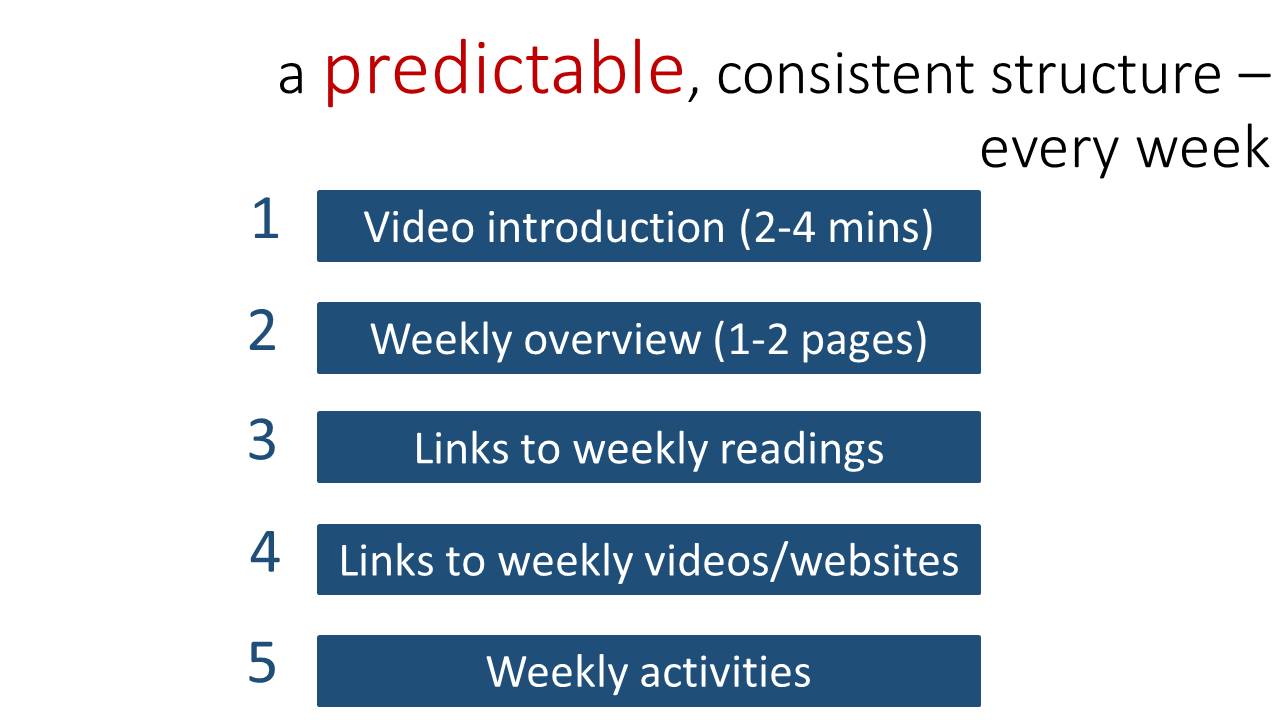
This offers a sense of continuity to the online classroom – analogous to holding a face-to-face course in the same room every week.

We live in an online culture of continuous and immersive sharing and collaboration. The trouble is, as course faculty, I’m not able to be accessible 24/7. It’s important to be explicit about how often I check in to the course (typically 6 days per week in the first two weeks of the course, and 3-4 days per week thereafter). I also let students know that I don’t always respond to emails on week ends. I do make a point of responding to emails/phone calls the same day or within 24 hours.
Even better, I ask students to share their questions in the small group discussion forums in a new thread titled “Question for Marilyn”. This accomplishes three things: (a) Other students can benefit from seeing the question and my response; (b) This cuts down on my having to respond over and over to the same question from different individuals; (c) If I only have a few minutes to dip into the course, I can quickly see questions and get to them as a first priority.
Incorporating a short video of myself at the beginning of each “class” (weekly module) helps to establish instructional immediacy, a key component of effective online teaching and learning. We’re not talking high production values, but just helping students to put a face and personality to my name helps foster a sense of connectedness and engagement.
It’s also good to mix things up and harness the rich array of web based applications and resources that are out there: videos, websites, blogs, news aggregators, and more. I also encourage students to find and share their online discoveries.

This took me a shockingly long time to figure out. I am embarrassed to say that it wasn’t until 2012 that I began to personally archive all of my postings in the group discussion forums, and I now use these as a base from which to continuously adapt and reframe year over year. Although I refresh and update the course content every year, many of the same issues, discussion points, questions and reflections come up. Having a resource archive to draw from has immeasurably enriched my own contributions to our online conversations.
This is no big secret, but paying close attention to the affective dimension is key to learning and teaching. The majority of online courses at this time are still largely text-based, so I pay special attention to the nuances and emotional tone in all of my communications with students, whether via email or in the course discussion board. I also encourage students to reach out to me by phone or video chat in real time when they get stuck or more complex issues arise.
Check out the complete slide deck here.

What does it take to be a wizard inside and outside the classroom?
1. Respond to student queries ASAP
For good or ill, people increasingly expect (and value) prompt replies to their questions or concerns, especially via email. And students seem to equate an instructor’s response time with instructor engagement and caring. A speedy reply is not always possible, and email communication can be delicate at times, but I try to live by the “24 hour or less” rule and interestingly, students make particular note of how helpful this responsiveness is to them in comments on the course evaluations.
2. Overcommunicate
Students’ lives, like ours, are complicated, busy, and sometimes chaotic. People don’t always attend to our verbal communications or instructions, and/or email, and/or written (print) communication, and/or online announcements. Similarly, the more channels that we can mobilize to share information with our students about upcoming assignments, due dates, key information or course resources, the greater the chance that our message will filter through the “white noise” of multiple, competing pressures and priorities.
3. Listen carefully
When students express an issue or concern, chances are – especially if we’ve been teaching for many years – we’ve heard it (or something very much like it) before. And we’ve also responded many times before. It’s sometimes easy to forget that for this student with this issue it might be the very first time, and every person and every situation is unique. Take the time to listen carefully with a goal of understanding.
4. Provide the back-story
I’ve found that when students feel like an assignment, an academic decision, a policy, or a course expectation is unfair or unwelcome, it’s usually because they’re not satisfied that there is a good rationale behind it. The trick is, how to communicate this without coming across as defensive, or worse, officious? I’ve found that the elicit-provide-elicit framework in Motivational Interviewing has been helpful in providing information to students: (a) elicit the student’s understanding of why they think I am proceeding in a certain way; (b) provide a brief explanation from my perspective; (c) elicit the student’s response (“What do you make of that? How does this fit for you?”).
5. Get excited
Everything in the world is inherently interesting. And everything in the world can be made incredibly boring. If I’m passionate about what I’m teaching, chances are some of that will rub off.
6. Don’t work harder than your students
Learning is active. It takes effort, involvement and application. If I’m at the front of the room lecturing and the group is passively listening, who’s working harder? It’s a challenge to create dynamic learning activities that engage students in co-constructing meaning, wrestling with new ideas, and trying out new skills. Admittedly, high quality curriculum design generally takes more work at the front end – so perhaps it’s more accurate to say “Don’t work harder than your students in the classroom”.
And yes, highly effective teachers have more than these six habits – but they’re a pretty good place to start.

We all go to school. Every day.
Tuition costs are highly variable, and sometimes paid a long time after.
Our teachers are many.
We’re teachers too.
Where is your classroom today?

No one likes to feel incompetent, but how else can we learn?
Last week I had a conversation with a student (not one of mine) who approached me because she was struggling with an essay she had to write. The obvious question is “Why not go to your instructor to talk about this?” In response, she described how the author’s key points in the literary theory text that she was referencing were hard to grasp, and raised more questions than they answered. The material was so challenging that she was having trouble even framing clear questions. Because she prided herself on being a bright and engaged student, she felt like her inability to wrap her mind around this complex and highly abstract material would colour her instructor’s regard for her abilities. In other words, she valued his positive approval and she didn’t want him to conclude that maybe she wasn’t that smart after all.
Are you thinking “high achiever”?!
In the midst of our discussion two things became apparent:
1. Whether as instructors, managers or supervisors, we invariably tell students/staff/clinicians to come to us when they’re in difficulty. I’m certain that the instructor in this case told his students on numerous occasions that he’d be glad to connect with them outside of class.
2. What we don’t always do is lay the groundwork to make it possible for others to come to us with their questions, concerns or issues. This example made me wonder…what more could the instructor have added to create a climate in which students felt 100% safe to risk looking foolish, clueless, unthinking (and all of the other labels we often apply to ourselves when we’re in the weeds). And what more could I be doing in this area?
It’s a human trait to want others to think well of us. Yet paradoxically, it’s hard to advance our knowledge and skills without venturing into the realm of not-knowing. Our willingness to shine a light on our weaknesses or knowledge/skill gaps might just be the biggest determinant of success!
The next time I hear myself say, “Please feel free to come to me with any questions that you have”, I’m going to add something along the lines of:
“It can be hard to shine a light on things you’re not so good at, but how else do you get good at them? If you’re feeling less-than-competent that’s fantastic – it means you’re learning! What can I do to make you feel totally at ease approaching me?”
Of course, creating a climate of mutual trust takes more than a couple of sentences – it’s a way of being, communicating unconditional positive regard and respect. But making a point to explicitly affirm the value of positive risk-taking might help tip the balance when others are struggling.
Now back to the student – as she talked more about her ideas and interpretations of what she had been reading, she was able to answer most of her own questions. And then I shared my own learning (see above) with her.
Another good lesson: we all possess a powerful innate wisdom. And we all benefit when a caring other takes the time to evoke it.

What do I want to be when I grow up? For a large proportion of high school students, now is when that question gets real.
Which program? Which college or university? What are the admission requirements and will my grades be good enough? Applying to undergraduate and graduate degree or diploma programs can be stressful, especially the dreaded “Personal Statement” in which applicants must respond to a series of questions in 3000 characters or less.
For example:
What makes a good citizen?
How will you make the best of your experience at this institution?
What are your future career plans and aspirations?
These are big questions, and it can be daunting to frame a concise, compelling and well-written response. Yet the Personal Statement is a golden opportunity to differentiate oneself from the rest of the pack. Here are some ‘best practice’ tips to get you started.
The 3 steps to success in school (and life)
Student tips: How to get good grades

The spirit and skills of Motivational Interviewing (MI) can transform even the most delicate email conversations
Responding to email can be tricky at the best of times, and when emotions run high email is downright perilous. We’re all aware of the email best practice to “sleep on it” before hitting send, and/or to just pick up the phone and step out of the email conversation altogether. But what if we have to respond the same day? And what if we can’t reach the person by phone or want to document our response?
Enter Motivational Interviewing (MI) as a guide and model of good practice in email communication.
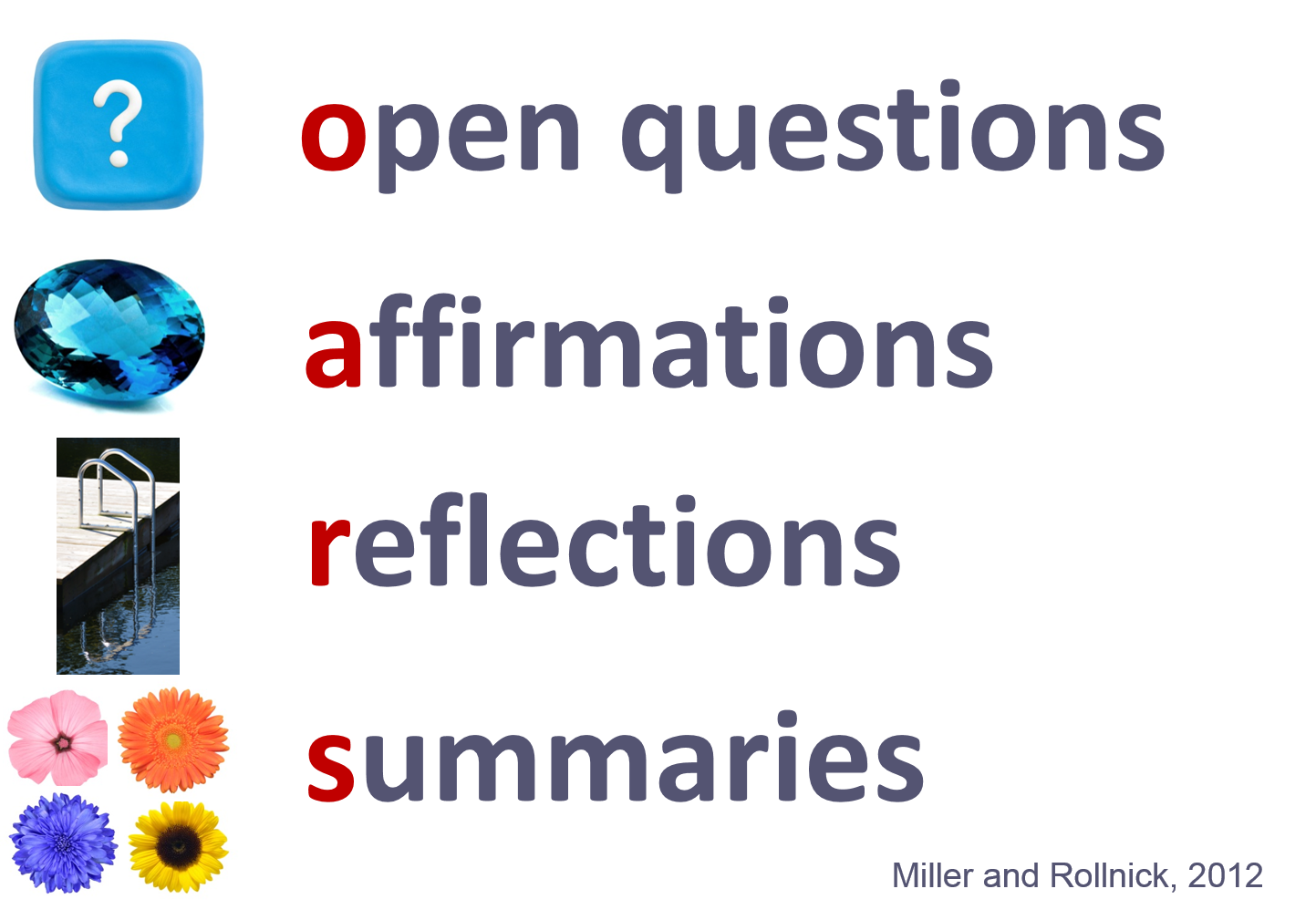
In responding to delicate or difficult emails, I try to employ the four core MI strategies (remember them with the acronym O A R S):
In addition, we know that the skills of MI fall flat in the absence of MI “spirit::

Say you receive an email in which the writer is clearly frustrated, and the tone is somewhat hostile and accusatory. Start with a modified affirmation/ reflection:
“I appreciate that you have been trying hard to get results, and it sounds like this has been a very frustrating process.”
Just the act of affirming the person’s efforts and accurately reflecting the feelings or experience helps the person to feel heard and acknowledged. This, in and of itself, can help to de-escalate the situation and starts to move the conversation in a positive trajectory. It sounds simple, but it’s not always easy when we want to reflexively put forward our response/justification/rejoinder.
Open questions can be used to evoke a constructive response and generate collaborative solutions:
“You raise an important – and difficult – issue, and it would be great to hear your thoughts about how we can best resolve this. What might be some ideal next steps?”
Of course, it might be appropriate to provide information and suggested solutions proactively, but my past experience is that when we jump to solutions too quickly, without first really hearing and acknowledging the person and evoking their preferred outcomes, our tone via email can come across as defensive or even abrupt (the “righting reflex”). If you do want or need to offer suggestions/solutions, an MI adaptation is to preface these with a caveat that affirms the individual’s autonomy:
“I’m not sure if this is the solution that you are looking for, but we could try…”
“I’d like to suggest some ideas, and I’m eager to hear your thoughts as to whether they are in line with what you are hoping to achieve…”
“This may not fit with what you have in mind, but is it worth exploring…”
Hmmm…sounds good (you say) but who has the time?! It’s true that thoughtfully responding to email with compassion and unconditional acceptance, and using the foundation skills of MI, might slow us down in the short-term. But in the big picture it actually ends up saving us time. Adopting an “MI approach to email” fosters good will, communicates mutual respect, and preserves the relationship.

A conceptual framework for SoTL offers a map to knowing, valuing and acting
The scholarship of teaching and learning (SoTL), is, by definition, public versus private, susceptible to peer review and critique, and can be built upon by others (Charbonneau, 2010). But what does SoTL look like? What’s the “roadmap”? A conceptual framework can illuminate and guide how we frame and understand academic scholarship in the context of 21st Century post-secondary teaching and learning.
I’ve been thinking about an integrated framework that incorporates SoTL knowledge, learning and growth, as well as ways of knowing, valuing and acting as academic teachers, learners and scholars. Two recent models seem complementary and enrich one-another when viewed in combination: Randall et al. (2013) focusing on overlapping and dynamic elements of teaching and learning scholarship, and Kereliuk et al. (2013) with a slightly broader conceptualization of 21st Century teacher knowledge.

Randall’s original framework represents three overlapping and dynamic elements of teaching and learning scholarship: (1) knowledge of scholarly teaching; (2) learning about one’s teaching; and (3) growth in SoTL. The three domains are represented in a Venn diagram, with points where the domains intersect/overlap. For example, where (1) knowledge of scholarly teaching meets (2) learning about one’s teaching, we see enhanced faculty engagement and motivation. Where (2) learning about one’s teaching meets (3) growth in SoTL we see increased commitment and professional academic/scholarly identity. Where (3) growth in SoTL meets (1) knowledge of scholarly teaching we see concrete SoTL performance and/or action. Finally, the central convergence point of all three domains represents SoTL transformation.
In the integrated model, foundation knowledge (such as teaching skills and digital, research and cross-disciplinary literacies) maps onto the domain of scholarly teaching broadly. Humanistic knowledge (which includes ethical/emotional awareness and diversity competence) corresponds to and enriches the domain of learning about one’s teaching. Finally, meta knowledge (such as creativity and innovation, problem solving and critical reflection, and communication and collaboration across disciplines) relates to faculty growth in SoTL.
I like how, when integrated, this framework affirms multiple and diverse ways of knowing and being.
With all that said, no roadmap is perfect – any GPS user who has been misdirected by the computer navigation guide will attest to that. We are continuously mapping and remapping physical and geographic terrains, and the same holds true for conceptual mapping of the terrains of knowledge, development and application.
A work in progress, like life itself, and our individual and collective learning journeys.

Why is it sometimes so hard to accept the personal agency of others?
Yesterday’s continuing professional education workshop on Motivational Interviewing was an absolute joy. Just me and 10 practitioners in an intensive clinical day of exploration, engaged practice and critical reflection.
One of the ideas that we kept circling back to was autonomy. It can be incredibly challenging for clinicians in the health and counselling fields to sustain absolute, nonjudgemental acceptance and collaboration when individuals engage in damaging or destructive behaviours/choices. And everyone agrees that a fundamental component of any health provider’s role is to facilitate change. So we have a bit of a paradox:
(a) On the one hand, we are here to support and facilitate clients’ change in positive directions.
(b) On the other hand, we come to the interaction with radical acceptance of clients’ autonomy, control and decision-making. This acceptance is integral to the ‘spirit’ of Motivational Interviewing, coupled with a deep compassion for what it is to see the world through another’s eyes.
Simple but not easy, when we care so much. When we want to make it right and lessen the suffering. When we just want to be helpful. If only this person would listen, things would improve!
I have found that the heavy work is generally not related to facilitating change. The really hard part is continuing to come alongside a person when he or she is not ready or willing to change. And hearing ourselves say, out loud, to that individual: “It really is your choice. You are the one who has to decide this.”
People are most able to change when they feel free not to.
Related:
 educateria
