sticky buns


One of the axioms about great presentation skills is to “make it sticky”


Sounds good, but how? Here are four of tried-and-true strategies (the “application” part is how I say it – you can adapt to your style!).


1. Get people talking

People remember most of what they say, versus what the presenter says

Application: “Take 3 minutes, turn to the person next to you and share one thing that stands out so far”


2. Evoke disagreement

Critical analysis often means criticism – ideas don’t stick if a person hasn’t had a chance to integrate within existing knowledge, assumptions, worldview

Application: “Write down one concern, question or skeptical comment or idea about what I’ve been saying”


3. Initiate a “Teach Back”

No matter how much knowledge/skills/expertise I might have started with, anything I’ve ever had to teach forced me to learn more deeply.

Application: “Find someone you haven’t spoken to yet and teach them ___ (concept, skill, approach, etc.)


4. Bridge the Gap

Don’t be afraid to assign homework.

Application: “Before you go to sleep tonight, write down three things that you are going to practice or do differently based on the work we’ve done here today…and put them on your computer screen/refrigerator/other.”


Last week I was asked to facilitate a workshop for a diverse group of community health and counselling providers. The organizers asked for an outline of the proposed session as well as an overview of a subsequent follow-up session to help ensure uptake and implementation. In other words, why invest in staff training if there’s no traction over the longer term?


The research/education/practice gap is undeniably tough to bridge, and follow-up coaching and training certainly helps increase adoption and skill development. But in my mind, every presentation is an important opportunity to foster motivation for change – with or without follow-up.

DSC_0149

DSC_0024

pumpkins truck

DSC_0111

DSC_0017


Related post

A Hallowe’en Tale for Educators

What’s not to like about putting on a costume and knocking on strangers’ doors for free candy?

hallway


A simple shift in perspective can transform dialogue and engagement


Today I got to shake hands with over 300 students. No, it wasn’t convocation – it was kind of the opposite of convocation. It was…the annual College Information Fair.

That’s when hundreds of (mostly) high school students pour into a massive convention centre by the busload, and let loose on aisles of kiosks and pavilions, each promoting specific academic institutions and programs. Some students were 100% clear about their post-secondary journeys, some expressed uncertainty about which school to attend. Others candidly acknowledged that they didn’t have a glimmer of an idea about where they wanted to head after high school. Some were leaning toward a program that wasn’t going to get them to their ultimate career destination, and many were just there to hang out with friends and pick up some free swag.

Last year I approached my role with the primary objective of offering information about the academic programs that I administer. This year, I decided to try a slightly different approach, more in line with motivational interviewing, where the goal is to evoke versus educate. In other words, instead of asking potential students “How can I help you?” / “What would you like to know?”, I opened the conversation with a couple of questions designed to briefly elicit each person’s “big picture” goals before honing in on the specifics of a particular program of study.

Instead of… I asked…
How can I help you? What programs are you interested in?
What would you like to know about Program X? What made you decide that you’re interested in Program X?
What other questions can I help with? Where do you see yourself in terms of your ultimate goal or career?
Here’s some additional information… Can I share how Program X (and/or Y and/or Z) might fit with your goals?

The results were amazing. Because many teenagers aren’t the most voluble conversationalists, our interactions were brief but much more meaningful than the conversations that I held last year. Students were engaged, they felt heard and affirmed, and for many who were unsure about their future, a couple of follow-up questions (“What kinds of courses in high school captured your interest most?” “If you could have any job, what would it be?”) helped them to clarify some possible directions. I also heard some amazing stories and made deeper connections.

And from a purely selfish perspective, at the end of the day I too felt energized. I felt like I contributed more than what’s written in the academic calendar!


welcome woodburned


Learning is up to the learner, but teaching is up to the teacher


It’s one thing to teach, and quite another to learn. Learning is up to the learner, not the teacher. Just like the old saying: “You can lead a horse to water, but you can’t make him drink.”

But…here’s the thing: You can make him thirsty!

So the question is, how do we create environments that make learners “thirsty”? In other words, how can we foster learner engagement? Herewith, my personal Top 10. Some are prosaic and some can be incredibly challenging. And that’s a good thing, because we are all learners and we’re all teachers.

1. Start as you mean to go on: Begin every workshop, class, course, etc. with a question. Establishing right at the outset that our learning journey will be collective and collaborative is key, and especially early on I make a point of explicitly praising and otherwise rewarding any and all signs of positive engagement on the part of individuals/groups.

2. Incentivize participation: We want learners to take risks and make mistakes. When a person volunteers for something high risk, reinforce the desired behaviour. I don’t advertise it ahead of time, but whoever comes to the front of the room to do a role play with me is going to go back to his or her seat with some small token. It doesn’t even really matter what it is (think $ store).

3. Provide normative feedback: Using in-class mobile polling or an audience response system (like iClickers) lets learners compare their own knowledge/opinions/beliefs/assumptions with others in the room.

4. Establish relevance: Learners what to know “what’s in it for me?” Creating learning activities that help people bridge curricula to their own lives = good. Co-constructing learning activities that address/solve real-world problems = better.

5. Show your sense of humour: It’s hard to be serious all the time. Make it fun and mix it up! Shared laughter builds group cohesion.

6. Affirm autonomy: Let’s face it. Some days we are more fired up than others about our life’s work, and it’s no different for our students. When individuals or groups just don’t seem to be getting on board, I find that stating out loud (with 100% sincerity and with 0% judgement) that how/when/if folks engage is entirely their choice seems to free up some good energy for engagement.

7. Deploy multiple “engagement channels”: Individuals come to learning environments with a range of different learning preferences and a range of preferred ways of participating and engaging. Some people like the limelight, others need time to process and formulate a thoughtful response, and many are more comfortable sharing in a smaller group. The more choices we can offer about how to participate the better, including: verbal/written, large group/small group, synchronous/asynchronous, classroom-based/online, and more.

8. Evoke affect:  Research about emotion (affect), memory, and implications for learning suggest that teaching needs to go beyond engaging at a purely intellectual (cognitive) level, and touch peoples’ feelings (for example, Sylwester, 1994; and more recent perspectives that encompass academic technology and affective/cognitive learning, Calvo & D’Mello, 2011). Create learning activities that pair new knowledge and skills acquisition with positive affect, like surprise, delight, excitement, curiosity for deeper and more durable learning.

9. Show them you care: Authentic care and concern can go far in building good will and fostering mutual respect and support for one another’s learning and achievement.

10. And last but not least – know when to break the rules (and go ahead and break them). Like the time I called it a day and took the group shopping. 


Related articles

Five Reasons why Reality TV is not a Waste of Time: How reality TV can inform teaching best practices

Seven Essentials for 21st Century Education and Teaching: Stuff it took me 20 years to learn and I’m still trying to figure out

Rules of Engagement: The “Top 4” preconditions for learner engagement


large pink flower


What’s the difference between education and learning?


“Education is what others do to you. Learning is what you do to yourself.”


Amy J.C. Cuddy


cogs and wheels

It’s often good to follow your own advice

Last Friday I presented to a group of health practitioners (registered dietitians) at their annual conference. The topic was “presentation skills” – an important element of their professional practice, as dietitians frequently work with various client goups experiencing complex and challenging health conditions. They are not just presenting information. It’s more about inspiring and motivating health behaviour change when the stakes are high.

I have always found that ‘presenting about presenting’ poses a particular set of mental challenges. Audience expectations are generally higher than the norm and my expectations of myself are correspondingly escalated. I have to keep reminding myself of the axiom that any presentation needs to feel more like a conversation than a performance. That means focusing on the audience’s learning needs, goals, and practice challenges, as opposed to my own ‘performance’.

And mirroring the dietitians’ clinical practice with groups, the information that I shared was nowhere near the most important part. (There’s a whole library of books written on presenting and facilitating, covering more content and in greater depth than any 45 minute talk could ever do justice to.) Sparking some lively critical reflection and dialogue (internal and external) about the pitfalls and best practices for us all to pay attention to when presenting to groups was the most meaningful part of the session.

It’s often effective to follow one’s own advice, and happily I was able to come reasonably close to putting into practice the four themes of my session:

1. Stop performing

2. Engage everyone

3. Transform your slides

4. Make it sticky.

OK, maybe I didn’t engage absolutely everyone – but on my way out of the room the A/V guy did give a big thumbs-up, and let’s just say that hasn’t been a uniform experience. I say, gather your nuggets where you find them!

acorn in forest


what if collage


Learning how to learn and deciding how to decide


We are all lifelong learners, and this has got me thinking about the learning that occurs outside of formal, post-secondary classrooms via the series of decisions, big and small, that comprise each person’s life path. In clinical/professional practice, critical judgment and decision-making are key, and we get to hone these skills every day in the multiplicity of choices that we are continuously called to make.

Sometimes the implications and outcomes of making one choice over another are clear; but a lot of the time there’s mighty thick cloud cover. On those occasions I have found myself wishing for a crystal ball to foresee the results of a specific decision before I decide. And maybe some future convergence of digital technology and computing (“the singularity”) will offer an uber-intelligent clarity and vision to better inform which direction to take. But at this time we pretty much weigh our options and just do the best we can.

psychic advisor sign


So, I’ve been wondering…is life’s learning trajectory essentially based on how we navigate through our own individual series of crossroads? For example…


We have to make many decisions without benefit of much experience or perspective to guide us:

Which high school? What’s after that? What’s my career path? How do I approach parenting? Do I choose to be a parent?


Some decisions are made either by default (inertia, status quo), or because we are willing to take a chance and leap into the unknown:

Start a relationship or end the relationship? Take the job or leave the job? Stick close to home or move to a whole new place?


Some decisions can be heartbreaking, and represent a lack of positive choices at all:

Do I pay the rent or feed the kids? Support the family or get an education?


And many crossroads test our own moral compass and integrity:

Should I speak out or follow the pack? Stand up and take action or do nothing?


crossroads house


The chaotic complexity of an individual’s inward/outward subjective experience and learning is never still. Each person’s journey accretes a unique composition and form. And every decision point at every crossroads iteratively informs the ones still to come.

Through this lens, effectively teaching professional decision-making might rest on our ability to come alongside learners, and link our vast, collective landscape of lifelong learning with discrete and situational reflective practice. In other words, the ultimate “meta crossroads” are learning how to learn and deciding how to decide. Over and over. Each and every day.


tree reflection in puddle

Toy Bucket Blue


Nine things I’ve always wanted to do and haven’t gotten around to yet


The first week of classes always feels like a fresh start. Just as students are wondering about what lies ahead in order to accomplish their dreams and aspirations, I am feeling inspired to consider some of my own outstanding “to-do” items. Here are some of the things on my Bucket List – not all are related to teaching, but all relate to learning, and in my mind that is as it should be.


1. Be inspired attending a TED Talk (in person)

Clouds blue sky


2. Take a chance and enter a poetry contest

someplace better woodburning


3. Join thousands of other students and enroll in a MOOC

DSC_0002


4. Step outside my comfort zone and teach a MOOC

Big ladder sky


5. Witness the drama of dining at Hell’s Kitchen

DSC_0005


6. Mine life’s experiences and write a novel

blue metal door


7. Eat perfect, delicious sushi in Tokyo, Japan

DSC_0076


8. Enter a whole new world at Burning Man


wooden beaver carving on woodpile


9. Hear stories of the sea on a cargo ship across the ocean

rusty ladder rail water


Our time here is precious and finite. What’s on your bucket list?


BG padlock closeup


Finding beauty all around you


In a previous post (PowerPoint Design Best Practice) I discussed my #1 tip for creating beautiful and compelling presentation slides:

PPT Essential Design Principle


Just one problem – where to find fabulous backgrounds and images? Although there are lots of “free” image sites online, I have found that many of these tend to be over-used and/or not what I’m looking for. Stock images are a great option and alternative, but subscriptions can be costly.

Believe it or not, you don’t have to be a professional photographer to create your own gorgeous images. Composing and capturing the “perfect shot” is far from easy, but there is great beauty in the tiny details that surround us every day. Here are some examples of pictures I’ve taken that I can’t wait to use in future presentations. The extreme close-up strategy makes it easy even for rank amateurs like me to create my own image stock with a borrowed camera during a morning walk.


Slide1


Slide2


Slide3


Slide4


Slide5


Slide6


Slide7


squirrel ornament


3 + 3 ‘Dos and Don’ts’ for Slideware Best Practices (plus a bonus tip)


Text-heavy slides + presenter’s commentary = missed opportunity. That’s because audiences experience “channel interference” when they’re confronted with text on a screen in tandem with spoken commentary. It’s challenging to both read and listen at the same time. (Like, for example, Saturday morning when you’re immersed in the weekend paper and significant other wants to chat.)

Even worse is reading the text directly from your slides, because people can read silently faster than you can read out loud (plus that announces to the audience that you are actually redundant, assuming that they can read your slides for themselves). On the other hand, seeing an image plus listening to a person speak does not create this channel interference, and engages us both visually and aurally.


In a nutshell, here are my 3 + 3 key ‘Dos and Don’ts’ for Slideware Best Practices:

DO break up complex diagrams and visual illustrations into “chunks” offered over a series of slides, and/or provide a handout of the entire image.

DO use an image scaled to cover the whole slide, perhaps accompanied by minimal text (or just a single word or phrase).

DO proofread your slides. Then go back and proofread them again.

DON’T put the content of your talk on your slides. That’s what handouts are for.

DON’T use PowerPoint templates and clip art. These look retro – and not in a good way.

DON’T use text animations. Unless you are a creative director for an ad agency with a big budget, and even then think twice.


Bonus tip: If you ever hear yourself apologizing for any [easily preventable] part of your presentation (for example, slides unreadable from the back of the room, random typos, content on a slide that you don’t really understand), chalk it up to presentation karma…and gather these nuggets of feedback for your cache of hard-earned wisdom.


Slide7


Be yourself, only better


The term present connotes giving a performance, with all of the formality and pomp that implies. But it can also mean being present; in other words, being our true and authentic selves in each moment with the group.

“The most precious gift that we can offer is our presence.” –Thich Nhat Hanh

Henderson and Henderson (2007) argue that the most effective presenters engage the audience in ways that feel like a one-on-one conversation. The qualities of a performance versus a conversation are summarized in the diagram below:


Slide11


Some strategies include:

  • Making eye contact that encompasses all sections of the audience (left to right, front to back).
  • Exercising self-awareness with respect to what makes you unique, appealing and enjoyable to be with? Leverage these qualities in your presentation style.
  • Intentionally modulating your vocal tone and phrasing consistent with a conversational approach.
  • Carefully considering the audience, including their needs, wisdom and experience (individually and collectively).

Of course, I don’t deny that presenting is different from a casual conversation. There is formality, gravity and hierarchy to it (as in the diagram above). But the more we see of you – the real you – the better. We’re most engaged when we can identify with the other person (even just a little). When their experiences connect to ours.

Sure, we’re all special, but we’re also all human. It’s a bit of a paradox: The more you express your unique and unreproducable humanness, the more universally engaging you are as a presenter. Easier said than done (especially when performance anxiety is a kind of enemy of authenticity – check out 5 tips for Coping with Stage Fright).

But there it is: that’s the journey!


relaxing


We all need time to recharge our batteries


Summer is my time to pause, reflect and recharge my batteries. Long days, swimming in a cool clean lake, the smell outside after a thunderstorm, open windows. Even the email traffic slows down a notch.

Last weekend, on an early morning walk by the water, I found a red plastic bucket half full, with a few sluggish minnows and two crayfish. I am really sorry children who must have spent hours the day before catching them in your nets. I set them free.


Summer feels like freedom.

Motivational Interviewing Change or No Change


Motivational interviewing is a form of collaborative conversation for strengthening a person’s own motivation and commitment to change.


In a recent workshop I presented on Motivational Interviewing (originated by Dr. William Miller and Dr. Stephen Rollnick), the audience of interprofessional clinical practitioners came with varying degrees of familiarity with this well-established and evidence-based practice model. Below is a short summary of the essentials, with links for further reading, exploration and video examples. Start with this short interview with Dr. Miller, offering an overview of the background and basics of Motivational Interviewing.


The Righting Reflex


The “righting reflex” happens when we are triggered to want to “fix it” for the person…and tends to evoke a “Yes, but…” response from the person we are trying to motivate. As soon as we hear a person respond “Yes, but…”, that is feedback that we have likely slipped into the righting reflex.


Motivational Interviewing Spirit


Motivational Interviewing Spirit


The spirit of Motivational Interviewing (compassion, acceptance, partnership, evocation) is even more important than the specific skills (Open questions, Affirmations, Reflective listening, Summary statements – OARS). The ‘spirit’ is the essential foundation from which we practice.


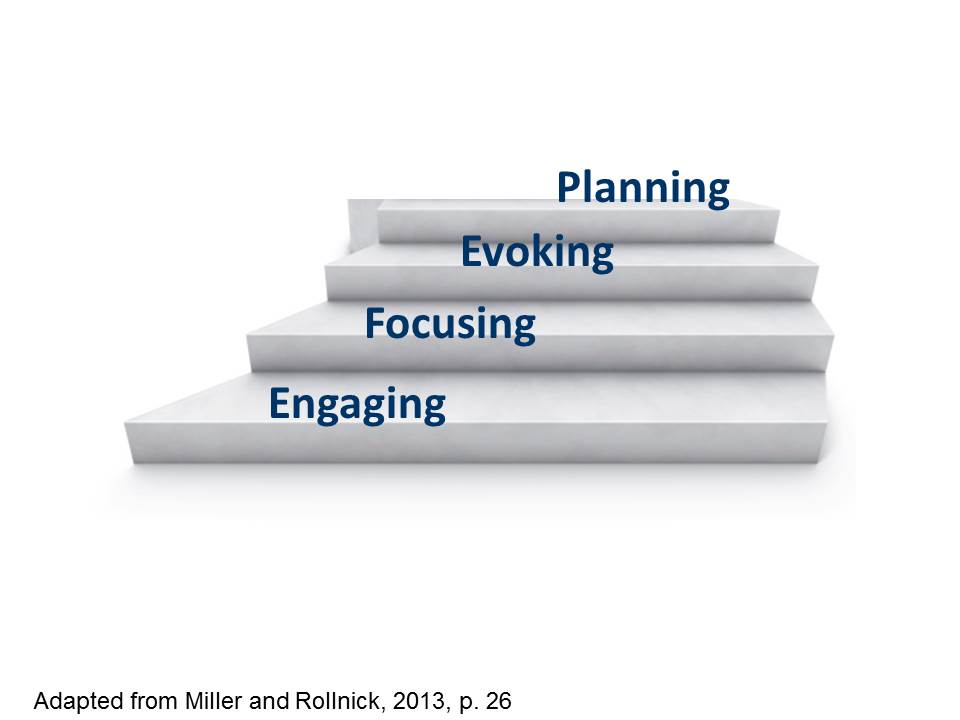
Four Motivational Interviewing Processes


Slide1


There are Four Processes in Motivational Interviewing. They are not all necessarily sequential or linear, and we may need to jump backwards and forwards depending on where the person is at.


1. The process starts with engaging: without engagement there can be nothing

2. Motivational Interviewing is directional (as opposed to directive), with a trajectory toward a common goal (with engagement comes the process of focusing)

3. Once we identify and agree on a goal with the person, we move to the process of evoking change talk to enhance motivation for change

4. Commitment language signals a person’s readiness for the process of planning key strategies and supports to mobilize change

Note that these processes are not linear – we are continuously moving between processes as we stay alongside the person we are working with.


Foundation Skills of Motivational Interviewing: OARS

There are four foundation skills in Motivational Interviewing. The OARS skills are used in different ways throughout the processes of Motivational Interviewing. Caution: these skills are simple but not easy!

1. Open questions help us to get to know the whole person – closed questions gather focused information

2. Affirmations offer a neutral observation of a person’s strengths, resources, efforts, values – and statements of affirmation are more motivational than praise

3. Reflective listening communicates understanding and attention. Complex reflections aren’t complicated – shorter can be better!

4. Summary statements offer an opportunity to gather together diverse aspects of a problem, issue or conversational journey, and can also link back to previous material or ideas, and/or further exploration and dialogue.


Here are some of my favourite “Motivational Interviewing Axioms”:


“People are most able to change when they feel free not to” (affirm autonomy)


“You have two ears and one mouth. Use them in that ratio” (listen to understand)


“People only change when the pain of change is less than the pain of staying the same” (working with ambivalence)


“I learn what I believe as I hear myself speak” (evoke change talk)


Guilford Press offers the definitive series of Motivational Interviewing ‘textbooks’ across a range of clinical practice populations, disciplines and target areas.


Motivational Interviewing Tip Sheet


Click here for a one-page Motivational Interviewing Tip Sheet


Click here for video examples of Motivational Interviewing


speech bubble social media


Fostering instructional immediacy in online classrooms


How can we create online learning environments that are as dynamic, collaborative and successful as the best face-to-face classrooms? Is it even possible? My own experience in online graduate teaching over the past 12 years suggests an emphatic “yes”. Or, should I say, an emphatic “yes, but…”.


Just as there are multiple and diverse classroom-based teaching approaches (some more successful than others in engaging learners and mobilizing knowledge transfer), there are as many ways and means of online instructional approaches. All students, regardless of the learning platform, engage best when they experience high instructional immediacy. That is, a sense of warmth, caring, support and positive regard in the learning environment.


A recent book focused on online teaching in the health professions (Melrose, Park & Berry, 2013) offers tips on creating and maintaining instructional immediacy in online settings, and it’s validating to see many of my own approaches and strategies reflected.


Here are 10 tips for how online instructors can project warmth and likeability (instructional immediacy):


1. Post a positive and supportive welcome message to greet students the first time they log into the course and each week thereafter


2. Share online bios (pictures are a bonus) (students and instructor)


3. Create smaller sub-groups for online discussion and reflection on course materials and assignments (8-10 students is optimal in my experience)


4. Include short (< 5 minutes) videos introducing course topics and offering tips and key learning to personalize each week’s focus


5. Assign “learning buddies” among students in the course to structure collaboration and collegiality


6. Have early and ongoing online conversations about process (versus course content)

What is it like to be in this course?

What are you looking forward to, and what is one thing you are concerned about?

How can we challenge each-other in ways that foster debate and dialogue but still feels respectful and affirming?

How can I (instructor) help maximize your learning and value from this course?


7. Set clear expectations in the Course Syllabus about online participation (my expectation of students is at least one original post per week, and at least two replies to other students’ posts per week)


8. Offer targeted encouragement at points in the course where motivation may be flagging (e.g., right after Reading Week, towards the final weeks of the course)


9. Use intentional word choices in online communication with students:

 

 Thumbs down  Thumbs up
The focus of this course is… Our course will focus on…
You will be required to… We’ll be working together to accomplish…
Students’ feedback has indicated… The conversation in our group this week has highlighted…


10. End the course with an explicit call to action – How does the learning in this course fit into the bigger picture of students’ learning trajectories and career goals? (here’s an example)


Student course evaluations attest to the possibility of online learning as a fun, rigorous and enriching alternative to face-to-face contact. Here are some representative student comments from the course evaluations for the 2014 online course I taught, both positive and negative (but comments overwhelmingly slanted toward the positive):

The instruction was very clear and very intellectually stimulating. The video clips were very well presented and made the instruction seem not virtual at all.

I enjoyed the online format of the course. I feel the online discussion help my learning and I benefit more from these discussions than in-class ones.

I really didn’t like the fact this course is online. I feel that I could have learned a lot more by having a classroom environment and participating through talking instead of writing
weekly reflections just because I had to.

Excellent, the most involved and interactive online course I have ever taken. I felt very engaged and connected to the instructor, students and material.


As students increasingly orient themselves to rich digital communication and sharing, this teaching/learning platform is aligned with what our students are already doing in their day-to-day lives. Not every student, but lots of our students.


Related:

Much ado about online learning

The three most important tips for teaching online

6 tips for facilitating webinars 



airplane wing 2


You’ve earned more than a piece of paper


Convocation ceremonies are always inspiring, and today’s was no exception. Many students opt to forego the pomp and speeches. But graduation represents an important transition, and one worth celebrating.

big time. Most things of value do. The financial costs are considerable, and so are the sacrifices along the way: family, free time, hobbies and interests, early mornings and late nights. And at the end of this particular journey comes the deep satisfaction of a thing completed.

There is always the next mountain to climb, but while all those other names are called out, after you’ve walked across the stage and shaken lots of hands, it’s a nice place to sit for awhile and enjoy the view. You’ve earned it.