educateria server


The third type of digital divide and why mobile devices should remain on


Much has been written about the digital divide. And we are now seeing research and publications focused on the “second-level digital divide” as mobile devices become increasingly ubiquitous. Now we’re talking about the structural inequities among not just who has digital access, but rather, the kinds of access and digital access skills.


In addition, the pervasiveness of mobile computing means that North American post-secondary classrooms are increasingly a site for a third kind of digital divide: between instructors struggling to wrest students’ attention away from their mobile devices, and students as tied to said devices as day traders to the Nasdaq. Maybe it doesn’t have to be one or the other: mobile computing can add value to any classroom.


Here are seven ways to leverage mobile capacity from the very first class.


1. Ice Breaker: App Show and Tell

People love apps (estimates for 2013 range from somewhere between 54 – 86 billion downloads). Ask students to stand up, mingle around, and query someone they haven’t met “What’s your favourite app and why?” What are the most popular apps represented in your class? What does this say about commonalities and differences?

2. Course Playlist

Playlists are the contemporary equivalent of mixtapes. What song(s) symbolize the themes of this course? Put together a collaborative playlist. Play a song at the beginning and end of every class.

3. In-ClassTwitterchat

Individual reflective activities are regarded as productive and constructive. Why not take 10 minutes and move the conversation into the social-digital realm? #yourcoursename


4. Open-search-engine pre-test

Mobile devices are banished from final exams – rightly so. Yet the skill of locating credible information efficiently is essential in any profession. Invite students to preview a modified final exam at the beginning of the course using their mobile devices to access information (they can work in pairs if not everyone has an Internet-enabled search engine on their phone). Extra points for the instructor if the pre-test is designed more for critical understanding/analysis than fact-memorization. Optimally, students will directly experience why attending class is a value-add over just reading the text.


5. Innovation and Entrepreneurship

Collectively develop an innovative idea based on the course content, or identify a community project or cause, and work with them to secure funding. Try to fund development using crowd-sourced micro finance (such as Kickstarter).


6. Social Justice

Identify a cause and create an online petition. Or locate, critique, endorse petitions. Reflect on the challenge of consensus building, ethics, values, decision-making.


7. Collaborative Learning Assessment

Invite students to collaboratively co-create the final exam throughout the course using a mobile test-maker application.


All of the above strategies are aimed at addressing classroom engagement and leveraging the reality that students will bring and access their mobile devices, whether sanctioned or not. But most important, these strategies can address the skills gaps identified in the concept of second-level digital divide. And do so in the spirit of new and emerging teaching and learning frameworks:

Paragogy and heutagogy.

(Also on Slideshare)


DSC_0084


A small investment that can add big value to your training or workshop


People attend courses and workshops for a variety of reasons: some are there to learn, some are forced to attend, and others are curious-but-skeptical. Yet whatever the reason, how can we add value in the form of creating a compelling and memorable experience? An experience that effectively reaches beyond the workshop into the “real world” inhabited by our learners?

An obvious way to help bridge the learning-practice gap is to offer a package of professional, relevant and well-designed handouts. We trainers reassure ourselves that this invaluable resource will serve as an oft-consulted reference for learners post-session. Yet, how many of these things have you unearthed and pitched out in an office-purge years later? It’s a natural tendency to “file it and forget about it”. So…What else is needed?

I have attended two recent faculty development sessions where the speakers employed an ingenious and appealing strategy. So brilliant, so obvious, why have I never done this before? I am decided that I will now incorporate this into every single workshop:

Give each and every participant a small, meaningful token – a symbol – of the underlying meaning or “spirit” of your session.

Don’t tell them ahead of time. Do it near the end of your workshop or talk. Involve them in an activity demonstrating how they might use it.


Example:

In the Motivational Interviewing workshops that I facilitate, we talk about the skill of affirming as one of four foundation skills in this counselling approach. Last week at a session I gave for Queen’s University Health, Counselling and Disability Services clinicians, I handed out “saphires” (plastic, from a discount store) to each participant, and asked them to consider an affirmation that they could offer to a challenging student they are working with. Long after the workshop, that “jewel” on a practioner’s desk is a tangible reminder of mindful practice, and more evocative (and concise) than the 40 page handout I provided! (Or even the one page ” MI Tips ” for that matter).

Learners give their time, attention and wisdom to us when we co-construct learning communities. In the spirit of reciprocity, I have decided that going forward, a symbolic token to take away represents a significant value-add for learners and a reminder of what we have collectively shared.


microphone


These essentials combine great design with utility and don’t break the bank


September is the time for students to gather together their learning tools (aka school supplies) for the coming year. What about teachers and presenters? Obviously, a laptop computer is handy. What else? Here are my essential presenter survival tools, all of which conform to my criteria of great design + utility + affordability. Plus a few extras that should not be forgotten on your packing list.


Remote mouse / slide advancer

professional-presenter-r80021792

If you use slideware, there is no excuse for being stuck beside your computer throughout your talk. If you haven’t yet gotten around to getting one of these, buy one immediately and take it with you everywhere. I like Logitech’s version which comes with its own case. And don’t forget to retrieve the little USB key at the end of your talk!


USB Hub

Belkin

So useful! Have you ever been one of five panel speakers all trying to copy their presentations to the conference’s laptop a few minutes before the symposium’s start time? Or you are presenting using someone else’s computer, and there is only one USB port available, and you need to plug in both your presentation and your slide advancer (see above)? I especially like Belkin’s version where each of the four USB ports has its own area (USB hubs with parallel ports can get a mite overcrowded). I am not sure if anyplace still carries this one, but can try here…


External laptop speakers

Cyber acoustics

Even if the training venue has a sound system, it doesn’t always work. You want to play your demonstration videos or your intro music, and these Cyber Acoustics portable USB speakers are super-light and magnetically snap together for travel. They also cost under $20.00.


Back-up of your presentation and handouts

What if you drop your computer? What if it gets stolen? For sure someone can borrow a laptop for you. They can’t help with the presentation though, so bring a spare USB key just in case.


Extension cord

It amazes me how many training rooms I have been in that don’t have an electric outlet anywhere even remotely convenient to plug in a laptop or projector. And for lack of my own extension cord, I have wasted precious time waiting for someone to track one down – they are invariably rare especially when needed most.


Extra pens you don’t care if you get back

If you want people to write stuff down, acknowledge that some folks may not have anything to write with. It’s easy to pack a few cheap pens, just in case.


Bottled water

Do not assume there will be a water source. Some training venues are dryer than the Sahara desert.


Energy (preferably in the form of chocolate)

temp_file_luna-bar-caramel-nut-brownie1


I don’t want to risk a melted mess all over my stuff, but I do want chocolate. My preferred energy sources are M&Ms and Luna Bars.


Rolling Briefcase

swissgear


OK – now where to stash everything? I have searched years for the perfect “training suitcase”, and I think I finally found it: great quality, good looking, well-designed, compact and affordable. This Swiss Gear four-wheeler has a mini-office organizer in front and a spacious interior for overnight travel necessities. It’s also carry-on size for most airlines, and packs up all my stuff with room to spare.

squirrel left


Do one thing this year that scares the hell out of you


When I think about learning and all it implies, my mind automatically goes to unicorns and rainbows. Phrases like “transformative learning”, “learning community”, “lifelong learning”, “learner-centred”, etc. conjure up an idyll of intrinsically motivated and enriching experiences and endeavors. Don’t get me wrong – this is legitimate and genuine and real. But it doesn’t tell the whole story.

Yesterday I attended a talk focused on institutional commitments in a learning-centred organization. The speaker ended with a powerful call to action: her own. She committed to identifying and doing “one thing this year that scares the hell out of me”. And then she invited everyone in the audience to do the same. This got me thinking: deep learning happens when the going gets tough. Doing something that scares you is a 100% guarantee that you will learn something new.

In his book The Talent Code, Daniel Coyle talks about the phenomenon of deep learning. In this mode, peoples’ acquisition of a new skill resembles a herd of deer on an icy, slippery slope: tenuous, tentative, struggling, messy. In other words, deep learning is hard and it’s scary, but it may be the most effective route towards mastery.

A few years ago I gave my undergraduate university class a critical analysis assignment, consisting of three parts: (a) Read a challenging scientific research article (selected by me); (b) Submit a critique of the article, no more than three pages in length; (c) Locate two related research articles from an academic database. I loved this assignment because it so effectively assessed essential professional skills of understanding and critiquing research literature in the field, as well as navigating academic databases and locating relevant research. Practicing professionals need to be able to do this.

My students, on the other hand, hated the assignment. They were up in arms! Some said they had to read the article six or more times before they even understood it. Others struggled with how to even begin to critically analyze a scientific article published in a peer-reviewed journal. And still others had successfully avoided exposing themselves to Scholars Portal, and wanted to keep it that way.

Faced with an onslaught of indignation and outrage from approximately 60 people, I went into reflective listening mode: “So, what you’re saying is, this assignment was incredibly challenging. You hated reading a boring article ten times before it even began to make sense. Scientists aren’t too good at making the products of research accessible. Life would have been so much better if the assignment I gave you involved no more than a couple of hours work the night before.” Nods of agreement and reluctant smiles.

But here was my pivotal question to the group:

“If I had given you that easy assignment (welcome as that may have been), tell me this, would you have learned anything?”

Umm…no.

“And what about this terrible assignment…did you learn anything useful?”

An unequivocal Yes! … even though it was pretty aversive.

And then the conversation shifted – big time.

We talked as a group about why they had come to university in the first place. We talked about the experience of learning. About how, when things are hard, that is exactly when learning happens. Instead of a mutiny on my hands, the experience was an epiphany for all of us.


I have to keep reminding myself of that lesson. The challenge to commit to one really tough thing this year and follow through is the challenge to commit to the slippery slope of deep learning.

And maybe among the herd of deer on that icy slope, there will be a couple of unicorns.


ocean fish


Every audience comes with varying levels of motivation to learn: What can you do to engage them?


A recurring challenge in facilitating continuing professional education workshops is how to respond to participants who do not see a value in attending. This isn’t uncommon, given that training is often mandated by management and the topic or content of your session doesn’t necessarily align with their individual learning goals or perceived needs. It’s easy to get focused on (or distracted by) these less-than-enthusiastic folks, but people participate along a diverse spectrum. A strong facilitator reaches out to everyone in the room.

So, you might wonder, how is an individualized, motivational approach possible with more than just a handful of participants? In my experience over 15 years of leading professional courses and workshops, I have found that groups of all sizes generally coalesce into five sub-groups:

  1. “Keeners”: It doesn’t matter whether they came voluntarily or because their manager made them attend. They are hungry for any and every opportunity for learning: 100% intrinsically motivated.
  2. “On the Fence”: These folks aren’t unhappy to take time off work for your session and are open to learning, but they are looking for a practical demonstration of how and why the topic/content is relevant before they will engage.
  3. “Open-minded Skeptics”: They are generally seasoned and respected experts in the group who are provisionally willing to give you a chance. However, because of their super-strong skill-set they have lots of experience sitting in courses with not much to show for it, and this can impact their motivation for learning in your course.
  4. “Convince Me”: These individuals can be hard core for even the most experienced trainer. They are not happy campers from the get-go, and they are not afraid to show it openly and repeatedly.
  5. “Multi-taskers”: This sub-group has other things on the go besides your training. Often arriving late, leaving early, on their mobile, or otherwise occupied, they are polite and willing to participate when present, but your workshop is not necessarily a high priority.


How can we best respond to and motivate these diverse groups, all at the same time, over a course that might range from an hour, or a day, through to multiple days? Let’s look at some quick tips for each:

The “Keeners” are on your side. You really need to mess up in order to alienate them. You will know who these individuals are right away because they are quick to raise their hands, offer insights and opinions, and generally smooth your path. Make sure to explicitly thank and encourage them.

Those who are “On the Fence” can (by definition) go either way. It’s important to prepare a strong start to the session by engaging the group in a conversation – or for a large audience, a demonstration –  of the practical value of the topic/course. A quick “Turn to the person next to you and identify the most important take-away”, or a video demonstration, case example or personal story can accomplish this. The key is to spark peoples’ interest and invite them in.

The “Open-minded Skeptics” can be your best friend or your worst enemy. Adult education affirms that learners come with pre-existing knowledge and skills, and that is never truer than for this group. Because they are, themselves, experts, it’s essential to explicitly acknowledge and invite their and others’ contributions to the content you have prepared. These folks often ask specific, technical questions, and they will know if you try to fake it. Probably everyone else will know too. My own approach is to be up front with the group, respectfully affirm where others’ knowledge and skills exceeds mine, and encourage a collaborative learning environment where everyone – regardless of months, years or decades of experience – has something of value to contribute (check out this link for a nice way to establish this climate from the start: First, empty your cup). In addition, I make a point of naming and reinforcing participants who demonstrate their skills and effectiveness – they are a resource to the whole group.

Now let’s consider those who come across as somewhat difficult, or even openly antagonistic: “Convince Me”. I don’t see these individuals in every workshop, but it’s happened often enough to be worth coming prepared. This is where skills in group facilitation and knowledge of group dynamics are essential. I need a large chunk of the group to be “with” me, in order to help manage what can become a facilitation disaster (I am not exaggerating). If the majority of participants are engaged, enjoying themselves, and find value in the material, it is hard for one or two naysayers to sabotage. On the other hand, if the group as a whole are “On the Fence”, the “Convince Me” contingent can bring it all down. If you do run into problems, here is a tried-and true strategy for How to TAME difficult, skeptical, hostile or challenging participants.

Last but not least, “Multi-taskers” should not be ignored. Artful facilitation can help them shift to “Open-minded Skeptics” or even “Keeners”. The thing is, you may never know because they aren’t totally present (literally). But that doesn’t mean your workshop didn’t make an impression – these individuals are often opinion leaders and influencers with large professional networks (that’s why they’re so busy). Articulating everyone’s right to participate however they choose is a win-win. They will do it anyway, and affirming personal choice and control communicates respect and positive regard.

One caveat: The real world is messy and disorganized, and slotting people into categories is perilous at best. Individuals and groups are dynamic, organic and open to complex reciprocal influences from you, one another and the environment. Thus, my most important tip? Don’t stand in the middle of the stream; go with the flow.


Check out more learner engagement strategies:

Classroom Management 101

Five Things About Teaching

That’s just how we roll

ideas lightbulbs


“What I don’t know I don’t know” – That’s the most essential learning


In nearly every course or workshop I teach on Motivational Interviewing (MI), there are nearly always practitioners who express some variation of “I already do MI naturally”. In other words, why spend time “learning” about something that I already know how to do? A reasonable response, if accurate.

I say ‘if accurate’ because research on MI practice suggests a disconnect between what practitioners say they do versus the MI skills they can actually demonstrate. We’re talking video recordings of actual client sessions, coded by skilled clinicians trained in the use of a standardized instrument. So while there may be a small proportion of therapists who really are “MI naturals”, it’s likely that most practitioners, whether they know it or not, can not or do not demonstrate the skills of MI without training, coaching, practice, coaching, and practice.


Motivational interviewing is essentially a way of being with a client (Dr. William Miller, the originator of MI, calls this “MI Spirit”), comprised of partnership, acceptance, compassion and evocation. It seems intuitive, but the “Righting Reflex” is hard to resist. Additionally the processes of MI – engaging, focusing, evoking and planning – are accompanied by a range of skills and strategies. Integrating both spirit and skills demands artful practice, and integrating MI with other approaches (for example Cognitive Behavioural Therapy, CBT) involves even greater therapeutic sophistication.

No practitioner ever reaches the apex of clinical perfection – it doesn’t exist! Just like the clients we serve, practitioners are engaged in an ongoing process of development. And it’s the basics (reflective listening is a good example) that can be the most challenging.


People come to a learning environment with four general categories capturing both pre-exisiting knowledge and knowledge deficits:

  1. What I know that I know: Everyone comes in with something of value
  2. What I know that I don’t know: Everyone has areas they can identify as avenues for further learning
  3. What I don’t know that I know: Everyone has knowledge and skills of which they aren’t aware
  4. What I don’t know that I don’t know: We all have a blind spot when it comes to what we still need to learn. When we can shine a light on it, that’s the “aha” moment! 

Shadows


Don’t judge me for liking Reality TV – it’s not my fault


Just over a year ago I wrote an article for educators and presenters titled 5 Reasons why Reality TV is not a waste of time (describing 5 lessons learned from Reality TV shows).

Since then, I’ve noticed that “Reality TV Waste of Time” comes up again and again in peoples’ web browser search terms. This makes me wonder, why is Reality TV so strangely compelling to so many?

Let’s face it. “Reality” TV is a bit of a misnomer since there is little “real” about the story arc portrayed over the course of a season. Out of hundreds of hours of video, a post hoc narrative is assembled to reference traditional literary/cinematic tropes. What we see is merely an illusion of the unscripted and imperfect.


Nonetheless, these shows tap into some deeply human essentials:

First, we all seek social connectedness and community and are reflexively interested in one-anothers’ lives. If you live in a small town everybody knows your business, but populations are increasingly centred in urban environments within which it’s not uncommon to have limited (or no) interaction with our geographically proximate neighbours. Enter Reality TV:

Television occupies our most intimate spaces offering a simulacrum of community and connectedness (Allen & Hill, 2004).

Furthermore, we think in narrative structures – the human brain is hard-wired for story-telling. Reality television simultaneously represents and distorts powerful human stories. (Roche & Sadowsky, 2003).

The modern “quests” described by Reality TV represent a contemporary re-imagining of centuries-old themes: innocence, villainy, betrayal, honour, valour, (in)justice, victory and defeat (Ibrahim, 2007).


So, from a mortifying wealth of choices, here are a few illustrative examples:

The epic journey: Amazing Race, Survivor, Ice Road Truckers

The Combat Myth: Hell’s Kitchen, America’s Got Talent, The Apprentice

The search for the “Holy Grail”: Storage Wars, American Pickers, Pawn Stars

Love and betrayal (and sometimes betrothal): The Bachelor/Bachelorette, Four Weddings, Real Housewives

A window into the lives of others: LA Ink, 19 Kids and Counting, Breaking Amish.


I am not saying that any time watching any TV is time well spent. There are lots of better things to do. But…all things in moderation, that’s the key.

Toronto-20130602-00130

Data is not information

Information is not knowledge

Knowledge is not understanding

Understanding is not wisdom.


– Clifford Stoll


leaf detail


Patient safety includes patients’ subjective feelings of safety

I have participated in and taught about interprofessional collaboration (IPC) for many years, but last week I experienced it firsthand from a new perspective… as a patient.

Here’s a quick replay:

It is 6:15 AM. No coffee. Emerging from the changing room in a hospital gown and disposable slippers I re-enter the Admitting waiting area with others similarly attired, accompanied by our respective escorts. The only exuberance is among a group of three teenage girls, whose noisy laughter and nonchalance exudes the indestructibility of youth.

From Admitting, on to the Pre-Op waiting area. One by one patients are called, and then it’s my turn. Past the swinging double doors, down a wide corridor, more people in surgical scrubs, into the Operating Room. It’s kind of freaky being the one with the IV: “Just hop up here onto the operating table.”  A narrow bed in the centre of that big room, with really bright lights just like on TV. Ummm…sure. Too late to back out now.

Have you noticed how right away you can feel a room’s atmosphere (positive or negative)? Well in that moment of total vulnerability, I sensed the camaraderie of a super-high-functioning team. I felt respect, cooperation, kindness and compassion. Not just toward me but to each other. More than anything anyone actually said or did, the underlying atmosphere was like a warm blanket of reassurance and comfort.

Health and counselling practitioners universally affirm the importance of positive regard, mutual respect, trust and acceptance in relation to our patients or clients. Last week was a good lesson about how profoundly our interprofessional relationships – those same elements of positive regard, mutual respect, trust and acceptance – are visible, impactful and meaningful. Just like kids know when their parents are fighting (even in the absence of verbal cues), patients know when there is discord in the team.

As I discovered firsthand, IPC is not just about patient safety, it’s also about patients’ subjective feelings of safety. A skillful surgeon is key. An outstanding team takes it to the next level.


P.S. The biopsy was negative.

bowling trophy figures


It’s all about creativity, reflexivity and connectivity

Teaching as informing is a short-term solution to a long-term problem. Today, providing information is secondary to engaging peoples’ interest and motivation so much that they will want to seek out more and more, beyond the boundaries of the boardroom, lecture hall or online discussion forum. It’s about meta-teaching…teaching others to become their own teachers.

Daniel Pink, in A Whole New Mind, describes how the information age has undergone a seismic shift to the conceptual age. Meaning that the left brain skills of information management/analysis have been surpassed by the right brain skills of creativity, reflexivity and connectivity.

We’ve progressed from a society of farmers [the agricultural revolution] to a society of factory workers [the industrial age] to a society of knowledge workers [the information age]. And now we’re progressing yet again – to a society of creators and empathizers, pattern recognizers, and meaning makers [the conceptual age].

In the conceptual age, educators and presenters need to go way beyond informing because:

a. The information that the presenter deems essential may not align with the relevance and priorities of the audience; so that means little incentive for long-term retention.

b. People generally don’t remember much of what they hear. Or if they do, the half-life of information is pretty short, so there isn’t much impact to be realized if our focus is on the content of a presentation.

c. Even if the information is relevant and memorable, our knowledge landscape is a moving target – information changes so rapidly that what is current today quickly becomes out of date.

And that is where transformative learning comes in…

Introduced by Jack Mezirow in 1997, transformative learning is about engaging peoples’ underlying assumptions and facilitating change in frames of reference. Think of it as that “aha!” moment, when a whole new concept seems to snap into place and suddenly we see things from a new and broader perspective. Signal moments in learning are accompanied by affect – delight, surprise, disappointment, satisfaction, excitement – extending beyond solely cognitive-based insight or understanding.

A defining condition of being human is that we have to understand the meaning of our experience. For some, any uncritically assimilated explanation by an authority figure will suffice. But in contemporary societies we must learn to make our own interpretations rather than act on the purposes, beliefs, judgments, and feelings of others. Facilitating such understanding is the cardinal goal of adult education. Transformative learning develops autonomous thinking.

How can we as educators make this magic happen in our day-to-day work? Well, transformative learning presupposes transformative teaching (if teaching is the right word in this context) (a.k.a. transformative faculty development?). And in turn, transformative teaching implies…teaching about teaching. Meta teaching.

Both the words and the music. Play that funky music.

nest blue eggs


Slideware 101: Tips and Resources


We’ve all been there: the uncomfortable chairs, the slightly darkened room, and slide after slide after slide. Each one identically bullet-ed, punctuated by the occasional graph and the speaker stating, “I know that you can’t read this, but…”.


The almost ubiquitous use of slideware has rigidified knowledge communication, and the sad part is that somewhere buried in the bullet points and boredom is someone’s singular message, lost. Not only that, sometimes the consequences of information presented poorly can be devastating.


Edward Tufte, a Yale University Professor Emeritus and visionary in information design and data visualization, wrote an influential essay – posted online – pointing to the use of PowerPoint slide decks in NASA engineering briefings as a contributing factor in the 2003 Columbia space shuttle disaster. In their report, the Columbia Accident Investigation Board concluded that the distinct cognitive style of PowerPoint reinforced the hierarchical filtering and biases of the NASA bureaucracy during the crucial period when the Columbia was injured but still alive”. The take-away? Templates that structure information into bullet points can obscure nuance and interrelationships within and between knowledge domains.


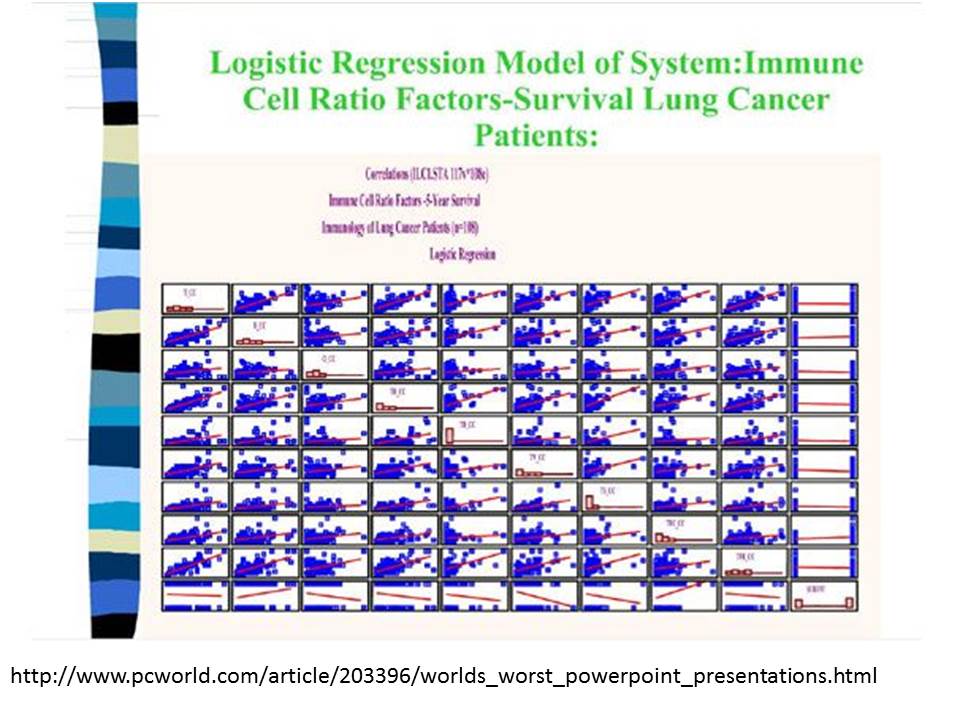
The way I see it, it’s not slideware that’s the problem, it’s how it is used. Done well, visuals (whether video or static images) can add impact and interest to a presentation. But the design tools and templates of PowerPoint et al. are generally used by folks who have never learned design. Thus we end up with…


PC World Article: Worst PPT Presentations


PC World: Worst PPT Presentations


You can check out the full article with more examples here.


I too have been guilty of multitudinous slideware sins, and found redemption in Garr ReynoldsPresentation Zen, and accompanying resources and slide decks. I especially like the PowerPoint “Before and After” demos to illustrate how good design can transform our visual communication.


In a nutshell: 

Simplicity is key to good design. Images trump words. Fewer words are better than a lot of words.


Here a couple of my own PowerPoint makeovers, inspired by Reynolds’ work.


This slide attempts to summarize (via text) the information and context that should be delivered in a narrative elaboration of the simplified (after) slide

Motivational Interviewing Processes: Before


Motivational Interviewing Processes: After


This was from a slide deck on presentation skills, and offers a good example of how slides and handouts should be two different things

Presentation Skills: Before


Presentation Skills: After


I was quite proud of this next slide, which had lots of text animations (shudder). The second slide conveys the “ACE” acronym via the image

Motivational Interviewing "Spirit": Before


Motivational Interviewing "Spirit": After


Follow this link for more examples of PowerPoint Makeovers.


do not go near to the pond sign


“A recent survey stated that the average person’s greatest fear is having to give a speech in public. This ranked even higher than death, which was third on the list. So, you’re telling me that at a funeral, most people would rather be the guy in the coffin than the guy giving the eulogy?”Jerry Seinfeld


We all get stage fright. Even the most seasoned presenters experience performance anxiety to some degree, although this lessens over time and with experience. From a behaviour modification perspective, the most effective long-term antidote to an acute and severe case of nerves is repeated exposure to the triggering stimuli. In other words, the more you force yourself on that stage, the more confident you will become.

“Of course”, you might be thinking, “That’s all well and good, but what can I do to deal with stage fright in the meantime?” Read on….

Here are my favorite five tried-and-true strategies for combating presentation jitters:

1. Sip juice instead of water

People often don’t eat much (if at all) before a talk because anxiety diminishes appetite. You probably don’t want a five-course meal before going onstage, but you need something! That shaky, sick feeling just might be low blood sugar, so pack a small bottle of orange juice in your brief case.

2. Talk to people in the audience ahead of time

It’s good to get a feel for who is attending and what brought them there. This shifts the focus away from yourself (and how you’re feeling) to the group (and how they’re feeling). This is right and good. You are there for them. Bonus points for learning and remembering peoples’ names and incorporating an important insight or contribution that an individual has shared into your onstage remarks.

3. Challenge cognitive distortions

What are your beliefs about the talk you are going to deliver? “I must succeed, and it will be catastrophic if I fail” is a message designed to evoke fear in anyone. Challenging these beliefs and replacing them with a more reasonable and realistic appraisal will lessen negative emotions (because emotions follow from how we interpret things). “It would be nice if I did well, and I really want to do well, but my life won’t end if I mess this up.”

4. Breathe…and smile

When anxious, our breathing tends to be shallow. Take a couple of deep, calming breaths as you’re being introduced. And smile too. Even fake smiling makes you feel better. Plus, people are looking over at you during your introduction, so best to look happy to be there even if – in that moment – you are anything but.

5. Slow down

Nerves make us talk fast, and fast talking doesn’t create the most compelling/positive first impression. When you get to the podium…pause. Collect your thoughts. Look right at the audience and make eye contact.

And one “don’t”: Please oh please don’t start things off with “I’m nervous”. We already know that most people are nervous about public speaking. Plus, once you get started you’ll be fine, so why handicap yourself? It’s so much better to start graciously and gracefully with a “thank you and pleased to be here”.

Follow these links for more presentation tips:

Tips for Engaging Large Audiences: What to do when it’s just you and several hundred people

That’s just how we roll: Presenting in less-than-optimal surroundings

How to TAME difficult, skeptical, hostile or challenging participants: Take a deep breath, pretend you’re not defensive, and say thank you


Auto repair


The foremost decision is the decision to provide treatment


Last week I met a colleague who leads a community college program on auto maintenance and repair. This arena of study and practice has always seemed fairly straightforward to me: learn the mechanics of engines and other things that make cars work, and learn how to fix them. I confess it was surprising to me when he shared that the most important skills his students need to learn are critical judgment, reflection and decision-making. That’s partly because car design has changed so dramatically over the last two decades that cars have become complex electronic as well as mechanical systems. Just like in health care, for a good mechanic the foremost decision is whether to provide treatment.


Who knew that our most important teaching goals and teaching challenges – his in auto repair and mine in counselling and health behaviour change – were so aligned?


This reminded me of another conversation I had with a surgeon a couple of years ago. We were talking about laparoscopic surgery, and I wondered whether today’s medical students had a learning advantage due to their years of experience playing videogames. The doctor stated that it doesn’t take long to teach anyone to how to perform laparoscopies (although video game players might learn a little faster). He said that what takes years to teach and learn is when not to do the surgery.


When and how to intervene may be the most challenging things for anyone to learn because the skills are so complex. Education for diverse fields of practice – from car repair to medicine and lots in between – demands that students master three essential foundation skills:


1. Critical reflection: Meaning-making and interrogating the limits of one’s knowledge and skills; considering costs, benefits and outcomes of different possibilities


2. Attention: Including listening, observation and data-gathering, from a stance of care and concern


3. Decision-making: This includes decisions regarding a specific course of action, as well as decisions about what additional information might be needed; acting with integrity and ethics.


A nice article on how diagnosis is more art than science features wisdom from “master diagnosticians”, and underlines the importance of the above three skills, along with humility and a commitment to continuous learning:


“If you want to be a master diagnostician,”  says Dr. Lewin,  ”you’d better be prepared to be a master student.” It’s a lesson Dr. Goodgold, now in his fifth decade of practice, still takes to heart.  ”Being a good diagnostician means being good at solving problems. It starts with being intellectually honest.  You must admit to yourself that you don’t know everything. Not a week goes by that I don’t see something new. I must continue to be a student of medicine and science.”

[…]

Consider the wisdom of Sherlock Holmes, who was modeled by his creator, Sir Arthur Conan Doyle (a physician turned fiction writer), after one of the most renowned diagnosticians of his day: Dr. Joseph Bell, professor of medicine at the University of Edinburgh.  ”I see no more than you,”  the super sleuth explained to his sidekick, Dr. Watson,  ”but I have trained myself to notice what I see.”


 road grass sky


Five big lessons learned along the way


1. How do you feel when you walk out the door?

I’ve always valued the axiom that people don’t remember what you do or say – they remember how you made them feel. Think about your favorite teacher – what do you remember most from that class? The course content? Or is it the passion, inspiration, affirmation, compassion, kindness and care that he or she offered? For the most part, process is way more important than content in teaching and learning.


2. Transformational learning is about inspiring change, not transmitting information (no matter how “essential”).

Another axiom: “To teach well we need not say all we know, only what is useful for the pupil to hear”. In other words, no course or continuing professional education workshop is ever long enough for all of the didactic content that we regard as essential. Here’s my most important learning objective, no matter what the content:

At the end of this course the learner will…

Be so energized and inspired by the importance and relevance of this topic that he or she will continue to access knowledge and skills development long after the session has ended.


3. It’s not my decision.

Learning is 100% volitional. So is change. No matter how urgently I believe that I know what is best, that’s not really the point. Each individual is the expert on his or her life, including the learning goals and activities that may guide growth and development.


4. Change is a process, not an event – and so is learning.

Teaching and learning are really about change. By definition, seeing things from a new perspective involves a fundamental shift in standpoint or beliefs. Sometimes a (brief) interaction and connection doesn’t yield any appreciable indication that I have successfully “taught” anything. Then ten years later I randomly see a former student at the airport and am privileged to hear an inspiring story of transformation – initiated by something that I said or did. We plant seeds and only rarely witness the harvest.


5. We’re all protagonists (and want to be treated as such).

No matter how ubiquitous the student concerns, complaints, issues, grade appeals, special requests – each of us is at the centre of our own lives. Individual experience is at once singular and universal: all people are “like all others, some others, and no others” (to paraphrase Murray and Kluckhohn, 1953). It’s about listening (on our part) and – more important – feeling heard (on the other person’s part). Which brings us right back to Point #1.


So…although these are my top five, as Joni Mitchell famously said:

“People will tell you where they’ve gone, they’ll tell you where to go, but till you get there yourself you never really know.”