Archive

Tag Archives: paragogy

Slide1


How can we bridge the teaching/learning gap?


The evidence-based clinical practice model that I use and teach, Motivational Interviewing, is a respectful and collaborative way to talk about change with people who are ambivalent or unwilling.

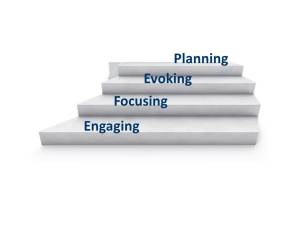
In fact, conversations about change are clearly relevant beyond counselling, therapy or health care. The new edition of Motivational Interviewing by William Miller and Stephen Rollnick outlines four essential processes that map well onto processes of adult education, particularly in contexts where learners may be less than enthusiastic. These processes are somewhat linear but also recursive –  one naturally leads to (and provides a foundation for) the next, but we may also circle backwards and forwards as needed.

1. Engaging:

This is about establishing a relationship with the group and creating a positive learning community. Is it safe to speak up, disagree, critique and explore? Meaningful discourse hinges on successful engagement.

2. Focusing:

Engagement comes first, but it is also important to understand and highlight the relevance of the topic/learning objectives to real world problems and issues. What will I learn, and why should I care? How will mastering new knowledge and skills make my work easier and better? Individuals may raise topics or issues that instructors hadn’t anticipated. These are the burning questions that need to be resolved through successful focusing. Optimally, adult learners are engaged in co-creating curricula.

3. Evoking:

Learning is 100% volitional. Constructivism and paragogy mark a shift from installing knowledge and solutions towards evoking these. Although faculty bring expertise to the table – and we shouldn’t shy away from sharing this – a motivational approach presupposes doing so in partnership with learners, and with a spirit of nonjudgmental acceptance and compassionate empathy.

4. Planning:

We’ve engaged learners in an active partnership, linked curricula to real-world issues, and evoked new connections, insights, ideas and approaches. Now what? Identifying implications for practice and committing to an action plan are key. The planning process helps bridge the gap between learning and life. If new learning has no real-world implications, then we’ve missed the boat somewhere along the way.



Will it be on the exam?

In-class exams may well be one of the most stressful – and for some, traumatic – experiences in a student’s life. This truism came front and centre last week at a certificate program I was teaching, geared to seasoned interprofessional practitioners. The varying responses to our in-class, summative, multiple-choice exam tended to cluster around the less enthusiastic end of the spectrum.

Why are exams so aversive?

One obvious reason is that they can be high stakes, as in this (admittedly oversimplified) equation:

high grades = approval + scholarship $$$ + grad school admission

Another reason may have to do with lack of autonomy: we didn’t write the exam questions, and we generally can’t know – or in many cases – anticipate – them in advance. And people inherently strive towards personal autonomy.

But I think that radical pedagogical analyses get closest to the crux of the matter, in their critical interrogation of power dynamics in the classroom, the stance of the professor as “expert”, and framing of “curricular content” (for example, Laura Béres 2008 article).

Constructivism frames learning as socially constructed by learners, where learning is meaningful and relevant to real life. In-class exams are, by nature, removed from real life and focus on content domains that the instructor sees as key.

This can be an uneasy alliance in progressive classrooms, and one that I am still struggling to reconcile… Especially in a knowledge landscape where locating information should take precedence over memorizing information (see Julio Frenk’s influential report in the Lancet, “Health professionals for a new century: transforming education to strengthen health systems in an interdependent world”).

Closing thought:

Exams do stimulate affective arousal, which is associated with enhanced memory retention. I’m just not sure that those memories correlate well with the exam content!


Network of networks = your very own PLN


Today, there’s no problem finding information – the challenge is sifting through and locating the right information at the right time. And not just the right information at the right time – it’s also about access to tools and ideas that you never even knew you needed until you saw them. That’s where PLNs come in.

In the olden days before the advent of online academic journals and research databases, I always made at least one serendipitous discovery while browsing library holdings or leafing through print materials. I would be scanning a row of books looking for a particular call number, and suddenly notice a different book that was a great fit for some other topic I was researching. It’s hard to replicate that kind of happenstance when digital searches yield a specific document or information source with laser-like precision.

Plus, learning is not just about acquiring information – paragogy (a.k.a. the new andragogy) views learning as inherently non-linear and socially constructed via networks/peers. So PLNs – because they’re naturally hyper-textual and social – fit beautifully within a paragogical frame.

This article about PLNs at edudemic.com gives a great overview and rationale for the functions of various social media tools in building, customizing and contributing to your own composite, ongoing knowledge stream. Your very own PLN.

Predicting the Future: Higher Education in 2112 (Part 2)

My workplace overlooks a big downtown university campus, and it’s always fun to see the frosh week excitement and back-to-school energy.

This made me think about: what will higher (university) education look like 100 years from now? Hard to imagine, especially because universities have sustained a pretty enduring business model and delivery system for – what – the last thousand years or so?

But I think we’re seeing the fault lines in higher education, some driven by students themselves and their expectations/learning preferences, some changes being driven by new technologies/social media, and perhaps the most significant changes are a result of globalization and rise of “educational megalopolies”.

So – here are some of my predictions:

This first one is kind of a no-brainer: Face-to-face learning will be the exception. Students will design and access knowledge and skills guided by both human and virtual tutors/faculty

Students will register and be affiliated with multiple academic institutions from the same family of university “brands” (as smaller schools become gobbled up by the big names)

Students will travel virtually or geographically throughout their academic careers and access a plethora of institutionally-branded choices in different metropolitan centres and online, with the entire academic record in a single transcript file location

The electronic transcript will look more like a virtual portfolio of students’ work and assessments, and will link to other accomplishments/activities

There will be no such thing as “full” courses (due to over-enrollment) because all courses will be webcast

The most successful university brands will offer programs in multiple languages: for example, English, Mandarin, Portuguese, Hindi, Russian (via automatic simultaneous translation of faculty/instructional materials)

Unique, personalized programs of study will be developed so as to fit specific jobs via proprietary algorithms (and these will be recalibrated as students’ career goals change)

Teaching performance will be graded on a variety of metrics – including student performance and feedback/reviews – and this will be integrated within mobile academic course calendars (inside-out universities).

bee flying dandylion

Lately everyone is asking “what happens after the workshop is over?”

In high school I worked as a cashier in my neighborhood convenience store. The pay wasn’t great, but at 16 what do you expect? However I got to see, over and over again, the actualization of the “let’s go to the corner store” meme: the place would be dead quiet (time to read a trashy celebrity mag cover-to-cover), then suddenly – how did all these people appear out of nowhere??? From a social anthropology perspective it allowed me to experience the “hive mind” in action.

Well, a similar phenomenon seems to be happening this summer: I am seeing a convergence in the training requests I’m getting that go beyond “can you do a one-day workshop”.  For the first time, organizations and individuals have been initiating the ask to explicitly integrate time and process on implementation during and after the course or workshop. Now, I’m not suggesting that in the past no one cared about implementation – in fact the opposite is true. It just seems like there is more attention being paid from the very beginning of the continuing professional education (CPE) process to a longer-term perspective and ultimate goal of performance improvement. This is in line with the proliferation of publications and calls for competency-based medical education, including recommendations in the 2012 “Future of Medical Education in Canada” report.

It’s exciting to me that organizations are starting to hold us educators accountable for what happens after the workshop is over. Positive course evaluations aren’t enough to demonstrate value when the real purpose of CPE is to facilitate change. And that’s a tough one. That’s why I no longer make New Year’s resolutions (they were always the same resolutions).

But the beauty of the hive mind is that it generates a certain energy. If our collective gaze (hive mind) is focused on the horizon as opposed to the windshield, I foresee some creative paragogical alternatives to “business as usual”.


Continuing Professional Education in 2112


Predicting the future is a risky and uncertain business, despite what psychics and fortune-tellers might proclaim. Still, I’ve been thinking about science fiction transformed into reality by the successful landing of NASA’s Curiosity Mars explorer vehicle. How many years before the first humans embark on the six-month journey to another planet? All this wondering has inspired me to consider what continuing education might look like a century from now.

So here goes – some predictions for continuing professional education:

The focus of continuing education requirements for professionals will shift away from accumulating a set number of accredited CPE course hours, and reflect an assessment of the richness and density of practitioners’ electronic networks and their contributions within and beyond these networks

The primacy of skills in researching and locating information will be replaced by skills in creating/designing an individualized architecture to harvest, sort, store and share essential knowledge and ideas

There will not be slideware

Knowledge Curator will be a popular job title

The CV will be replaced by a tag cloud or an infographic resume with active links to relevant media, and this will be a more accurate reflection of professional contributions and experience

Education will be evaluated based on net benefit to learners in practice, and this will be possible at low cost due to the proliferation of mlearning applications and integrated performance databases

Didactic lectures will still exist, but they will look more like (high production value) TV commercials and less like (low production value) infomercials. They will be a lot shorter too.

For fun – here is a tag cloud for this website updated October 2012:


Pushing the boundaries of education theory – A hurricane at our backs

How are teaching and learning theories evolving to take into account the opportunities and advances in social media and “Web 2.0”?

Andragogy, as a theory of adult learning, has been around since the 1980s, extending the notion of pedagogy to an adult learning context (Malcolm Knowles, discussed in a chapter I wrote on online learning theory).  I have been thinking about what a “2.0” conceptualizing of andragogy might look like, given the incursions of user-generated content into both live and online learning contexts. Two recent models – paragogy and heutagogy – have captured my attention as useful extensions of Knowles’ adult learning theory. These models may well constitute a kind of “Androgogy 2.0.”

Both paragogy and heutagogy present a model of learning that is (1) decentred, (2) non-linear, (3) peer-led and (4) self-determined. These characteristics map onto social media applications and the democratization of knowledge and information. Paragogical and heutagogical approaches also extend traditional adult learning frameworks through their emphasis on meta learning, or learning how to learn.

A new model for health care education is needed at this time for a number of reasons:

The explosion of evidence-based information in health care means that “just in time” learning may be more helpful and important than “just in case” learning.

Patient access to – and use of – internet-based health information means that providers need to understand how to access, assess, critique, and translate credible sources of information.

The new generation of learners are already “hyper-learners” (i.e. non-linear in their approach to accessing and processing information), and are accustomed to generating as well as consuming content.

Power dynamics in the classroom are already shifting towards learner-as-consumer, with all of the attendant opportunities and pitfalls that we are seeing. On one hand, learning is volitional, so it makes intuitive sense that learners should be autonomous and self-determining. Shifting the power dynamics in the classroom in favour of the learner can facilitate many-to-many communication and crowdsourcing. On the other hand, our educational structures and institutions are not set up to accommodate radically student-centred approaches, and as faculty we can find ourselves caught in the middle.

So what are the practical implications for clinical education? I have been experimenting with student-centred assignments and activities, as well as peer evaluation and use of social media, and the going is not always easy. The preconditions of psychological safety and willingness to risk are key, and I find that these strategies take considerably more of my time in coaching and reassuring. However based on students’ feedback, there is a depth and richness to the learning that goes beyond instructor-centric approaches.

In any case, when it comes to radically student-centred approaches to 21st Century health care education, “We’re not walking into a headwind, we have a hurricane at our backs.”


View a presentation on the topic of “Andragogy 2.0: Introducing emerging frameworks for teaching and learning: Paragogy and Heutagogy” on Slideshare