Archive

Tag Archives: Presentation skills; Presenter tips

nest blue eggs


Slideware 101: Tips and Resources


We’ve all been there: the uncomfortable chairs, the slightly darkened room, and slide after slide after slide. Each one identically bullet-ed, punctuated by the occasional graph and the speaker stating, “I know that you can’t read this, but…”.


The almost ubiquitous use of slideware has rigidified knowledge communication, and the sad part is that somewhere buried in the bullet points and boredom is someone’s singular message, lost. Not only that, sometimes the consequences of information presented poorly can be devastating.


Edward Tufte, a Yale University Professor Emeritus and visionary in information design and data visualization, wrote an influential essay – posted online – pointing to the use of PowerPoint slide decks in NASA engineering briefings as a contributing factor in the 2003 Columbia space shuttle disaster. In their report, the Columbia Accident Investigation Board concluded that the distinct cognitive style of PowerPoint reinforced the hierarchical filtering and biases of the NASA bureaucracy during the crucial period when the Columbia was injured but still alive”. The take-away? Templates that structure information into bullet points can obscure nuance and interrelationships within and between knowledge domains.


The way I see it, it’s not slideware that’s the problem, it’s how it is used. Done well, visuals (whether video or static images) can add impact and interest to a presentation. But the design tools and templates of PowerPoint et al. are generally used by folks who have never learned design. Thus we end up with…

 

PC World Article: Worst PPT Presentations


PC World: Worst PPT Presentations


You can check out the full article with more examples here.


I too have been guilty of multitudinous slideware sins, and found redemption in Garr ReynoldsPresentation Zen, and accompanying resources and slide decks. I especially like the PowerPoint “Before and After” demos to illustrate how good design can transform our visual communication.


In a nutshell: 

Simplicity is key to good design. Images trump words. Fewer words are better than a lot of words.


Here a couple of my own PowerPoint makeovers, inspired by Reynolds’ work.


This slide attempts to summarize (via text) the information and context that should be delivered in a narrative elaboration of the simplified (after) slide

Motivational Interviewing Processes: Before


Motivational Interviewing Processes: After


This was from a slide deck on presentation skills, and offers a good example of how slides and handouts should be two different things

Presentation Skills: Before


Presentation Skills: After


I was quite proud of this next slide, which had lots of text animations (shudder). The second slide conveys the “ACE” acronym via the image

Motivational Interviewing "Spirit": Before


Motivational Interviewing "Spirit": After


Follow this link for more examples of PowerPoint Makeovers.


do not go near to the pond sign


“A recent survey stated that the average person’s greatest fear is having to give a speech in public. This ranked even higher than death, which was third on the list. So, you’re telling me that at a funeral, most people would rather be the guy in the coffin than the guy giving the eulogy?”Jerry Seinfeld


We all get stage fright. Even the most seasoned presenters experience performance anxiety to some degree, although this lessens over time and with experience. From a behaviour modification perspective, the most effective long-term antidote to an acute and severe case of nerves is repeated exposure to the triggering stimuli. In other words, the more you force yourself on that stage, the more confident you will become.

“Of course”, you might be thinking, “That’s all well and good, but what can I do to deal with stage fright in the meantime?” Read on….

Here are my favorite five tried-and-true strategies for combating presentation jitters:

1. Sip juice instead of water

People often don’t eat much (if at all) before a talk because anxiety diminishes appetite. You probably don’t want a five-course meal before going onstage, but you need something! That shaky, sick feeling just might be low blood sugar, so pack a small bottle of orange juice in your brief case.

2. Talk to people in the audience ahead of time

It’s good to get a feel for who is attending and what brought them there. This shifts the focus away from yourself (and how you’re feeling) to the group (and how they’re feeling). This is right and good. You are there for them. Bonus points for learning and remembering peoples’ names and incorporating an important insight or contribution that an individual has shared into your onstage remarks.

3. Challenge cognitive distortions

What are your beliefs about the talk you are going to deliver? “I must succeed, and it will be catastrophic if I fail” is a message designed to evoke fear in anyone. Challenging these beliefs and replacing them with a more reasonable and realistic appraisal will lessen negative emotions (because emotions follow from how we interpret things). “It would be nice if I did well, and I really want to do well, but my life won’t end if I mess this up.”

4. Breathe…and smile

When anxious, our breathing tends to be shallow. Take a couple of deep, calming breaths as you’re being introduced. And smile too. Even fake smiling makes you feel better. Plus, people are looking over at you during your introduction, so best to look happy to be there even if – in that moment – you are anything but.

5. Slow down

Nerves make us talk fast, and fast talking doesn’t create the most compelling/positive first impression. When you get to the podium…pause. Collect your thoughts. Look right at the audience and make eye contact.

And one “don’t”: Please oh please don’t start things off with “I’m nervous”. We already know that most people are nervous about public speaking. Plus, once you get started you’ll be fine, so why handicap yourself? It’s so much better to start graciously and gracefully with a “thank you and pleased to be here”.

Follow these links for more presentation tips:

Tips for Engaging Large Audiences: What to do when it’s just you and several hundred people

That’s just how we roll: Presenting in less-than-optimal surroundings

How to TAME difficult, skeptical, hostile or challenging participants: Take a deep breath, pretend you’re not defensive, and say thank you

 road grass sky


Five big lessons learned along the way


1. How do you feel when you walk out the door?

I’ve always valued the axiom that people don’t remember what you do or say – they remember how you made them feel. Think about your favorite teacher – what do you remember most from that class? The course content? Or is it the passion, inspiration, affirmation, compassion, kindness and care that he or she offered? For the most part, process is way more important than content in teaching and learning.


2. Transformational learning is about inspiring change, not transmitting information (no matter how “essential”).

Another axiom: “To teach well we need not say all we know, only what is useful for the pupil to hear”. In other words, no course or continuing professional education workshop is ever long enough for all of the didactic content that we regard as essential. Here’s my most important learning objective, no matter what the content:

At the end of this course the learner will…

Be so energized and inspired by the importance and relevance of this topic that he or she will continue to access knowledge and skills development long after the session has ended.


3. It’s not my decision.

Learning is 100% volitional. So is change. No matter how urgently I believe that I know what is best, that’s not really the point. Each individual is the expert on his or her life, including the learning goals and activities that may guide growth and development.


4. Change is a process, not an event – and so is learning.

Teaching and learning are really about change. By definition, seeing things from a new perspective involves a fundamental shift in standpoint or beliefs. Sometimes a (brief) interaction and connection doesn’t yield any appreciable indication that I have successfully “taught” anything. Then ten years later I randomly see a former student at the airport and am privileged to hear an inspiring story of transformation – initiated by something that I said or did. We plant seeds and only rarely witness the harvest.


5. We’re all protagonists (and want to be treated as such).

No matter how ubiquitous the student concerns, complaints, issues, grade appeals, special requests – each of us is at the centre of our own lives. Individual experience is at once singular and universal: all people are “like all others, some others, and no others” (to paraphrase Murray and Kluckhohn, 1953). It’s about listening (on our part) and – more important – feeling heard (on the other person’s part). Which brings us right back to Point #1.


So…although these are my top five, as Joni Mitchell famously said:

“People will tell you where they’ve gone, they’ll tell you where to go, but till you get there yourself you never really know.”


Toronto-20140510-00694


Here’s what the ultimate teaching challenge might look like…and in the future it may be the rule rather than the exception

A new book, Motivational Interviewing in Groups (Wagner and Ingersoll) outlines motivational approaches and strategies in group facilitation. While the book’s emphasis is on clinical practice, the principles and applications are also relevant to education settings.

The book’s authors present a table illustrating different types of group format, structure, composition, size, length and admission arranged along a continuum of difficulty (for facilitators) from easier to harder:

Slide1


This looks different for educational groups, but the essentials still apply. Here is my modification of Wagner and Ingersoll’s framework calibrated for teaching and learning:

Slide1


In other words:

Elective courses are easier to teach than mandatory courses. Students generally take electives out of interest, as opposed to being forced to take mandatory courses. Teaching students content that someone else thinks they ought to know is tougher than content in which they’re already interested.

Instructor-led courses presuppose a “script” (i.e. lesson plan), versus collaborative or student-led curricula. Paragogical approaches posit peer-to-peer learning and individual autonomy, and demand a proportionately higher level of finesse and facilitation.

Classes where students share more similarities than differences can be easier to work with than heterogeneous class compositions. For example, students who differ widely in age, ability or pre-existing knowledge and skills present more of a challenge in ensuring that all learning needs are met, and establishing an inclusive, cohesive and positive community of learning. Of course diversity, including culture, sex, gender and lived experience, enriches everyone’s learning exponentially – but demands artful facilitation on our part.

Student engagement and interactivity are more straightforward in classes of 25 or less. As class size increases so does the challenge of promoting opportunities for practice and integration of knowledge and skills.

It’s easier to keep peoples’ interest and attention for a single class of 2 or 3 hours than it is for a whole day or for multiple days. The latter demands both a varied menu of instructional strategies as well as formidable stamina (on the part of the instructor and the students).

Strict and highly competitive admission criteria can yield the “cream of the crop” of high-achieving and highly motivated learners. On the other hand, classes where admission is unrestricted means addressing the needs of the best and the brightest alongside those with academic struggles and other challenges.

Like any framework, this conceptualization tends to oversimplify and blur the many complexities and nuances of artful classroom teaching. Real life is always messier than the manual (if there even is a manual). But in general, teaching a mandatory class using a student-led curriculum, among a highly diverse cohort of 100 students or more, over a multi-day course that is freely open to all could well represent the ultimate teaching challenge.

We haven’t added the layer of classroom-based versus online teaching and learning, but does this scenario represent what may well be future of higher education…MOOC 2.0?


Tulips2


Six surefire ways to lose an hour in the classroom

Each spring 60 minutes evaporate when we set the clocks forward. Daylight Savings Time (DST) signals the start of long days, fresh colour, smell of earth and birdsong. But still, it hurts to lose that precious hour, especially when there are few enough in the weekend to begin with.

Of course we get an hour of DST back again in the fall, so it’s only a temporary loss. But for educators and students, how many precious hours of learning opportunity are lost in the classroom? Hours that add up to days, weeks, months and years over the course of a high school and post-secondary career. We could argue that this is a student issue based on motivation, attention or capacity: after all, learning is volitional and each of us is personally responsible. Still, I see this stance as at least somewhat disingenuous.

Even the most motivated, attentive and able students can find themselves wishing there was such a thing as what I call Classroom Savings Time (CST) during boring, irrelevant or unproductive “learning” activities. Here are a few tried and true instructional strategies to make them want to fast-forward the clock:

1. Give too much information (because “To teach well, we need not say all that we know, only what is useful for the pupil to hear.”)

2. Teach people what they already know

3. Lecture for more than 10 minutes at a time (TED talks might run twice as long, but after all these are some of the world’s most compelling speakers)

4. Permit student presentations in excess of 10 minutes each (see previous point)

5. Play a video for longer than eight minutes (and that’s still probably three minutes too long)

6. At all times stick to your script (textbook and/or lesson plan).

There is truth to the old saying: “You can lead a horse to water, but you can’t make him drink.” However, you CAN make him thirsty! There may be no getting away from DST, but we can all avoid CST. Students everywhere will be grateful.

cat paw


Why it’s less about managing the class than joining with the group

Recently overheard in a high school classroom: “F#*%  you…sir!”    Wow: Did I just witness respect + disrespect expressed simultaneously? How does that work exactly?

Teaching is a tough job whatever the age group. Adults may be less “out there” than teenagers, but the group dynamics are the same. Groups tend to behave like unitary entities: they can be your best friend or your worst enemy. But if they fall into the latter category they are a many-headed hydra who cannot be vanquished.

Here’s how I see it: If you have to actually “manage” the class that is not a good sign. Now I am not talking about classroom management in terms of providing guidance or direction with respect to learning content or processes. Every group needs a guide to stay on track. What I mean is that if students act out, tune out or walk out, things have already gone bad. At that point it’s likely not so much a student issue as a group issue.

Here are a few tips to help get things off to a good start, and to keep it that way:

1. Mutual respect is an essential precondition for ANY relationship. If it’s lacking there’s no relating. Regularly affirm your respect for each student and for the class as a whole (the “two clients”: the individual and the group).

2. Make it interesting. Easy to say, but how? Three words: make it relevant. OK, but how? The group will tell you if you ask. What do they care about? Why are they there in the first place? What do they want from you and from each-other?

3. But… what if I am teaching a mandatory course that no one cares about? Here’s the thing: There is no such thing as a topic that’s inherently interesting (have you ever gone to a talk that intrigued you only to be bored out of your mind?). And, conversely, there is no such thing as a topic that’s inherently boring (have you ever gone to a talk you were dreading only to be pleasantly surprised?). Why is the course mandatory? What’s the larger narrative? Why is this essential knowledge and learning? These are the primary questions to address as part of an ongoing group dialogue.

4. Show that you care. Not just about what you’re teaching, and not just about your students as people, but about their experience in the here-and-now. Who’s tired? Who’s bored? How comfortable is the room? What else is happening in the world and how does that impact the tasks at hand? This in-the-moment reflection continuously reestablishes the connection between facilitator and class. In clinical practice it’s called therapeutic use of self – tune in to your own experience to help you tune in to the group.

5. Be generous. Generous with your humour, your time, your interest, yourself. I think of generosity as comprised of curiosity, authenticity, empathy and joy. It’s less a focus on how the group sees you than on who is in the group and what you see in them. And be generous with people when they’re having a bad day. It happens to all of us.

Over the last two days I facilitated a mandatory training for a diverse group of health and social service professionals in Halifax, Nova Scotia. What a pleasure – even if some learners started off the day with ambivalence, we all ended on a high note. And just to add…if you ever find yourself in that beautiful city, be sure to check out Cabin Coffee on Hollis Street for a latte and a killer cinnamon bun!

 TO LISTEN

Ears + Eyes + Undivided Attention + Heart

Zen rocks lake

Group facilitation is more about listening than speaking

Facilitating groups is a delicate art: groups progress through certain well-defined stages of development, and our style as facilitators needs to be pitched to where the group is at. Furthermore, facilitators need to respond to the “two clients” – the individual, and the group – and attend to both content and process. This multilayered complexity, whether in education or clinical contexts, is a big part of what makes groups so energizing and exciting.

What is reflective listening?

In its simplest form, it’s a response that paraphrases or mirrors the spoken content of a person’s statement. Reflective listening is a way to check back and make sure that we’ve understood what someone else tells us. This type of response is also a good alternative to the “Righting Reflex”!

Done artfully, the skill of reflective listening looks easy but is far from it (at least in my own experience). Really impactful reflective listening goes further than paraphrasing, and mirrors back the implied meaning beneath a person’s words; exploring the emotions, assumptions, ideas, hopes, concerns or wishes. These types of complex reflections demand our full listening attention and focus on the other. We all want to feel understood, and reflective listening helps bridge the communication gap in a respectful and validating way.

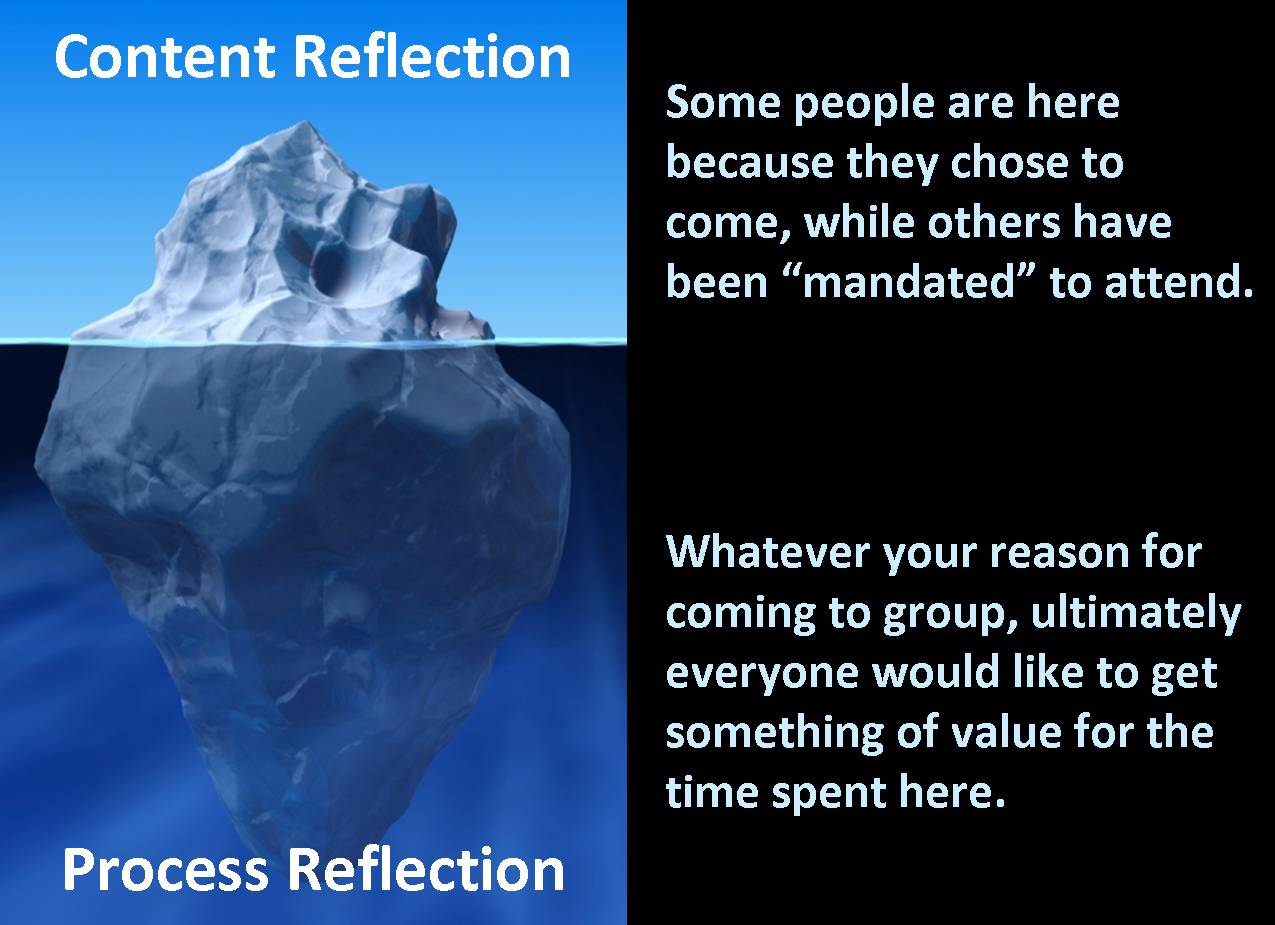
Here’s an analogy: simple reflections are like the tip of an iceberg – the content “above the waterline” – while complex reflections go deeper.

This video example of an angry client demonstrates how the practitioner uses lots of reflective listening to establish understanding and build rapport.

Reflective Listening in Groups

Reflective listening in groups ups the ante because of their interpersonal complexity. But, looked at another way, groups give us even more options and opportunities to use this important skill. I’ve come up with three general categories for practicing reflective listening in groups (and I’m sure that there are more):

1. Simple versus complex reflections

2. Reflecting an individual’s comments versus content taken from the group’s overall contributions

3. Reflecting group content versus group process.

Note that a facilitator might decide to use any one of these approaches (and within each category are a myriad of alternate ways of responding)…that’s the artful strategy part!

Here’s an illustrative example of a hypothetical client who is coming to the first session of a support group for people living with heart disease. The facilitator has asked group members to share their goals for attending, and the last client to speak says:

“I’m only coming to group today because my doctor and my wife are both pressuring me.”

Reflect 1

Reflect 2

Reflect 3

Notice how each reflective strategy builds on the next – but they aren’t sequential (or prescriptive for that matter). Just some pretty powerful tools that are appropriate across a spectrum of clinical, educational, professional and other kinds of groups. Because in the end, the best facilitation is more about listening than talking.

mail full mailbox


Unsolicited advice is the junk mail of life (Bern Williams, in Miller & Rollnick)

Compassionate listening – stepping back and allowing learners to individually explore their ambivalence, concerns and ideas about an issue or concept – is at the crux of individual discovery and adult learning.

Here’s the rub: as educators we want to support student success, so when we see someone heading in the wrong direction or struggling, we’re often galvanized into action with all good intentions! This “Righting Reflex” is essentially the imperative to do something…to “fix it”, and often kicks in without any conscious awareness (see Miller and Rollnick’s 2013 text on Motivational Interviewing).

To add clarity: A a quick illustration of the Righting Reflex from a conversation I had on my way in to work this morning (for real):

Me: “I’m thinking that I’d like to buy a Smart Car.” 

Significant other: “Well what about a Honda CR-V? I know someone who has one for sale.” 

Me:   ?   !   ?

O-kayyy…How useful was that unsolicited (albeit well-meaning) advice in helping me think things through? And, to be fair, my own Righting Reflex isn’t hard to activate in both personal and professional spheres. Learner autonomy as being at the heart of constructivist approaches is widely discussed and accepted, yet in practice it’s “simple but not easy”.

In an ideal world, educators validate, explore, question. They evoke and encourage students to critically examine different sides of an issue. This doesn’t negate our roles of teacher, guide or concerned other, but it does place the onus – quite rightly – on the learner’s capacity for decision-making and problem-solving.

A big part of education in health care (and other fields) is less about teaching the correct answer, than in facilitating the process of ethical and nuanced judgment and decision-making. If we can resist the Righting Reflex we’re creating a positive space in which to explore, experiment and make mistakes.

So…as for my own automotive decision-making process…a design endorsement by the MOMA may just tip the balance!

Slide1


How can we bridge the teaching/learning gap?


The evidence-based clinical practice model that I use and teach, Motivational Interviewing, is a respectful and collaborative way to talk about change with people who are ambivalent or unwilling.

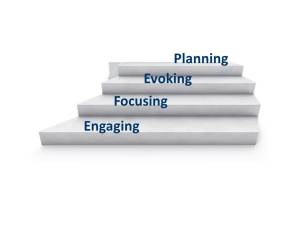
In fact, conversations about change are clearly relevant beyond counselling, therapy or health care. The new edition of Motivational Interviewing by William Miller and Stephen Rollnick outlines four essential processes that map well onto processes of adult education, particularly in contexts where learners may be less than enthusiastic. These processes are somewhat linear but also recursive –  one naturally leads to (and provides a foundation for) the next, but we may also circle backwards and forwards as needed.

1. Engaging:

This is about establishing a relationship with the group and creating a positive learning community. Is it safe to speak up, disagree, critique and explore? Meaningful discourse hinges on successful engagement.

2. Focusing:

Engagement comes first, but it is also important to understand and highlight the relevance of the topic/learning objectives to real world problems and issues. What will I learn, and why should I care? How will mastering new knowledge and skills make my work easier and better? Individuals may raise topics or issues that instructors hadn’t anticipated. These are the burning questions that need to be resolved through successful focusing. Optimally, adult learners are engaged in co-creating curricula.

3. Evoking:

Learning is 100% volitional. Constructivism and paragogy mark a shift from installing knowledge and solutions towards evoking these. Although faculty bring expertise to the table – and we shouldn’t shy away from sharing this – a motivational approach presupposes doing so in partnership with learners, and with a spirit of nonjudgmental acceptance and compassionate empathy.

4. Planning:

We’ve engaged learners in an active partnership, linked curricula to real-world issues, and evoked new connections, insights, ideas and approaches. Now what? Identifying implications for practice and committing to an action plan are key. The planning process helps bridge the gap between learning and life. If new learning has no real-world implications, then we’ve missed the boat somewhere along the way.


What to do when it’s just you and several hundred people

Big room, big crowd, big sound system. It’s all about a big performance, right? In fact, the opposite is true. In my experience, larger audiences mean that it’s even more essential to take the approach of a one-on-one conversation.

What does that look like in the context of one presenter and hundreds of participants? Here are a few tips to keep in mind:

Talk to the audience as if you were at a really great social event with a group of professionals. In other words, you are kind of on your best behavior, but you can still be spontaneous, authentic and funny.

Tell stories – lots of stories. People are hard-wired to respond to, and remember, stories, so come prepared with anecdotes and examples. These can be some combination of work, practice or personal illustrations of key points. Just keep things brief and to the point.

If you’re using slideware rely on images versus text. This is a good principle for presenting to any size group, but it’s even more relevant with larger audiences where the sightlines may not be as good from every vantage point in the room.

Audit your presentation with a non-expert who has a really short attention span (I suggest a teen-ager). What parts of the talk do they like? Where are they bored? Adjust accordingly.

Promote direct interaction using methods such as: Individual reflection (“Write down the first thing that comes to your mind in response to the following statement…”); Peer-to-peer conversation (“take two minutes and turn to the person next to you and talk about…”); Rhetorical questions (“What would you do in the following situation?”); Video or audio clips with direction (“As you’re looking at this video, here’s what to watch for…”); A call to action (“What’s one thing you will commit to practicing after this session?”).

Reflect what’s happening in the here-and now. Is the room too cold or too warm? Are people tired or hungry? Is there an interesting event that’s all over the news? Acknowledge the “meta-context” in which the session is taking place.

I love giving talks to large audiences: the dynamic energy that happens when lots of people come together is socially infectious. It’s not you versus them – you’re all in it together.


Are the most important health care competencies the ones that can’t be taught?

 What, in your opinion, are the core competencies for practitioners working with women and girls who have concurrent mental health and substance use problems?

This was the question that I posed to a group of about 100 interprofessional clinicians at a recent conference session titled “Women and Concurrent Disorders (Addiction and Mental Health)”.

I posed the question before referencing the core competency domains identified by the Substance Abuse and Mental Health Service Administration’s 2011 document Addressing the needs of women and girls: Developing core competencies for mental health and substance abuse service professionals:

 SAMHSA Core Competency Domains

Sex and gender differences

Relational approaches in working with women and girls

Family-centred needs

Special considerations during pregnancy

Women’s health and health care

Interprofessional collaboration

I was curious to hear what this group of experienced and seasoned health care providers had to say about the core competencies that were top of mind. Without hesitation, hands went up and people called out examples: 

Practitioner-Identified Core Competency Domains

Empathy

Respect

Trust

Compassion

Listening

Care

It’s striking that no one mentioned any of the SAMHSA competencies, which focus on domain-specific knowledge and skills. Rather, the areas addressed by the audience emphasized process over content. Now, this is not to minimize the centrality of scientific and clinical knowledge and skills. Healthcare consumers expect this of us, and we as professionals expect it of ourselves.

But in those moments when the group named these key areas as most important, we collectively moved to the tacit underpinnings of excellence in healthcare: the human interactions that form the basis of helping. The things that are much harder to teach – if we can teach them at all.

View the full presentation on slideshare 


The good, the bad and the ugly

Over the last few years there’s been an explosion and widespread adoption of webinars as (in many cases) the primary or preferred strategy for delivering continuing education to large groups of geographically disparate people. It makes sense: education can be delivered in a brief, cheap and convenient form that has minimal impact on busy practitioners’ time.

But, just like classroom-based learning, there is huge variation in the quality, interactivity and utility of web-based learning. At their best, webinars are a model of multi-modal learning, with a dynamic and engaging facilitator, lots of interactive sidebar chat, and great use of visuals and reflective activities. At their worst, webinars are the workplace equivalent of a really boring TV show.

Here are a few tips culled from my own experience as facilitator and participant:

  1. It might not be a webinar: Sometimes network connections fail, either at your end or for participants. Send out a complete slide deck ahead of time and have a teleconference line just in case.
  2. I like text chat better than voice: In webinars, text chat is really seamless, especially with large groups (e.g., 100 or more). Encourage people to chat with each-other as well as the facilitator throughout the webinar. This brings me to two more points:
  3. Prime participants to participate: Most people regard online, text-based communication as more an act of publishing than as an act of speech. This cognition tends to constrain spontaneous conversation, so I ask participants to write down at least one question ahead of time. That way people are “primed” to participate, and once the ice is broken the group can really take off.
  4. You can’t do it all: With lots of sidebar chat it’s pretty much impossible to present AND read comments/questions at the same time. Having a moderator to help cue the presenter with key questions or pauses is essential.
  5. Ready for your close-up: Built-in computer webcams tend not to give the most flattering angle. Use a separate webcam for better camera postioning, add extra light, and talk to the camera. Participants want to feel connected to the facilitator.
  6. Less text more pictures: If text-heavy presentations are boring in person, they are even more deadly by webinar. (Plus, disengaged participants will toggle back and forth between a boring webinar and another, more interesting, website). Keep people engaged with well-designed content and activities.

I love the convenience of webinars, and done well they can really add value to an organization’s staff training and development strategy. The key phrase is “done well” – watching bad TV in the middle of the day is best kept for when you’re home in bed with a cold.


Last week I did a talk for about 60 members of the general public, for a short annual series called “Mini-Med School” offered through the University of Toronto. The title of my talk, “Alcohol: A Delightful Poison?” was meant to pique peoples’ interest in a substance that is pretty thoroughly integrated into everyday life in Western culture. The focus was on challenging assumptions and providing a few “aha” moments – we looked at standard drink conversions, low-risk drinking guidelines, health effects of alcohol, brief screening tools and treatment options.

Since didactic lecturing is counter to constructivist approaches, here are a few ways that I encouraged learning by doing in this 90 minute session:

– At the beginning and the end I invited the audience the consider 3 things: (1) A feature that resonated for me (2) A question I want to think through (3) A seed I could plant now.

– A “bar” set up at the front of the room had a white tablecloth and liquor bottles full of coloured water and empty glasses of different sizes. A volunteer bartender and customer from the audience poured drinks, while another volunteer measured. The results? The “martini” was close to 4 standard drinks; the highball glass contained just over three standard drinks, and the wine was just under one standard drink.

– I asked people to turn to the person next to them and guess the percentage of Canadian men and Canadian women who consume over 14 standard drinks in a typical week. The large-group polling revealed a massive over-estimate of Canadian drinking norms based on research data – in other words, marketing trumps science in the popular imagination.

– Q & A after each section distributed questions throughout, instead of asking people to save everything up for the end. This elicited some of the “burning questions” and relevant issues as they occurred to learners.

– When it came to exploring screening tools to see who might be at risk for alcohol-related problems, we collectively, as a large group, went through the various tools using a fictional case example (“Alex”).  This evoked some great comments and questions about the shortfalls of brief screening (sensitivity and specificity), and made the tools more relevant to real-world applications.

– We held a raffle for prizes – a few books focused on alcohol and alcohol treatment – which kept everyone in their seats until the conclusion, and helped to end the session on a high note.

– Along with the slides, I put together a “playlist” of songs related to drinking – as a way of further underlining how alcohol is culturally interwoven with relationships and experience.

It’s not easy to keep people on the edge of their seats for 90 minutes on a Thursday evening, but I felt like the group stayed present and brought home some memorable key elements and applications.

You can check out the slide deck for this talk on Slideshare…or see it on Vimeo.

1 lion stonework


Take a deep breath, pretend you’re not defensive, and say thank you


You feel like your presentation is going well, the group is on board, and then someone says (in not the most collegial tone), “Excuse me, but I already know all this stuff – are we going to be covering anything new today?”

What now? How to quickly get back on track?

We can’t always predict peoples’ behaviour, but it’s safe to assume that sooner or later we will be challenged, no matter how accommodating, engaging, well-prepared and genuinely nice people we are. I developed the acronym “TAMERS” as an easy way to remind myself to slow down in these kinds of situations, and to respond with poise and professionalism. Here are the steps, followed by an illustrative example.

Thank the person asking: This is the opposite of what we generally feel like doing when we’re challenged; however we can be genuine in thanking the person for two reasons: (1) Suddenly the whole audience is paying attention, and audience engagement is always a good thing. (2) As a rule, if one person expresses dissatisfaction or disagreement, he or she is not alone. That person has just done you a big favor by giving you some valuable in-the-moment feedback. So say “thanks” with sincerity.

Acknowledge their experience/ commitment/ willingness to take a risk: Adults come with pre-existing knowledge, experience and wisdom, and it pays to acknowledge that openly and bring it into the curriculum.

Mirror the question or comment back: Mirroring or reflecting back accomplishes three things: (1) When we are challenged in front of a group, suddenly our defenses get activated and we aren’t able to think or hear as clearly as usual. Mirroring makes sure that we’ve accurately understood the message – this is critical because it helps avoid the “No, that’s not what I meant” trap. (2) Mirroring back lets the other person know that he or she has been understood. This communicates respect and tends to de-escalate any combative or hostile tendencies on the part of the audience member. (3) A good reflective statement tends to elicit a “yes” response from the other person. So now you both agree about at least one thing, and this paves the way to finding even more common ground.

Extrapolate to a broader context or principle: If you can generalize the specific statement to a broader value, something that the whole group can get behind, it is easier to respond and find solutions.

Respond to the question or comment: The above steps have prepared the ground to respond to the person’s challenging question or comment. Responding right away (without first Thanking, Acknowledging and Mirroring) can come across as defensive and can even escalate the situation.

See what others think and check back: It’s always a good idea to bring it back to the whole group and invite different perspectives. That includes audience members who agree with you – and it is more palatable to the “challenger” to hear disagreement from another group member than from the presenter.

Here is an example of “TAMERS” in action, using the challenging statement from the beginning of this post:

Audience member: “Excuse me, but I already know all this stuff – are we going to be covering anything new today?”

T: Thanks for speaking up and sharing your concerns,

A: I’m guessing that you aren’t the only person in the group that is feeling this way.

M: So you’re saying that this information is pretty much just a review – and not a very helpful one at that…

E: Everyone here has taken their valuable time to be here today, and I’m committed to making this an outstanding learning experience.

R: I wonder if it would be helpful to take a couple of minutes to talk about what you and others were hoping for, and how we can accomplish that.

S: (to the group) What do you think?

And if all of the steps seem like a lot to remember, it still works if you take out the vowels and make it “TMRS”:

T: Thanks for speaking up and sharing your concerns,

M: So you’re saying that this information is pretty much just a review – and not a very helpful one at that…

R: I wonder if it would be helpful to take a couple of minutes to talk about what you and others were hoping for, and how we can accomplish that.

S: (to the group) What do you think?

Important note: TAMERS will work for you if you are willing to really engage the other person and the group in an open dialogue. It’s not about manipulating or “tricking” the person into agreeing with you; but rather it is a set of strategies to help ground a productive response in the moment.

Good luck and feel free to share how this works for you!


A video lecture that could have been a lot better if only…

Last week I did a 30-minute, video-recorded lecture for a community service organization. I figured that the format would be similar to my past experience: stand at the front, speak to the audience, and a camera set-up at the back of the room recording the presentation. No way, not this time!

For one thing, there was no projector to display my slides to audience (I worked hard on those slides). No questions from the group either – there was no audience microphone. Just a close-up of me talking, trying not to look down at the laptop positioned just below the camera frame. In retrospect I wish I had:

–          Made ZERO assumptions and asked more questions beforehand about set-up

–          Used Prezi (to map out the talk and not have to rely on changing slides)

–          Kept things way simpler = more compelling.

On the other hand, I’m glad that I:

–          Tried to keep the tone conversational

–          Asked rhetorical questions for individual reflection

–          Periodically paused to summarize key concepts/messages.

No doubt I’ll get some more tips when I see the rough cut, but in the meantime the “make zero assumptions” rule seems to be one lesson I just keep learning.